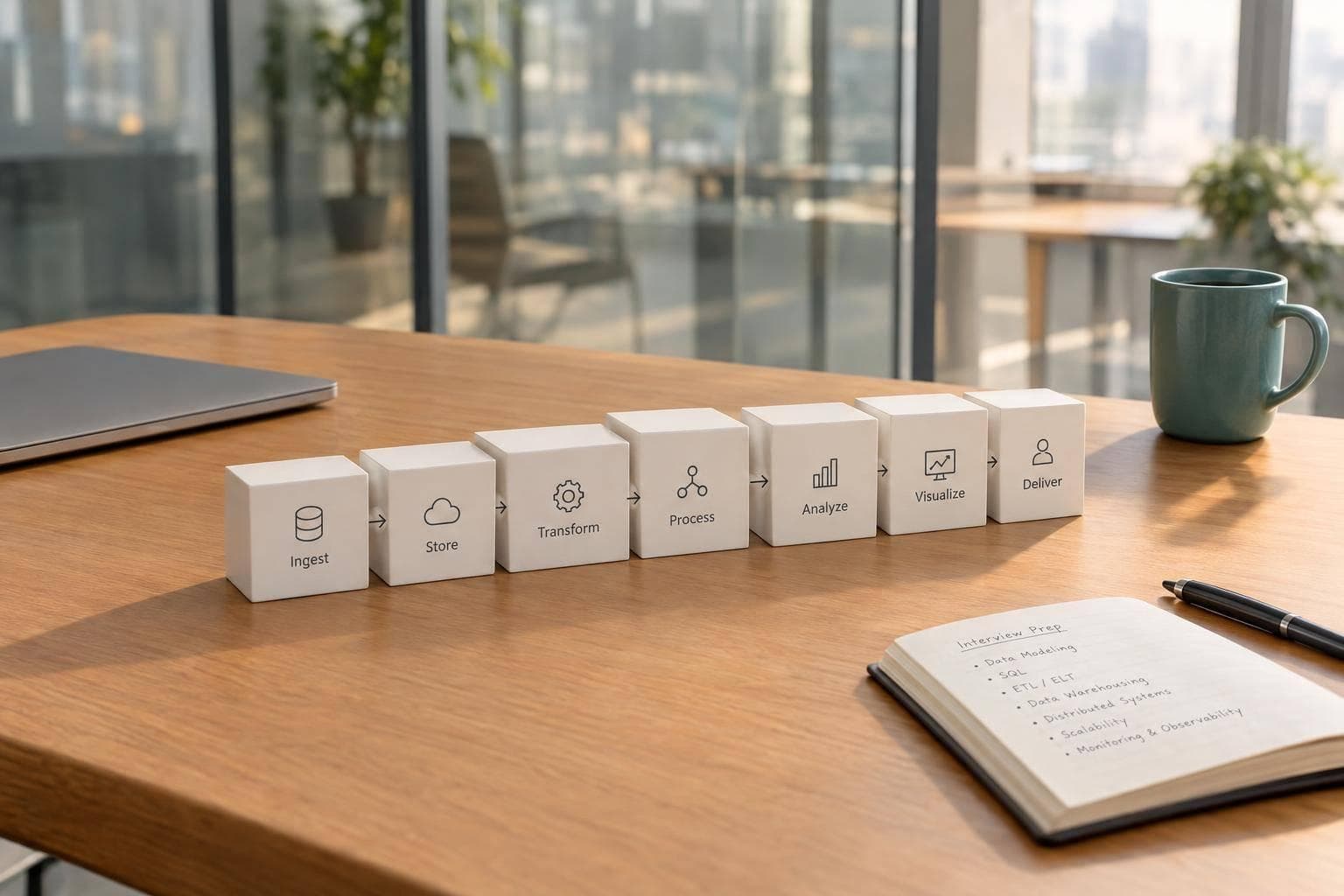
Data Engineer Interview Questions
Prepare Smarter for Data Engineering Interviews
Getting ready for a data engineering interview can feel scattered when you're jumping between SQL drills, pipeline design notes, and cloud architecture guides. A focused practice tool makes that process much easier. This Data Engineer Interview Questions tool helps you study by topic, seniority, and interview format, so you can spend time on the questions that actually match the role you're targeting.
Built Around Real Interview Patterns
Instead of relying on trivia or overly academic prompts, the tool centers on practical scenarios hiring teams commonly use. You'll find questions on SQL, ETL and ELT design, data modeling, warehousing, orchestration, Spark, Python, cloud platforms, and behavioral situations tied to real data engineering work. Each result includes a concise model answer, key talking points, and realistic follow-up prompts that mirror how interviews often unfold.
Better Practice, Clearer Answers
Strong prep isn't just about recognizing a question. It's about learning how to answer clearly, explain tradeoffs, and avoid weak or incomplete responses. With categorized Data Engineer Interview Questions, you can practice at the right level, sharpen your thinking, and build more confident answers for screening calls, technical rounds, and system design interviews.
FAQs
What makes this different from a basic list of interview questions?
A plain list can be useful for brainstorming, but it usually doesn't help you practice like a real interview. This tool adds structure by grouping questions by level, topic, and interview format, then pairing each one with a concise sample answer and the points an interviewer is listening for. That makes it easier to compare your response against a strong version, spot gaps, and improve how you explain your thinking under pressure.
Are the questions better for beginners or experienced data engineers?
Both. Entry-level users can focus on core areas like SQL, ETL, warehousing, and Python, while mid-level and senior candidates can dig into pipeline design, scaling tradeoffs, cloud architecture, orchestration, and system design. The experience filter keeps the practice relevant, so you're not wasting time on questions that are either too shallow or unrealistically advanced for your target role.
Should I keep the answers visible while practicing?
It depends on how you want to study. If you're learning a topic for the first time, keeping answers on can help you build a mental model for strong responses. If you're closer to interview day, it's better to hide answers first, speak or write your own response, and then compare it to the model answer. That's usually the fastest way to find weak spots in both your technical knowledge and your communication.