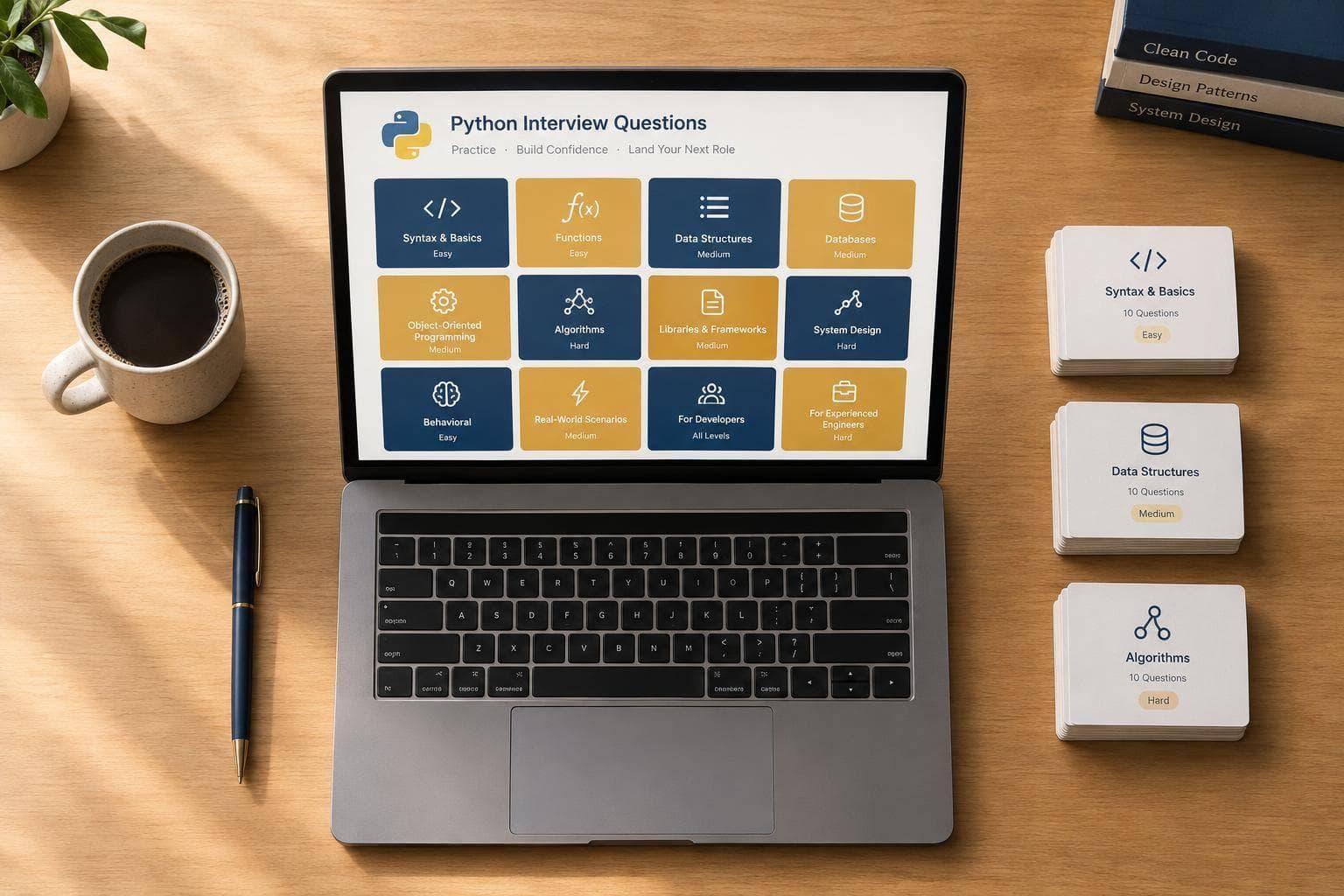
Python Interview Questions
Prepare Smarter with Python Interview Practice
Getting ready for a technical interview is easier when your study material is organized around the questions employers actually ask. This Python interview questions tool helps you focus on the topics that matter most, from syntax and data structures to decorators, generators, concurrency, and testing. Instead of scrolling through endless generic lists, you can filter by difficulty, topic, and role to build a study session that fits your goals.
Built for Real Interview Prep
Whether you're applying for a software engineering job, a data-focused role, or an automation position, the tool surfaces relevant prompts with concise model answers and short explanations. That means you can review quickly while still understanding the reasoning behind each response. The optional follow-up questions are especially useful if you want to practice thinking beyond the first answer.
Study by Topic and Difficulty
A strong Python interview questions resource should help you move from foundational concepts to deeper problem-solving. This tool does exactly that by grouping realistic interview prompts into clear categories and experience levels. If you're looking for a practical way to review Python interview prep material without distractions, this study tool keeps the process focused, relevant, and easy to repeat.
FAQs
What kinds of Python interview questions does this tool include?
The tool covers a balanced mix of conceptual and practical Python interview questions. You'll find topics such as core syntax, data structures, object-oriented programming, functions, iterators, decorators, error handling, file handling, libraries, concurrency, and testing. Some questions are tailored to role context too, so a data engineer may see more workflow-focused prompts while a software engineer may get more backend-oriented scenarios.
Are the sample answers meant to be memorized word for word?
No, and that's actually not the best way to prepare. The sample answers are designed to give you a strong, accurate baseline so you can understand what a good response should include. It's better to study the structure of the answer, learn the core concept, and then explain it back in your own words during an interview. That usually sounds more confident and natural.
How should I use this tool to prepare for a real interview?
Start by filtering for the role and difficulty level you're aiming for, then work through one topic at a time. First, try answering each question on your own before revealing the sample answer. After that, read the explanation to make sure you truly understand the concept, not just the wording. If follow-up questions are enabled, use them to simulate how an interviewer might dig deeper and test whether your understanding holds up under pressure.