
Data Engineer vs Analytics Engineer: Key Differences
Data Engineers and Analytics Engineers are two crucial roles in modern data teams, each addressing different parts of the data lifecycle. Data Engineers focus on building systems to collect, store, and move raw data, while Analytics Engineers transform that data into clean, organized formats for business use. Both roles are highly paid, with U.S. salaries ranging from $115,000 to $170,000, and are in growing demand as companies aim to leverage data for decision-making.
Key Takeaways:
- Data Engineers: Build infrastructure (e.g., pipelines, warehouses) to handle raw data. Tools include Python, Spark, and AWS.
- Analytics Engineers: Model and transform data into usable formats for analytics. Tools include SQL, dbt, and Snowflake.
- Main Difference: Data Engineers work on raw data and infrastructure; Analytics Engineers focus on transforming data for business insights.
- Collaboration: Data Engineers handle ingestion and storage; Analytics Engineers ensure data is clean and accessible for stakeholders.
Quick Comparison:
| Aspect | Data Engineer | Analytics Engineer |
|---|---|---|
| Focus | Raw data, infrastructure | Clean, modeled data for analysis |
| Tools | Python, Spark, Airflow, AWS | SQL, dbt, Git, Snowflake |
| Skills | Programming, data pipelines | Advanced SQL, business metrics |
| Stakeholders | Engineers, developers | Analysts, business teams |
| Salary Range (US) | $115,000 – $160,000 | $120,000 – $170,000 |
Understanding these roles helps businesses structure their teams and allows individuals to choose their career paths based on technical or business-oriented interests.
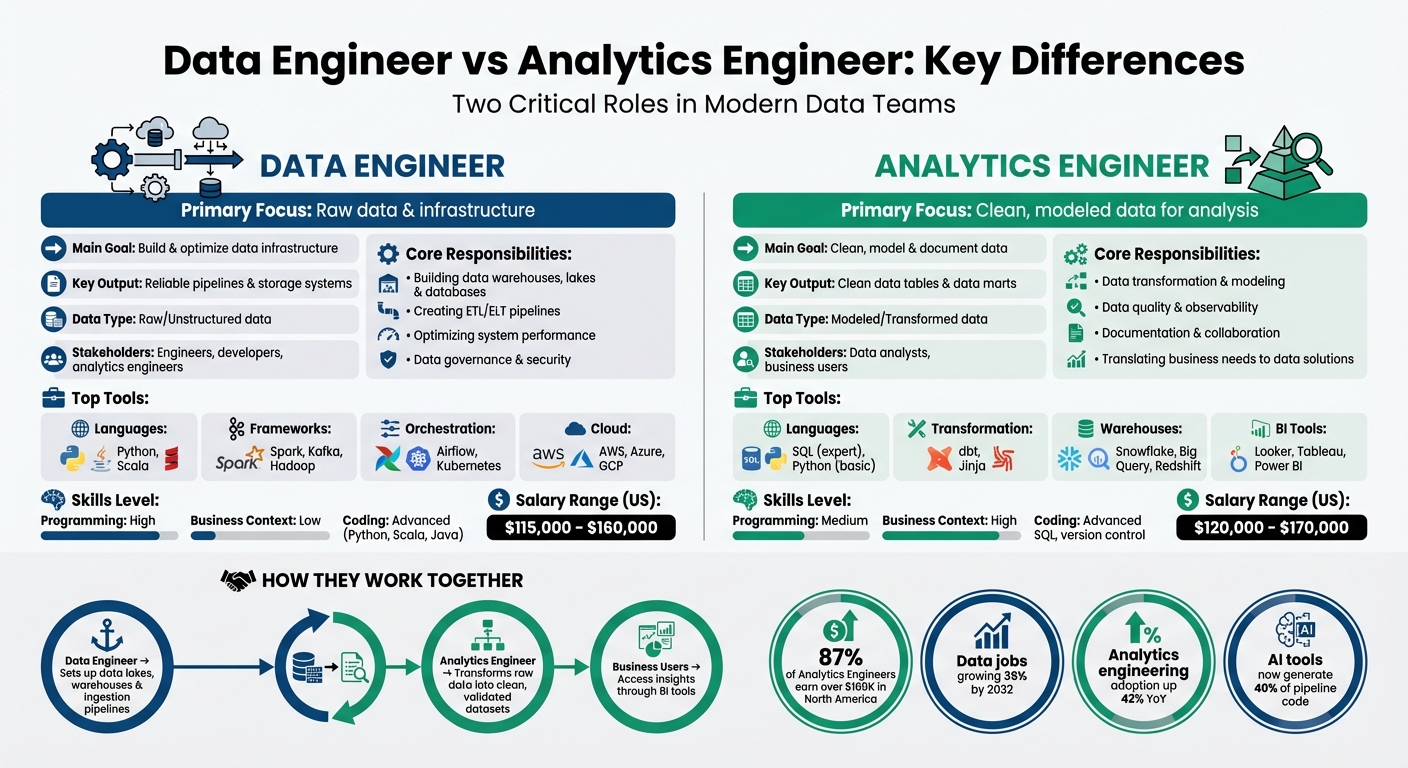
Data Engineer vs Analytics Engineer: Roles, Skills, Tools and Salaries Comparison
Data Engineer Vs Analytics Engineer Vs Analyst - Which Position Is Right For You?
sbb-itb-61a6e59
What is a Data Engineer?
A Data Engineer is essentially the architect behind the systems that collect, store, and move massive amounts of raw data. Their work lays the groundwork for data to flow seamlessly into analytical systems, making it accessible and usable at scale.
Daniel Poppy from dbt Labs captures the essence of their role perfectly:
"Data engineers build the data infrastructure on which all users depend. This includes creating data storage facilities such as databases, data warehouses, and data lakes."
This role is the backbone of the data lifecycle, enabling businesses to manage and make sense of ever-growing volumes of information. With daily data generation projected to hit an astounding 394 zettabytes by 2028 and U.S. salaries averaging $107,000 - reaching as high as $164,000 - data engineers are pivotal in turning raw data into actionable insights.
Core Responsibilities of a Data Engineer
Data Engineers are the unseen heroes ensuring data systems are reliable, accessible, and scalable. Their responsibilities span several critical areas:
- Building Infrastructure: They design and maintain systems like data warehouses (e.g., Snowflake, BigQuery), data lakes, and databases that can handle vast and varied data types. These systems must be robust enough to grow alongside increasing data demands.
- Creating Pipelines: They develop ETL (Extract, Transform, Load) or ELT (Extract, Load, Transform) pipelines to move data from sources like SaaS platforms, APIs, and legacy systems into centralized repositories. These pipelines often handle millions of records daily.
- Optimizing Systems: They fine-tune performance by improving query speed, implementing partitioning, and balancing cost versus efficiency. Without these optimizations, systems can slow down, delaying critical business decisions.
- Data Governance and Security: With data breaches on the rise, engineers enforce security measures, manage data access, and ensure compliance with regulations. This aspect of their work has become increasingly vital.
Common Tools Used by Data Engineers
Data Engineers rely on a wide array of tools, from programming languages to cloud platforms, to manage and process data effectively. Some of the most commonly used tools include:
- Programming Languages: SQL is indispensable for database management and querying, while Python is a go-to for automation and advanced data processing. Java and Scala are also used for building high-performance systems.
- Processing and Workflow Tools: Apache Spark handles massive datasets, and Apache Kafka manages real-time data streams. For orchestrating complex workflows, Apache Airflow is a favorite, automating task dependencies and retries.
- Cloud Platforms and Data Warehouses: Platforms like AWS, Google Cloud Platform, and Microsoft Azure offer scalable infrastructure with minimal maintenance. Data warehouses such as Snowflake, BigQuery, and Amazon Redshift store data in formats optimized for analysis.
- Data Ingestion Tools: Tools like Fivetran, Airbyte (which boasts over 600 pre-built connectors), and Stitch simplify moving data from diverse sources into centralized systems.
The field is evolving rapidly. AI tools like GitHub Copilot are now helping engineers by generating roughly 40% of the repetitive code for data pipelines, freeing them to focus on more complex challenges. Additionally, the global data pipeline market is expected to grow from $12.26 billion in 2025 to $43.61 billion by 2032, highlighting the increasing demand for advanced data infrastructure.
What is an Analytics Engineer?
An Analytics Engineer acts as the crucial link between raw data systems and actionable business insights. They take raw, unstructured data and transform it into clean, organized datasets that teams can rely on. Think of data engineers as the builders of highways for data, while analytics engineers create the well-maintained rest stops where business users can easily find what they need.
Claire Carroll from dbt Labs sums it up well:
"Analytics engineers provide clean data sets to end users, modeling data in a way that empowers end users to answer their own questions."
This role emerged in 2018 as a solution to a growing problem: analysts were stuck waiting for data engineers to handle even minor logic updates, while data engineers were overwhelmed with constant transformation requests. The analytics engineer role was born to bridge this gap, bringing in software engineering practices like version control, automated testing, and CI/CD to streamline how data transformations are handled.
In North America, 87% of Analytics Engineers earn over $100,000 annually, a stark contrast to less than 50% of Data Analysts earning the same. With nearly half of data professionals prioritizing investments in data quality and observability, the demand for this role is steadily increasing.
Core Responsibilities of an Analytics Engineer
Analytics Engineers focus on making data accessible and trustworthy, ensuring that business teams don’t need technical expertise to extract insights. Their responsibilities typically fall into four main areas:
Data Transformation and Modeling is their primary focus. They refine raw data into structured, reusable tables tailored to business needs. By applying dimensional modeling techniques and software development practices, they create scalable data models that prevent duplication and inconsistencies across departments. Using tools like Git for version control, automated testing to catch errors, and CI/CD pipelines to streamline updates, they ensure data transformations are reliable and easy to manage.
Data Quality and Observability is all about keeping the data dependable. They write tests to check for accuracy, completeness, and freshness, and they monitor pipelines for anomalies. If data volumes drop unexpectedly or duplicate records appear, they investigate and resolve the issue before it affects dashboards or reports.
Documentation and Stakeholder Collaboration ensures that data is both discoverable and usable. They create clear documentation for table schemas and metrics, preventing datasets from being ignored simply because no one understands them. They also work closely with stakeholders to translate vague requests - like "we need better customer insights" - into actionable data solutions.
Common Tools Used by Analytics Engineers
The toolkit of an analytics engineer revolves around SQL as the backbone, supported by platforms and tools that streamline data transformation and orchestration. Here’s what they rely on most:
- dbt (Data Build Tool): A go-to tool for transformations, dbt allows engineers to build, test, and document data models using SQL. It incorporates version control and automated testing, treating data transformations as modular, maintainable code.
- Cloud Data Warehouses: Platforms like Snowflake, BigQuery, Redshift, and Databricks provide the scalability to process massive datasets. These warehouses separate storage from compute, ensuring teams only pay for the resources they use.
- Version Control Tools: Tools like Git and GitHub help manage code changes, track edits, and enable collaborative reviews. This prevents accidental errors from disrupting downstream processes.
- Orchestration Platforms: Tools like Apache Airflow, Dagster, and Prefect handle the scheduling and sequencing of data jobs. They ensure transformations run in the correct order and automatically retry failed tasks.
- Business Intelligence Tools: Platforms such as Looker, Tableau, Mode, and Power BI leverage the clean datasets created by analytics engineers, empowering business users to generate insights without needing to write SQL.
As Oleg Agapov from #dbtips explains:
"Turn raw, messy data into clean, reliable, useful datasets - so the business can focus on insights, not on hunting for data."
Key Responsibilities Comparison
Data engineers and analytics engineers play distinct but complementary roles in the data ecosystem. While data engineers focus on building the infrastructure necessary to collect, store, and transport raw data, analytics engineers transform this data into usable insights that drive business decisions. Think of data engineers as architects and builders, laying the foundation for data systems, and analytics engineers as curators, refining and organizing data for practical use.
Data engineers are responsible for ensuring the reliability, scalability, and performance of data systems. Their work involves creating pipelines that move data from source systems to warehouses or lakes. On the other hand, analytics engineers concentrate on transforming raw data into clean, well-documented datasets that are ready for analysis. Their efforts emphasize usability, consistency in metrics, and empowering teams to access data independently.
This division of responsibilities addresses a long-standing challenge: the "bottleneck problem." In the past, data analysts often had to wait for data engineers to update pipelines or resolve issues, slowing down the entire process. The introduction of the analytics engineer role has streamlined this workflow, enabling SQL-savvy professionals to handle data transformations themselves. Data engineers handle ingestion - bringing data into the warehouse - while analytics engineers focus on modeling and transforming it within the warehouse.
The day-to-day tasks of these roles further highlight their differences. Data engineers build and maintain pipelines, design data storage solutions, and integrate data from various sources. Meanwhile, analytics engineers write SQL transformations (often using tools like dbt), enforce data quality standards, implement version control practices, and ensure datasets are well-documented and accessible to business users.
By understanding these distinct roles, organizations can better structure their teams and individuals can make informed career choices. The table below provides a clear comparison of the responsibilities of data engineers and analytics engineers.
Comparison Table: Data Engineer vs. Analytics Engineer Responsibilities
| Responsibility Area | Data Engineer | Analytics Engineer |
|---|---|---|
| Primary Goal | Build & optimize data infrastructure | Clean, model, & document data |
| Key Output | Reliable pipelines & storage | Clean data tables & data marts |
| Data Focus | Raw / Unstructured data | Modeled / Transformed data |
| Daily Tasks | Building ingestion pipelines, designing warehouses | Writing transformation logic, testing data quality |
| Core Tools | Spark, Kafka, Airflow, AWS/Azure | dbt, SQL, Git, Snowflake/BigQuery |
| Coding Level | High (Python, Scala, Java) | Medium (Advanced SQL, Jinja) |
| Business Context | Low (Focus on technical delivery) | High (Focus on stakeholder needs) |
| Primary Stakeholders | Analytics engineers, software developers | Data analysts, business users |
Skills and Tools Comparison
Data engineers and analytics engineers bring distinct skill sets to the table, each tailored to their specific responsibilities. Data engineers focus on building scalable, distributed systems capable of handling massive data volumes. To achieve this, they rely on programming languages like Python, Java, and Scala, along with expertise in cloud platforms such as AWS, Azure, and GCP. They also work extensively with big data frameworks like Spark and Kafka, as well as orchestration tools like Airflow. This combination of skills allows them to create reliable infrastructures designed for large-scale data processing.
On the other hand, analytics engineers prioritize advanced SQL and a deep understanding of business metrics like ROI and CAC. Their role involves translating business needs into structured data models, often using tools like dbt (data build tool), Git for version control, and cloud data warehouses such as Snowflake or BigQuery. While their coding demands are less intensive than those of data engineers, their expertise lies in bridging the gap between raw data and actionable insights, making business knowledge a critical component of their work.
Interestingly, compensation reflects these differences. In the U.S., data engineers typically earn between $115,000 and $160,000, while analytics engineers command slightly higher salaries, ranging from $120,000 to $170,000.
Another emerging trend is the integration of AI-assisted development tools like GitHub Copilot, which now generate up to 40% of boilerplate code for data pipelines. For aspiring data engineers, this highlights the growing importance of mastering cloud infrastructure and distributed computing, as routine coding tasks become increasingly automated. Meanwhile, analytics engineers can stand out by honing their skills in dbt and version control, applying software engineering principles to data transformation tasks. These distinct technical focuses define their roles and the tools they rely on.
Comparison Table: Skills and Tools
| Skill/Tool Category | Data Engineer | Analytics Engineer |
|---|---|---|
| Programming Languages | Python, Java, Scala, Bash | SQL (expert-level), Python (basic) |
| Core Frameworks | Spark, Hadoop, Kafka, Kubernetes | dbt, Jinja templating |
| Cloud Platforms | AWS, Azure, GCP (deep infrastructure knowledge) | Snowflake, BigQuery, Redshift (usage-focused) |
| Data Movement | Custom APIs, Spark Streaming, Kafka | Fivetran, Stitch, Airbyte |
| Orchestration | Airflow, Jenkins, Kubernetes | dbt Cloud, Airflow (basic) |
| Monitoring & DevOps | DataDog, Prometheus, CI/CD pipelines | Looker, Tableau, ThoughtSpot |
| Version Control | Git | Git |
| Business Knowledge | Low (technical delivery focus) | High (KPIs, metrics, stakeholder needs) |
| Typical Salary Range (US) | $115,000 – $160,000 | $120,000 – $170,000 |
How These Roles Work Together in Data Teams
Building a Complete Data Workflow
Data engineers and analytics engineers work together to create a smooth and efficient data pipeline. The process begins with data engineers, who handle the heavy lifting by setting up data lakes, warehouses, and ingestion pipelines. These pipelines bring raw data into platforms like Snowflake or Databricks, forming the backbone of the data infrastructure. Once the groundwork is laid, analytics engineers step in to transform that raw data into clean, validated datasets that business users can rely on.
This division of labor not only clarifies responsibilities but also eliminates common workflow bottlenecks. In the past, data engineering teams were often burdened with routine transformation tasks, leaving little room for higher-level priorities. By shifting this transformation work to analytics engineers, data engineers can focus on crucial tasks like query optimization, data governance, and building tools that enable self-service analytics.
A great example of this collaboration can be seen at Squarespace. There, data engineers focus on creating and maintaining data stores, while analytics engineers are embedded within functional teams to craft business insights and drive decision-making.
"High-functioning data teams need end-to-end ownership of the work they produce, meaning that there shouldn't be a 'throw it over the fence' mentality between these roles."
- Jeff Magnuson, Vice President, Data Platform, Stitch Fix
Both roles maintain ownership over their respective parts of the data lifecycle. Data engineers ensure the quality of raw data at the point of ingestion, while analytics engineers deliver it in a format ready for queries. This collaborative approach creates a data environment that is both robust and flexible.
Modern Data Stack in Action
This teamwork is further amplified by the modern data stack, which brings together tools and practices to streamline workflows. For instance, a data engineer might use Fivetran or Databricks to load customer data into Snowflake. From there, the analytics engineer takes over, using dbt to transform the raw data into production-ready tables. These tables are tested for quality, documented for clarity, and version-controlled through Git to track changes over time.
What makes this approach so effective is its application of software engineering principles to analytics. Analytics engineers incorporate practices like CI/CD pipelines, automated testing, and code reviews into the data transformation process. This ensures pipelines are not only reliable but also scalable. As Alex Dovenmuehle, Co-Founder of Big Time Data, explains:
"Data Engineering is ensuring the quality and timeliness of raw data coming into the Data Warehouse and Analytics Engineering takes that and builds the models that will power the business insights."
The outcome is a self-service analytics environment where business users can directly access clean, query-ready data without waiting in line for custom solutions. Data engineers maintain the central platform, while analytics engineers - often embedded within teams like marketing or finance - develop tailored data models to meet specific needs. This hybrid structure is gaining traction, with 40% of organizations reporting an increase in data team headcount in 2024 to support this model.
Conclusion: Choosing Your Path in Data Teams
Data engineers and analytics engineers are the backbone of modern data teams, each bringing unique strengths to the table. While data engineers specialize in constructing reliable pipelines and optimizing system performance to ensure seamless data flow, analytics engineers focus on transforming raw data into clean, well-documented datasets that directly inform business decisions. They bridge the gap between technical expertise and business strategy, often collaborating with teams like marketing and finance.
When deciding which path to pursue, consider your interests and approach to problem-solving. If you thrive on back-end development, ensuring system reliability, and working at the infrastructure level, data engineering might be your calling. As Madison Schott, Analytics Engineer, noted:
"As a data engineer, I felt like I was completing tasks that were already strategically decided on, rather than having a say in prioritization and the needs of the business."
On the other hand, if you’re drawn to seeing the tangible impact of your work on business outcomes and enjoy converting broad business questions into technical solutions, analytics engineering offers a rewarding mix of technical depth and strategic influence.
Both roles promise strong career prospects. Data and AI-related jobs are set to grow by 35% by 2032, with analytics engineering adoption increasing by 42% year-over-year. Whether your passion lies in building the foundation or refining data into actionable insights, both paths are indispensable in today’s data-driven world.
For those considering a transition, the route is clear. Data analysts aiming to become analytics engineers should focus on mastering tools like Git, CI/CD, and Snowflake and dbt. Meanwhile, data engineers looking to broaden their scope should develop a deeper understanding of business domains and hone their documentation skills. Together, these roles form a partnership that ensures data systems are both powerful and adaptable.
Ultimately, the choice comes down to your preference: do you enjoy constructing robust systems, or do you find satisfaction in shaping data into meaningful insights? Both paths are essential, and both lead to impactful, fulfilling careers in the data field.
FAQs
What’s the difference between a Data Engineer and an Analytics Engineer?
A Data Engineer is responsible for building and maintaining the backbone of data management - creating the infrastructure that handles the collection, storage, and processing of massive amounts of raw data. This involves setting up databases, data warehouses, or data lakes, designing efficient pipelines to move data seamlessly, and fine-tuning systems to ensure they can handle growth and perform effectively.
An Analytics Engineer, on the other hand, takes that raw data and turns it into something usable. Their work focuses on cleaning and organizing data, developing transformation logic (often with tools like dbt), and building reusable data models or tables. These efforts make it easier for business teams to extract meaningful insights without wading through unstructured information.
These two roles work hand-in-hand, creating a smooth path from raw data collection to actionable insights, ensuring that data-driven organizations can operate efficiently and effectively.
How do Data Engineers and Analytics Engineers work together in a data team?
Data Engineers are the architects behind the systems that keep data flowing smoothly. They design and maintain the pipelines, warehouses, and lakes where raw data is securely stored and efficiently managed. Their work ensures that data is organized, cleaned, and ready for further use.
Analytics Engineers build on this groundwork by transforming raw data into meaningful insights. They write the transformation code, test data models, and apply business logic to create datasets that are ready for analysis. Their goal is to make data easy to understand and actionable for decision-makers.
The collaboration between these roles is key. Data Engineers deliver dependable pipelines and well-documented tables, while Analytics Engineers refine the data and provide feedback to address any issues. This teamwork ensures a smooth data workflow, enabling businesses to make informed decisions quickly and confidently.
What are the key skills and tools needed to succeed as an Analytics Engineer?
Analytics engineers need a strong mix of data analytics knowledge and software engineering expertise. Key technical skills include writing and testing data transformations, often using SQL or scripting languages, working with version control systems like Git, and creating thorough documentation to make data models easy to find and reuse. Tools like dbt play a big role here, as they allow for modular, testable code and integrate smoothly with modern platforms such as Snowflake and Databricks.
Beyond technical tools, analytics engineers must grasp the full data pipeline lifecycle - starting from cleaning raw data to building reusable datasets and crafting clear documentation for business teams. Success in this role hinges on solid SQL skills, a deep understanding of data modeling, and the ability to turn business requirements into scalable, version-controlled data solutions. Familiarity with command-line tools and lightweight code editors like VS Code can also streamline daily tasks.