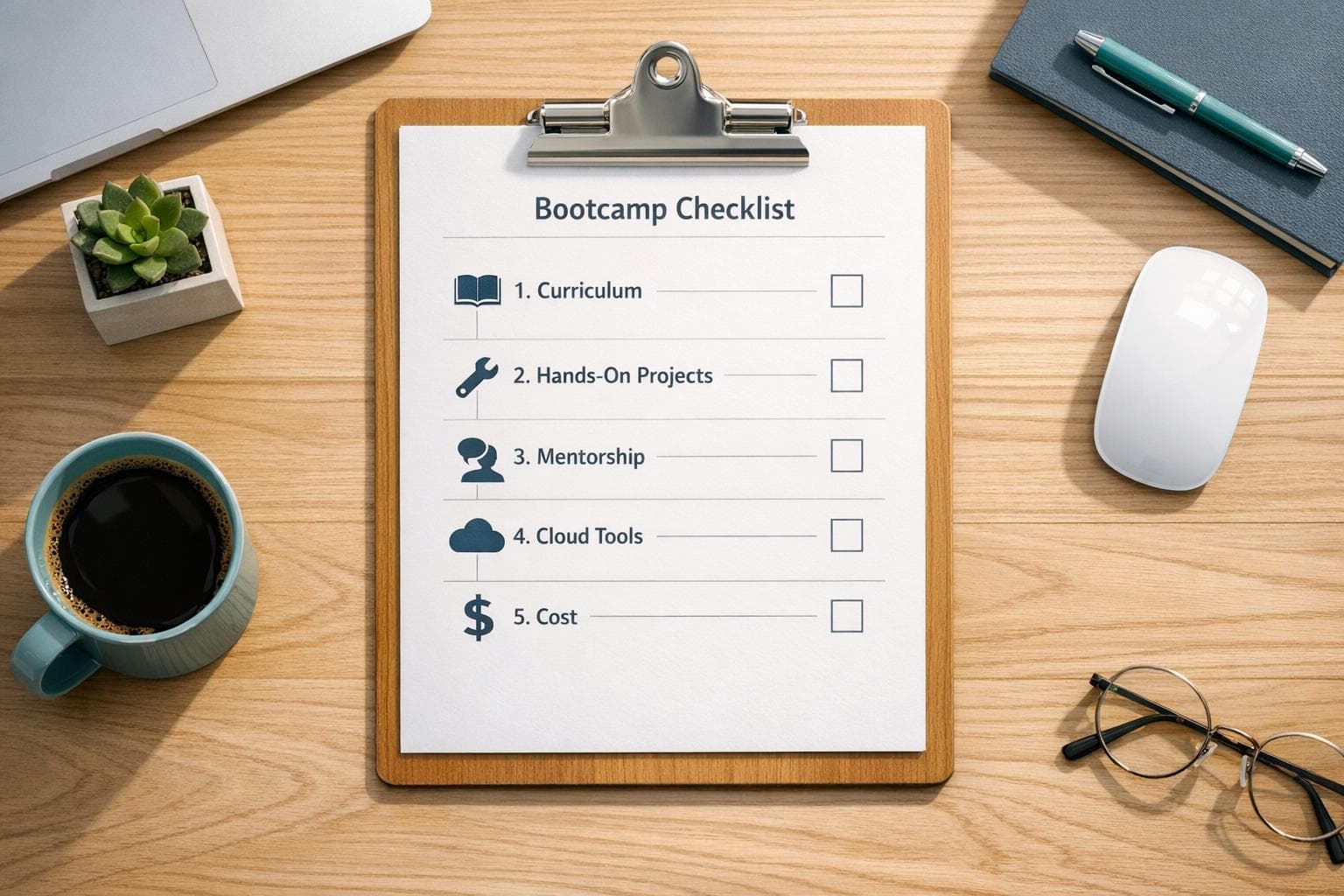
Data Engineering Bootcamp Checklist: What to Look For
Not all data engineering bootcamps are equal. Some programs promise job-ready skills but leave students unprepared for real-world challenges like building data pipelines or succeeding in technical interviews.
Here’s what you need to know:
- Demand is growing: Data engineering roles are expected to grow 36% from 2023 to 2033, with 20,800 new jobs annually.
- Key skills matter: Top programs focus on SQL, Python, ETL/ELT processes, and tools like Airflow, Spark, and Kafka.
- Hands-on experience is critical: Look for bootcamps offering real-world projects, cloud platform training (AWS, GCP, or Azure), and end-to-end pipeline building.
- Mentorship and career support: Programs with one-on-one mentorship, resume reviews, mock interviews, and alumni networks can boost your job prospects.
- Cost vs. value: Bootcamps range from $2,000 to $18,000, with options for subscriptions, deferred payments, or job guarantees. Always check what’s included, like cloud platform access or certification prep.
Bottom line: Choose a bootcamp that offers a strong curriculum, practical projects, and solid career support to meet the rising demand for skilled data engineers.
I Tried 50 Data Engineer Courses. Here Are Top 5
Curriculum and Technical Skills
A strong curriculum is the cornerstone of turning theoretical knowledge into practical, job-ready expertise. The technical depth of a bootcamp determines whether you'll confidently step into the workforce or scramble to fill critical knowledge gaps. An effective program focuses on the core skills data engineers rely on daily, rather than just skimming over popular topics.
SQL and Data Modeling
SQL is the heart of data engineering. As WeCloudData puts it, "SQL is probably THE most important tool to grasp as a data engineer. It's probably even more important than Python in most of the DE roles". A comprehensive bootcamp should teach foundational SQL operations like SELECT, GROUP BY, and JOIN, while also diving into advanced techniques such as Window Functions and Common Table Expressions (CTEs). To truly prepare students, the curriculum should also include query performance optimization strategies like partitioning and indexing.
When it comes to data modeling, the goal is to transform raw data into meaningful, actionable insights. Look for programs that teach industry-standard methods like Star Schema (Kimball), Data Vault Modeling, and cloud-friendly approaches such as the "One Big Table" (OBT) pattern. A solid curriculum will also cover Slowly Changing Dimensions (SCD) to track historical data changes and explore the trade-offs between normalization (reducing redundancy) and denormalization (improving query speed). In the real world, data engineers often work with complex queries involving ten or more table joins, making it essential to balance efficiency with maintainable code.
While SQL and data modeling lay the groundwork, programming skills are equally critical to round out a data engineer's toolkit.
Python Programming
Programming in Python takes your data engineering skills to the next level. Python is widely used in the field because it seamlessly integrates with various data engineering tools and frameworks. Some bootcamps start with the basics - loops, dictionaries, and other fundamentals - while others assume prior knowledge and focus on advanced applications. Either way, a strong program should cover essential libraries like Pandas for data manipulation, PySpark for handling large-scale datasets, and additional libraries for working with APIs.
A well-rounded curriculum will also show how Python connects with tools like Apache Airflow for workflow orchestration, Apache Spark for batch processing, and Kafka for streaming data. Hands-on practice, such as writing code in Jupyter Notebooks, is key to mastering these concepts and building confidence.
ETL/ELT Processes and Data Structures
Understanding how data flows through pipelines is a must for any data engineer. A quality curriculum will walk students through the entire ETL (Extract, Transform, Load) and ELT (Extract, Load, Transform) lifecycle. This includes orchestrating pipelines with tools like Apache Airflow, transforming data with dbt, and handling streaming data using Kafka or Flink. As cloud adoption grows, the shift toward ELT - where transformations happen directly in data warehouses using SQL - has become increasingly important.
Advanced programs also explore specialized data structures that optimize performance. This might include Cumulative Table Design or Date list structures. Students should also learn about modern table formats like Apache Iceberg and Delta Tables, along with techniques like Change Data Capture (CDC) for managing historical data and tracking updates. As one student reflected on fact data modeling, "Maybe the most powerful part of the course. This week offered insights on storing and condensing complex historical fact data. I have already used these techniques at work".
These technical skills form the backbone of a data engineer's expertise, setting the stage for hands-on training with production-grade tools in the next stages of learning.
Hands-On Training with Industry Tools
While understanding theory is important, getting hands-on with production-grade tools is what truly sets you apart. The top bootcamps don’t just introduce tools like Snowflake or Airflow - they let you take the wheel. You’ll build, deploy, and troubleshoot real pipelines, gaining experience that helps you hit the ground running from day one. This practical approach is what distinguishes graduates who are job-ready from those who still require months of additional training. Let’s dive into how leading bootcamps incorporate cloud platforms and orchestration tools into their programs.
Cloud Platforms and Frameworks
A strong bootcamp ensures you’re proficient with at least one major cloud platform - whether it’s AWS, Azure, or GCP - and teaches you to deploy data infrastructure in real-world environments. Look for courses that go beyond local setups, guiding you through deployment using tools like Terraform, Docker, and services such as AWS S3 or Google Cloud Storage.
When it comes to big data, Apache Spark is a must-have skill. A solid program will teach you not just the basics but also Spark internals, DataFrames, Spark SQL, and how to optimize queries. Real-time data processing is just as critical, so training on Apache Kafka for streaming data ingestion should also be part of the curriculum.
"Within weeks, I was able to set up a Kafka pipeline, use dbt to transform data, and set up a CI/CD pipeline via GitHub Actions." - Paul Hallaste, Analytics Lead at Fidelity International
Once you’ve mastered these tools, the next step is diving into data warehousing and workflow orchestration.
Data Warehousing and Workflow Orchestration
Modern data engineering revolves around cloud data warehouses and orchestration tools. A high-quality program will provide in-depth training on platforms like Snowflake or Databricks, covering everything from architecture and role-based access control to advanced topics like JSON parsing, data loading, and performance optimization techniques such as micro-partitioning and clustering. For Databricks, expect to learn about the Data Lakehouse architecture, managing workspaces through APIs and CLI, and working with Delta Lake for ACID-compliant transactions.
On the orchestration front, Apache Airflow is the go-to tool in the industry. A comprehensive bootcamp will teach you how to build directed acyclic graphs (DAGs), manage operators, and execute tasks. The real magic happens when these tools are integrated - using Airflow providers to connect tools like Airbyte, dbt, Snowflake, and Databricks into a seamless pipeline. The ability to bring these tools together in a production setting is what truly defines a bootcamp’s value.
Production-Grade Tool Integration
The best bootcamps replicate real-world tool integration, allowing you to build end-to-end pipelines that mirror workplace environments. Capstone projects like “Formula One” and “Heart Rate Stream” are great examples, showcasing how tools such as AWS, Kafka, Databricks, Snowflake, Airbyte, Dagster, and dbt can work together to solve real data challenges. These projects aren’t just academic exercises - they’re designed to reflect the kind of solutions you’ll be expected to deliver on the job.
"The bootcamp really went deep into spark internals, which I was really impressed by, and that level of detail was maintained across every single topic." - Alexander Potts, Data Engineer at Endeavour Group
Project-Based Learning and Capstone Projects
When it comes to mastering data engineering, hands-on projects are where theory meets practice. These projects are more than just exercises - they're a chance to tackle real-world challenges and showcase your ability to create functional solutions. This practical experience often sets graduates apart, making them ready to contribute from day one, rather than requiring months of additional training. The depth and complexity of these projects are what truly measure their value.
Project Depth and Complexity
The best bootcamps don’t just teach concepts - they immerse students in projects that mirror real-world scenarios. These typically include tasks like data ingestion, transformation, and loading, alongside advanced challenges such as Docker containerization and cloud orchestration. Programs that integrate cloud deployment and orchestration tools help students simulate professional environments. Some bootcamps even offer up to 12 hands-on projects, building a portfolio that demonstrates readiness for the field.
But it’s not just about quantity. The quality and scope of these projects matter just as much. They need to reflect industry-level complexity, not simplified academic exercises. A prime example? A capstone project involving complex datasets and a modern tech stack. For instance, Madyar Marat, an Operations Research Specialist at AHOY, built an end-to-end batch and streaming pipeline processing real-time heart rate data. His work incorporated tools like Kafka, Confluent, AWS, Airbyte, Snowflake, Dagster, dbt, and Tableau. These aren’t just classroom exercises - they’re pipelines that demonstrate job-ready expertise.
End-to-End Capstone Project
The capstone project is a defining moment in any data engineering program. It’s your opportunity to take on the full complexity of a data engineering workflow, from data ingestion to final analytics. The best programs ensure students have access to industry-standard tools, such as Snowflake or Databricks, often included for free. Some programs, however, require students to "bring your own cloud", which can lead to unexpected expenses.
Advanced capstones often incorporate real-time processing with tools like Kafka, Flink, or Spark Streaming. Additionally, programs that include peer reviews for capstone projects mimic real-world code review processes. This not only helps refine the project but also introduces diverse perspectives on pipeline design and architecture.
"It will help you to have a good understanding of how to combine all the tools together into the single pipeline... build the portfolio to showcase to the potential employers." - Mantas Liutkus, Data and Automation Engineer, M Solutions Corp
Portfolio Development
How you present your projects is just as important as the work itself. A strong portfolio should feature job-ready projects hosted on professional GitHub repositories. Include clear READMEs and detailed architecture diagrams to make your work accessible and professional. Instead of focusing on quantity, aim for 2–3 well-executed projects that demonstrate a range of high-demand skills.
Some programs take portfolio development a step further by hosting Demo Days, where students present their capstone projects to industry experts and recruiters from startups and major companies. Career services often include one-on-one coaching to refine portfolios, ensuring they highlight sought-after skills like real-time data streaming with Kafka or big data processing with Spark. When presenting your work, don’t forget to include architecture diagrams and automated data validation techniques - like checks for null values or record counts - to demonstrate your understanding of data governance.
sbb-itb-61a6e59
Mentorship and Career Support
When it comes to landing a data engineering role, the mentorship and career support offered by a program can make or break your journey. These resources often determine whether you'll face challenges alone or benefit from the guidance needed to land that first job. The key lies in how accessible mentors are and the quality of career services included in your tuition. Strong mentorship naturally leads to effective career support, creating a smoother path from learning to professional success.
Mentor Access and Guidance
Having access to one-on-one technical mentorship is a game-changer. Personalized guidance throughout your learning journey ensures you can tackle challenges effectively. Some programs provide this direct support, while others rely on group office hours or peer interactions through platforms like Slack or Discord. For instance, DataExpert.io’s 2025 New Year cohort offered 6.1 hours of TA Office Hours and 2.6 hours of direct Q&A with the founder. If frequent, individualized help is what you need, look for programs that prioritize dedicated one-on-one mentorship over group-based support.
Programs led by seasoned professionals from top-tier companies often provide mentorship that aligns with current industry trends and expectations. As Lalit Sharma, Senior Data Engineer at Teranet Inc, shared:
"Zach Wilson has proven to be an outstanding instructor, mentor, and guide. His deep knowledge... made the learning experience both engaging and rewarding".
This kind of mentorship not only enhances your learning experience but also sets the stage for career development services that support your long-term goals.
Career Development Services
A strong career support system is essential. Look for programs that offer resume reviews, mock interviews, and job placement assistance as part of their curriculum. Some even include specialized modules, such as "LinkedIn Mastery" or "Interview Skills", which cover critical areas like SQL, Python algorithms, and system design. Certain bootcamps go a step further by offering job guarantees, where tuition is refunded if you don’t secure a qualifying role within a specified timeframe. However, these guarantees often come with conditions, like mandatory attendance at coaching sessions and applying to a set number of jobs each week.
The duration of career support also varies. While some programs offer up to 12 months of post-graduation services - including resume building, interview prep, and job referrals - others provide lifetime access, ensuring you have ongoing resources for future career transitions.
Networking and Alumni Access
Connections can often open doors that applications alone cannot. The best programs actively promote networking through weekly guest speakers from top companies like OpenAI, Netflix, and Airbnb. These sessions provide valuable industry insights and direct access to influential professionals. DataExpert.io, for example, maintains a referral network to help students secure interviews through internal recommendations.
Active online communities on platforms like Discord or Slack also play a vital role, keeping you connected with peers and alumni long after graduation. Julio Suriano, a Data Engineer at Gap Inc, highlighted the importance of these connections:
"I also had the opportunity to connect with exceptional data engineers and learn from prominent voices in the field. These enlightening sessions provided invaluable insights to elevate my professional prowess".
Before committing to a program, inquire whether alumni retain access to these communities or if they’re limited to current students. This can make a big difference in maintaining professional connections over time.
Program Format and Schedule
The structure and timing of a bootcamp can directly influence your ability to complete it successfully. Finding a schedule that fits your lifestyle is crucial, especially if you're juggling work or other responsibilities. Data engineering bootcamps vary widely in length, from intense 5-week programs to more relaxed 8-month self-paced options. The key is figuring out which format works best with your current commitments.
Duration and Time Requirements
Bootcamps typically offer a few different formats to suit varying needs:
- Immersive tracks: These programs usually last 10–12 weeks and require a significant weekly time commitment.
- Part-time schedules: These extend up to 6 months and are designed for those who can only dedicate limited hours each week.
- Accelerated modules: These shorter programs, lasting 5–6 weeks, demand 12–18 hours per week, often split between live sessions (about 9 hours) and project work (3–8 hours).
Self-paced courses, on the other hand, are designed for those who prefer flexibility, requiring around 5 hours per week and stretching up to 8 months. For instance, DataExpert.io's 2025 New Year Data Engineering Boot Camp offered 50 hours of core content condensed into a 5–6 week format. The method of course delivery - whether live or self-paced - can also significantly affect your learning experience.
Live vs. Self-Paced Learning
Live sessions provide structure and accountability, as they follow a set schedule. However, this can be restrictive for those with unpredictable routines. Self-paced courses, in contrast, offer the freedom to learn on your own timeline but require a lot of self-motivation to stay on track. Many programs now offer hybrid models to strike a balance. For example:
- Live evening classes, such as 6–8 PM Pacific Time, cater to working professionals.
- Recordings of live sessions are often made available within 8 hours, allowing students in different time zones or with schedule conflicts to catch up.
- Fully self-paced formats eliminate deadlines altogether, giving you complete control over your progress.
Flexibility for Working Professionals
Since many participants are working full-time, bootcamps often build their schedules to accommodate professionals. Evening classes, part-time tracks, and weekend sessions are common features, making it possible to keep your job while pursuing education. Luke Huntley, a data engineer, highlighted the value of this setup:
"Learning alongside students who volunteer to give up their evenings and weekends has allowed me to connect with dedicated industry peers".
Before committing to a program, it’s essential to check the time zone for live sessions and confirm whether watching recordings will satisfy attendance or graduation requirements.
Cost and Value
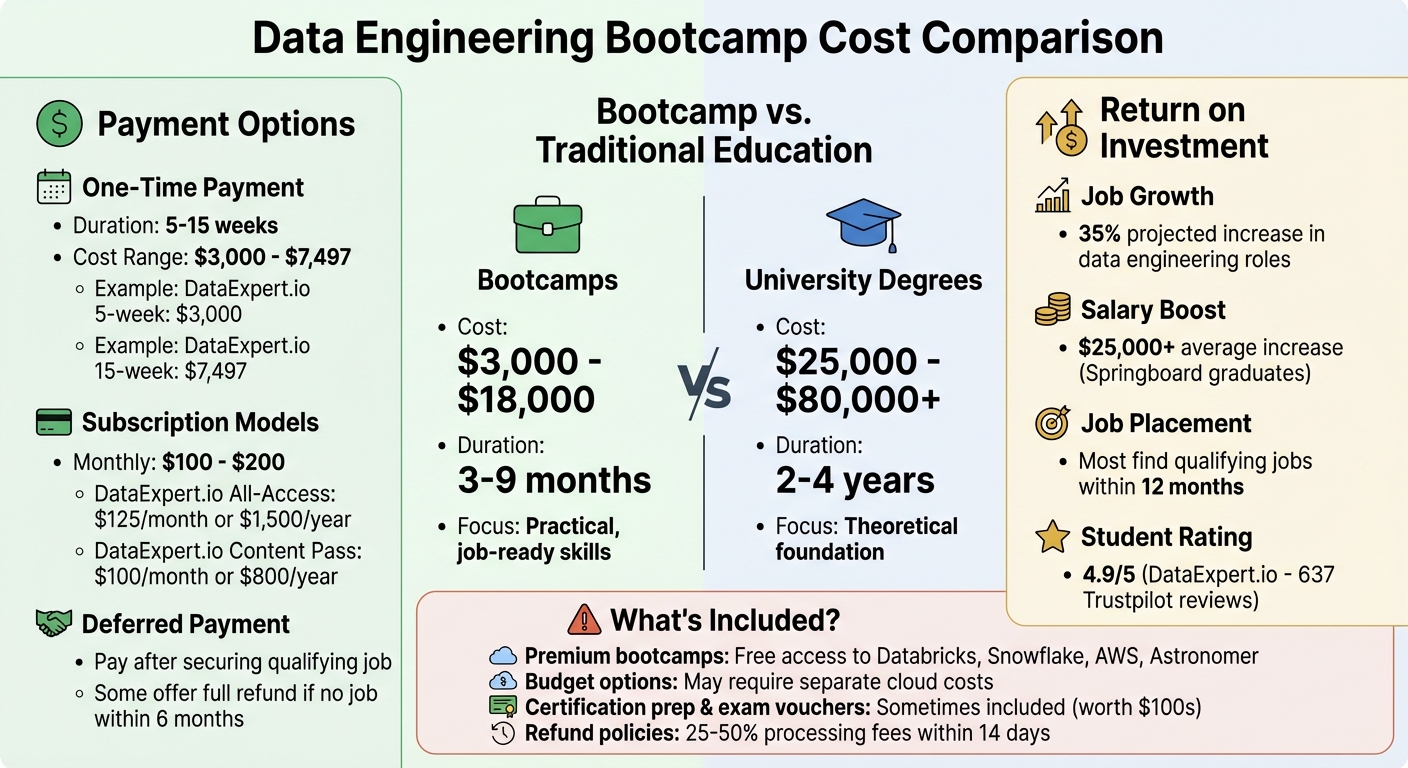
Data Engineering Bootcamp Comparison: Cost, Duration, and Payment Options
Bootcamp prices can vary widely, ranging from free community-led programs to intensive courses costing anywhere from $2,000 to over $10,000. Before committing, it’s important to weigh the cost against the value of what’s being offered.
Tuition and Payment Options
Bootcamps typically offer several payment models to suit different needs:
- One-time payments: These are common for intensive programs lasting 5 to 15 weeks, with prices ranging from $3,000 to $7,497. For example, DataExpert.io charges $3,000 for their 5-week bootcamp and $7,497 for their comprehensive 15-week Data and AI Engineering Challenge.
- Subscription models: Monthly subscriptions for self-paced content generally cost between $100 and $200. DataExpert.io, for instance, offers an All-Access Subscription for $125 per month or $1,500 annually. They also have a Content Pass for $100 per month or $800 annually, though this requires you to manage your own cloud resources.
- Deferred payment plans: Some bootcamps allow students to defer most of the tuition until they secure a qualifying job. Others even offer full tuition refunds if you’re unable to land a job within six months of graduating.
Included Resources and Platform Access
It’s crucial to confirm what’s included in the tuition to avoid unexpected costs. Many premium bootcamps provide free access to essential tools like Databricks, Snowflake, AWS, and Astronomer (for Airflow), sparing students from additional cloud usage fees during their training. This is particularly important since consumption-based pricing models for cloud services can lead to surprise bills if you’re managing your own accounts.
Programs with lower price points or self-paced tiers may not include cloud compute time or necessary API keys (like those for OpenAI), leaving students to cover these costs separately. On the other hand, some bootcamps include preparation materials and exam vouchers for industry certifications, which can otherwise cost several hundred dollars.
Refund policies also vary. Many live bootcamps charge processing fees - usually between 25% and 50% - for refunds within the first 14 days, and often no refunds are available after that period. These factors highlight the importance of understanding the full financial commitment before enrolling.
Return on Investment
While bootcamps can be expensive, their value often lies in the outcomes they deliver. Data engineering roles are projected to grow by about 35%, with similar positions expected to increase by 34% over the next decade. Additionally, Springboard graduates report an average salary boost of over $25,000, with most finding qualifying jobs within 12 months.
Miguel Jimeno, an Associate Professor, described his experience with DataExpert.io:
"A very useful set of 6 weeks of classes and labs. This is not an entry-level bootcamp though, but the learning and networking opportunities are worth the investment".
DataExpert.io has earned a 4.9/5 rating on Trustpilot from 637 reviews, with students frequently praising the immediate applicability of the skills they gain.
When compared to traditional education, bootcamps offer a faster and more cost-effective path. While bootcamps typically cost between $3,000 and $18,000 and require 3 to 9 months of study, university degrees can range from $25,000 to $80,000+ and take 2 to 4 years to complete. The shorter duration of bootcamps not only accelerates entry into the workforce but also focuses on practical, job-ready skills, often leading to quicker employment opportunities than traditional academic routes.
Conclusion
Selecting the right bootcamp is key to advancing your career in data engineering. Look for programs that offer a well-rounded curriculum, covering crucial tools like SQL, Python, Spark, and major cloud platforms. Avoid courses that skim the surface - focus on those that include hands-on capstone projects designed to mimic real-world production environments. These projects not only help you apply what you’ve learned but also give you a portfolio that showcases your job-ready skills.
Before you commit, it’s smart to have a conversation with program advisors. Ask about what’s included in the tuition - especially when it comes to access to premium cloud platforms like AWS, Snowflake, or Databricks. Understanding these details upfront can save you from unexpected costs later. If you’re hesitant about diving in financially, many bootcamps offer free introductory modules. These can help you figure out whether you prefer self-paced learning or live instruction.
Connecting with alumni through LinkedIn is another valuable step. They can give you honest feedback about the program’s career support and share insights into what working as a data engineer actually looks like. As the demand for skilled data engineers continues to grow, having this insider perspective can make a big difference.
Finally, choose a bootcamp that aligns with your current expertise. Whether you’re starting from scratch or already have experience with Python and SQL, the right program should help you develop production-grade skills. Industry professionals agree: mastering these real-world skills is what sets you apart in this competitive and rapidly expanding field.
FAQs
What essential skills do I need to succeed as a data engineer?
To thrive as a data engineer, it’s essential to develop core technical skills and gain hands-on experience. Begin with SQL - a must-have skill for managing and querying data. Pair that with learning programming languages like Python, Java, or Scala, which are crucial for building and maintaining data pipelines. It’s also important to get familiar with cloud platforms like AWS and tools such as Snowflake, data warehouses, and data lakes, as these are staples in the industry.
Beyond that, a solid grasp of data architecture, data modeling, and workflow orchestration tools like Apache Airflow will help you design scalable, dependable systems. Experience with tools like Kafka, Hadoop, and NoSQL databases can further distinguish you from the crowd. By combining strong coding abilities, cloud platform knowledge, and real-world project experience, you’ll be well-equipped for a successful career in data engineering.
Why are hands-on projects important in a data engineering bootcamp?
Hands-on projects play a crucial role in any data engineering bootcamp because they allow you to put your knowledge into action. By creating data pipelines, using tools like Airflow, Snowflake, and Databricks, and tackling real-world challenges, you gain practical experience that closely reflects what professional data engineers do.
These projects don’t just sharpen your technical skills - they also leave you with tangible outcomes, like fully built pipelines and structured data models. These are perfect additions to your portfolio and can serve as talking points during job interviews. This kind of practical work bridges the gap between learning the theory and meeting the expectations of the industry, helping you feel prepared and confident for the challenges of a data engineering role.
How can I evaluate if a data engineering bootcamp is worth the cost?
When deciding if a data engineering bootcamp is worth the expense, it’s crucial to look beyond the price tag and focus on the value it provides. Start by examining the curriculum - does it cover key topics and include hands-on experience with tools like Databricks, Snowflake, and Airflow? These are widely used in the industry, and practical experience with them can make a difference. Also, pay attention to the quality of mentorship, real-world projects, and career support, as these are strong indicators of how well the program prepares you for actual job roles.
Think about the potential outcomes, too. Look at job placement rates, certifications offered, and whether the program is recognized within the industry. Sometimes, a more expensive bootcamp might be worth it if it offers robust career support and clear paths to employment. However, budget-friendly options can also be effective if they provide thorough, practical training to close your skills gap. The key is to align the program’s features with your career objectives and determine if the benefits outweigh the cost.