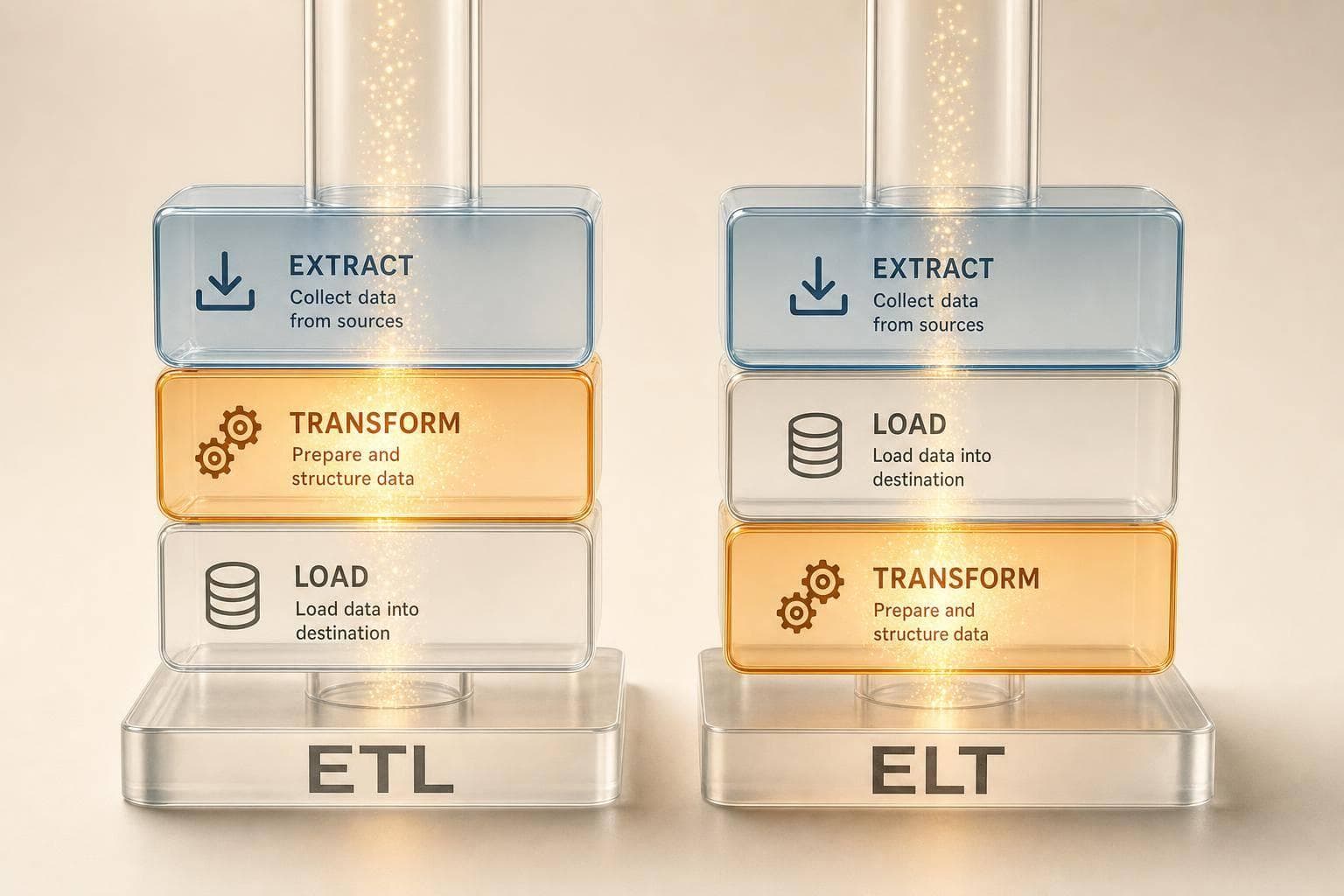
ETL vs ELT: Pros, Cons, and Use Cases
If you need tight control before data is stored, I’d pick ETL. If you need scale, reprocessing, and cloud-based analytics, I’d pick ELT.
That’s the short answer.
In this piece, I compare ETL (Extract, Transform, Load) and ELT (Extract, Load, Transform) based on the things that shape the choice most:
- When data gets transformed
- Where compute runs
- Cost trade-offs
- Security and compliance needs
- Scale and data volume
- Support for structured vs. semi-structured data
- Reprocessing
- Fit for cloud, on-prem, BI, and ML
A few facts stand out:
- ETL transforms data before it enters the target system
- ELT loads raw data first and transforms it later
- ELT fits cloud warehouses and lakehouses
- ETL is often used where data must be masked or cleaned before storage
- ELT can cut time to data access, but it can also push more compute spend into the warehouse
My simple rule: use ETL when control and pre-load checks matter most. Use ELT when you need high-volume pipelines, warehouse-based SQL transforms, or repeat transformation runs as logic changes.
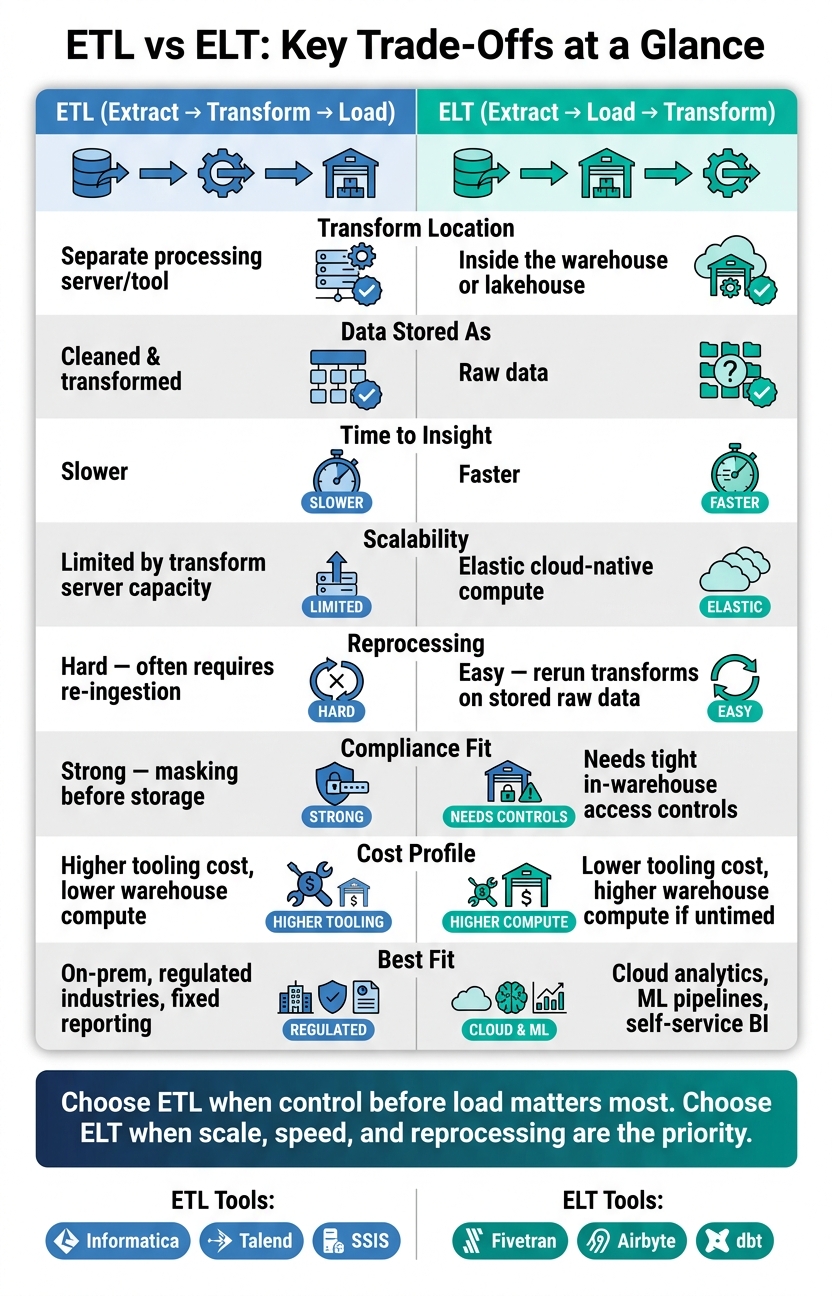
ETL vs ELT: Side-by-Side Comparison of Key Trade-Offs
ETL vs ELT: The Real Difference in Modern Data Pipelines
sbb-itb-61a6e59
Quick Comparison
| Criteria | ETL | ELT |
|---|---|---|
| Order | Extract → Transform → Load | Extract → Load → Transform |
| Transform location | Separate engine or staging layer | Inside the warehouse or lakehouse |
| Data stored first | Cleaned data | Raw data |
| Time to use data | Slower | Faster |
| Compliance fit | Strong for pre-load masking | Needs tight warehouse access control |
| Scale | Bound by separate transform layer | Fits elastic cloud compute |
| Reprocessing | Harder | Easier |
| Best fit | On-prem, fixed reporting, sensitive data | Cloud analytics, ML, self-service BI |
If you’re deciding between the two, I’d frame it this way: ETL lowers risk before load; ELT gives you more room after load. The rest comes down to your platform, budget, and rules around raw data—or even which data engineer bootcamp you choose to master these architectures.
How ETL and ELT differ
Processing order and architecture
The main difference comes down to when data gets transformed. That one shift changes how the pipeline works and how fast teams can start using the data, a core skill taught in our free data engineering boot camp.
With ETL, data is transformed before it gets loaded. With ELT, data is loaded first and transformed inside the warehouse later.
That also changes the shape of the pipeline. ETL uses a separate transformation layer. ELT sends raw data into the warehouse first, then runs transformations there.
The timing matters for analysis too. ETL holds things up until transformation is done. ELT lets teams query raw data right away and clean or model it afterward.
Platform fit and data types
ETL works well for legacy or on-prem systems that need heavy cleanup before data is stored. ELT lines up well with cloud-native warehouses, where storage and compute are separate. ELT also works well for semi-structured data, such as JSON, because the raw data stays in the target system until transformation.
The table below sums up the main trade-offs.
| Feature | ETL | ELT |
|---|---|---|
| Transformation location | Separate processing server/tool | Target warehouse or lakehouse |
| Data state in target | Transformed and cleaned | Raw |
| Time to insight | Slower | Faster |
| Data types | Structured | Structured and semi-structured |
| Platform fit | Legacy, on-premises, compute-limited | Cloud warehouses |
| Typical tools | Informatica, Talend, SSIS | Fivetran, Airbyte, dbt |
Pros and cons of ETL vs ELT
ETL and ELT don't differ much in purpose. The bigger difference is where control sits, where costs show up, and where risk lands. Once you understand the mechanics, the real decision comes down to trade-offs.
ETL: strengths and limitations
ETL's biggest strength is control before load. Teams can mask sensitive fields before data ever reaches the warehouse. That's a strong match for healthcare and finance, where raw data often shouldn't be stored at all.
ETL can also help keep warehouse compute costs down. The heavy transformation work happens in a separate layer instead of inside the target system. But that control comes with extra moving parts. When logic changes, teams often have to update and rerun the pipeline, which makes ETL less flexible as source systems change.
ELT: strengths and limitations
ELT's main advantage is speed. Raw data lands in the warehouse right away, which gives teams faster access to fresh data.
Keeping raw data also makes reprocessing much easier. If business logic changes, teams can rerun transformations without pulling the data in again. The downside is cost risk inside the warehouse. If transformations aren't tuned well, compute spend can climb fast, so ELT needs tight governance. Teams also need strong access controls because raw data arrives first.
Side-by-side comparison table
The table below focuses on the trade-offs that tend to shape tool choice. Aspiring engineers can learn to navigate these trade-offs in a free data engineering program.
| Aspect | ETL | ELT |
|---|---|---|
| Security and compliance | Strong; masking happens before data lands | Needs strong in-platform governance |
| Flexibility | Lower; changes often mean rerunning the pipeline | Higher; raw data can be reprocessed on demand |
| Costs | Higher tool and infrastructure costs; lower target-system compute | Lower tooling costs; higher warehouse compute if transformations are not tuned |
| Scalability | Limited by the transformation server's capacity | Scales well through cloud-native elastic compute |
| Governance burden | Lower; data is cleaned before it enters the warehouse | Higher; raw data needs access controls from the start |
| Reprocessing ease | Low; logic changes often require re-ingestion | High; transformations can be rerun against stored raw data |
| Operational complexity | Higher; separate transformation layer to maintain | Lower; transformations run inside the warehouse |
These trade-offs lead straight into the use-case split below.
Use cases: when to use ETL and when to use ELT
The trade-offs above help you line up ETL or ELT with your compliance needs, setup, workload, and how mature your data team is.
When ETL is the better fit
When control matters more than speed, ETL is usually the safer call. In healthcare and finance, data often needs to be masked, encrypted, cleansed, or standardized before it reaches storage. ETL helps by keeping masked or standardized data out of storage in the first place.
ETL also makes sense for legacy or on-premises warehouses that may not have enough compute for heavy in-warehouse transformation work. It works well for stable, structured batch reporting and audit-heavy workflows too.
When ELT is the better fit
ELT is often the go-to option for cloud-native warehouses and lakehouses, where storage is low-cost and compute can scale when you need it. Keeping raw data also makes reprocessing and feature engineering easier, which is a big deal for high-volume or near-real-time pipelines.
It also fits machine learning work well. Business logic can shift a lot during testing, and storing raw data in the warehouse makes it easier to rerun transformations without pulling data again from the source. ELT also supports self-service BI and warehouse-native modeling with SQL tools like dbt.
A simple decision framework
If both approaches could work, go with the one that lines up with your governance maturity. The table below gives you a plain-English way to match each method to your limits.
| Priority | Choose ETL if... | Choose ELT if... |
|---|---|---|
| Compliance | Data must be masked or standardized before storage | Transformation can happen after loading |
| Platform | On-premises or legacy warehouse | Cloud-native warehouse or lakehouse |
| Volume | Small to medium, structured datasets | High-volume, streaming, or mixed data types |
| Workflow | Stable batch reporting, fixed schemas | Exploratory analytics, ML, self-service BI |
Use ELT only when schema validation and freshness monitoring are already in place. If those controls are still weak, ETL's pre-load checks can cut down on cleanup later.
Conclusion and next steps
ETL puts validation and masking before data lands in the target system. ELT shifts that work to the warehouse, which gives teams more room to work with large data sets and cloud-native platforms.
The right pick comes down to a few things: your platform, how hard the transformations are, data volume, latency needs, and governance rules.
If you want hands-on practice, DataExpert.io Academy offers boot camps, capstone projects, and subscriptions for Databricks, Snowflake, and AWS.
FAQs
How do I choose between ETL and ELT?
Choose based on your data volume, transformation needs, and the limits of your target system.
Use ETL when data needs to be transformed, cleaned, enriched, or masked before it’s loaded, or when you’re working with rigid schemas. Choose ELT for cloud warehouses like Snowflake or Databricks, especially when you’re dealing with large, fast-moving data and near real-time needs.
It also helps to look at your team’s SQL or Python skills, along with your infrastructure goals. In plain terms: the right choice isn’t just about the data. It’s also about who will manage the pipeline and where you want your stack to go.
Can ETL and ELT be used together?
Yes. ETL and ELT often work side by side in modern data setups, especially when a company deals with mixed data sources, older systems, and near real-time demands.
For example, a pipeline might use ETL to clean sensitive data for compliance before loading it into a staging area. Then it can use ELT for more complex, on-demand transformations inside a cloud data warehouse like Snowflake or Databricks.
What skills do teams need for ELT?
Teams need strong SQL skills to turn raw data into something useful inside cloud warehouses like Snowflake or BigQuery. They also need Python for automation, custom connectors, and workflow management.
Just as important, teams should know their way around cloud-native platforms, orchestration tools like Apache Airflow or Dagster, data modeling, Git, and data governance. That mix helps keep pipelines reliable, secure, and high quality.