
Securing Event-Driven Architecture: Best Practices
I secure event-driven systems by checking every step - not just the broker. I start by mapping event routes and assigning owners, then check access, data handling, and failure recovery from publishing through downstream writes.
My checklist covers 8 areas:
- Limit permissions: Give producers, consumers, and recovery teams only the actions and resources they need.
- Protect service identities and connections: Use short-lived credentials, TLS 1.2 or higher, and encryption for stored copies.
- Validate events: Check schemas, payload limits, and business rules before processing.
- Reduce data exposure: Keep sensitive fields out of events and logs unless needed; restrict readers and set retention limits.
- Control retries and dead-letter queues: Cap retries, prevent duplicate side effects, and require approval for replay.
- Restrict downstream writes: Check tenant and resource permissions rather than trusting payload identifiers.
- Review logs and access: Track event activity alongside identity, permission, and configuration changes.
- Test enforcement and recovery: Try disallowed actions and failure paths, verify alerts, and retest after fixes.
My rule: <u>private networking and encryption are not proof of permission</u>. I check who can act, what they can do, and whether the controls work - then assign each gap an owner and a fix date.
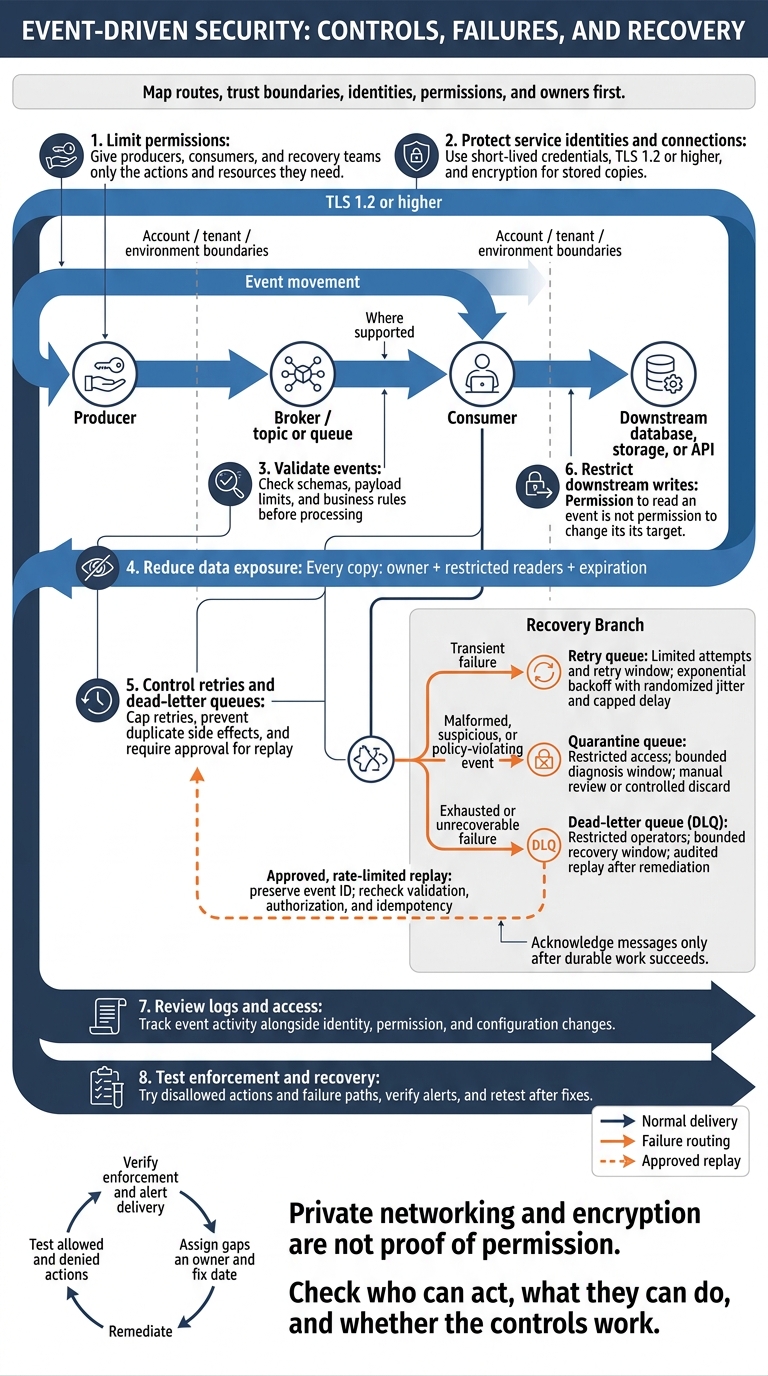
Event-Driven Architecture Security: 8 Control Areas
Securing Your Event-Driven Systems
sbb-itb-61a6e59
Map Event Flows, Trust Boundaries, and Owners
Map every source, producer, broker, topic/queue, subscription, consumer, downstream destination, admin interface, external integration, retry path, replay tool, and archive. Label each component with its account, cloud project, cloud subscription, region, tenant, and environment. Mark every arrow that crosses these boundaries, including production, staging, and development.
For each path, record its purpose, event type, schema version, data class, sensitive fields, retention, workload identity, and permitted actions. Make clear who can request access and who can grant it. Include authentication, encryption, network rules, validation, logging, and failure behavior only where they affect access or retention. Classify fields so access, masking, and retention rules match the payload.
Separate identity from access control: authentication verifies the workload; authorization grants the action. Record the service account, role, certificate, or token subject - not just the application name. Keep identities separate across environments. A verified consumer identity does not automatically have permission to write to a downstream database.
Map permissions for publishing, consuming, replaying, purging, downstream writes, policy changes, and key management. Deny undocumented paths by default.
Record backup contacts, the review schedule, and evidence locations. Check the map against broker settings, IAM exports, deployment manifests, schema registries, and audit logs. Investigate unknown identities or destinations. Update the inventory whenever a topic, subscription, consumer, destination, identity, permission, region, tenant, or environment changes. Track mapping coverage, close ownership gaps, and use the map to set least-privilege permissions.
1. Limit Producer and Consumer Permissions
Security threat
Broad permissions let a compromised service inject, read, or delete events across unrelated flows. Limit both actions and resources to enforce least privilege.
Give each owner and boundary in the flow map its own set of grants.
Controls and cloud implementation
Turn the flow map into role-specific grants. Use the matrix below to keep application access separate from recovery and admin access. Treat acknowledgment, replay, and purge as separate permissions.
| Role | Allowed actions | Prohibited actions by default | Resource scope |
|---|---|---|---|
| Producer | Publish/send; describe destination if required | Read, acknowledge, replay, purge, change policies | Named topics or queues |
| Consumer | Read/receive; acknowledge/delete processed messages; use its assigned consumer group | Publish, purge, change retention, administer ACLs, perform privileged redrive | Assigned topics, queues, subscriptions, and consumer groups |
| Broker operator | View configuration; make approved changes through a privileged role | Read sensitive payloads without approval; use operator credentials for application traffic | Assigned environment or cluster |
| DLQ operator | Inspect, quarantine, redrive, or delete messages under an approved procedure | Purge by default; redrive to arbitrary destinations; change broker-wide settings | Named DLQs and approved destinations |
Use cloud IAM and queue policies where supported, plus broker ACLs for topic- or queue-level access. Scope Kafka consumer-group access separately from topic access. Replace wildcards with exact identifiers. If you can't avoid a wildcard, limit it to one environment.
After every permission change, test both allowed and denied actions.
Production checks
After each permission change, confirm that publishing, reading, purging, configuration changes, and cross-environment access fail when the role lacks permission. Check that DLQ redrive stays within approved destinations.
Regularly review IAM findings, ACLs, access logs, and role-assumption events. Remove unused access and expired emergency grants.
Common mistakes
Keep application roles separate from broker-admin and DLQ-admin access. Use dedicated workload identities—a concept covered in our free data engineering boot camp - not personal credentials or shared administrator accounts. Give human operators time-limited privileged access with MFA, and make sure each operator's actions can be traced to that person.
For Kafka, treat read and replay as separate permissions. Retained events can be reread, so grant replay only to approved recovery roles.
Next, lock these roles to service identities and encrypted transport.
2. Secure Service Identities and Encrypt Connections
Security threat
Stolen credentials let attackers impersonate producers or consumers, read brokers, or write to downstream systems. Unencrypted connections can also expose events in transit.
Private endpoints limit network access, not identity. A compromised workload inside the network can still reach a broker. Keep authentication, authorization, and TLS checks enabled.
Controls and cloud implementation
Use cloud-managed identities or workload identity federation when supported. Temporary credentials keep static secrets out of source code, images, and deployment manifests. Bind each workload identity to one app, one environment, and one permission set.
For each identity, document its owner, purpose, permitted channels, issuer, expiration, revocation contact, and resource limits. To rotate credentials, deploy the new credential, verify that it works, and then revoke the old one.
Secure the connection path as well as the identity. Require TLS 1.2 or higher on every hop, including downstream database connections. Validate hostnames and certificate chains, and disable insecure fallback.
Where supported, use mTLS for every mapped service-to-service hop. Verify the chain, issuer, subject, expiration, revocation, and audience.
Encrypt retained events, retries, DLQs, checkpoints, databases, backups, and logs. Restrict key-policy changes to a separate admin role. Record which key protects each resource, and redact secrets before logs are ingested.
Production checks
Before deployment, scan code, Git history, images, build artifacts, manifests, CI/CD output, and sample payloads for credentials. Block releases with confirmed secrets.
In nonproduction, test expired and revoked credentials, incorrect identities, and invalid certificate chains. Check that access is denied, authentication errors are clear, and authentication retries don't loop endlessly. After rollout, review expirations, failed handshakes, unexpected identity access, and key-policy changes.
Common mistakes
Don't disable certificate validation to fix connection failures, trust every certificate from a trusted issuer, or give retry workers broader credentials.
Encrypting broker disks doesn't protect unencrypted backups or logs. Lock down the full path, then validate payloads and retry behavior. Keep key-policy changes out of application roles, and never log full payloads or tokens when authentication fails.
After identity and transport checks pass, validate event schemas before processing payloads.
3. Validate Event Schemas and Payloads
Security threat
A valid schema does not make an event safe. Malformed records, injection strings, unsafe deserialization, and deeply nested or compressed payloads can trigger actions without permission or exhaust resources.
Treat internal, imported, and replayed events as untrusted input. Reject ambiguous encodings, and apply the same parser policy across boundaries.
Controls and cloud implementation
Define versioned JSON Schema, Avro, or Protobuf contracts that specify required fields, types, ranges, nullability, and allowed extra fields. Gate schema changes in CI/CD using an approved compatibility policy, and retain the versions needed for delayed or archived records. Classify sensitive fields in the contract. Reject unexpected credentials or secrets before publishing.
| Component | Validation responsibility |
|---|---|
| Producers | Validate fields, identifiers, timestamps, and size before publishing. Minimize sensitive data. |
| Brokers or ingestion boundaries | Enforce approved schema IDs, subject mappings, size limits, and rate limits where supported. |
| Consumers | Recheck allowed schema versions and payload constraints, including older, imported, and replayed events. Use bounded parsers and allowlisted types. |
| Downstream systems | Enforce business rules and tenant authorization before writes. Use parameterized queries, safe APIs, and destination-specific escaping. |
Set explicit limits for timestamp age and clock skew, string length, array counts, nesting depth, message size, and decompressed size. Apply byte limits before parsing and depth limits during parsing.
Don't assume the broker validates schemas. Add checks in producers, ingestion code, and consumers. Keep schema-registration permissions separate from producer publish rights.
Production checks
Before deployment, test missing fields, unknown schema IDs, incompatible versions, malformed timestamps, oversized records, parser exhaustion, injection strings, and unsafe serialized objects. Include older, imported, and replayed fixtures.
Confirm that failures block downstream writes and that failed records enter quarantine without retry loops. Log the event ID, schema version, producer identity, and reason code - not payload values.
Restrict access to any payloads needed for forensic review, and set retention limits. Review rejection spikes, parser errors, latency, and quarantine access.
Common mistakes
Don't mistake compatibility checks for content security, deserialize arbitrary classes, or disable consumer validation to improve performance. Avoid unbounded fields, silent changes to field meanings, and timestamps without timezone rules.
Broker acceptance isn't proof of safety. Rejected records should never become accessible payload dumps, and even valid payloads should contain only the fields downstream systems need.
4. Limit Sensitive Data Exposure
Security threat
After schema validation, control where each field appears and who can read each copy. Every event copy expands exposure. Sensitive fields can linger in retries, backups, logs, and analytics tables long after processing ends. Encryption at rest doesn’t remove unnecessary fields or prevent authorized readers from accessing exports and decrypted copies.
Controls and cloud implementation
Publish only the fields needed for the event’s business purpose. Apply that rule to retries, DLQs, logs, exports, and derived tables. Leave out passwords, access tokens, keys, payment-card security codes, authentication data, and unnecessary personal or health information.
Use tokenization, masking, field-level encryption, or keyed hashes only when downstream use calls for them. Plain hashes of predictable emails, phone numbers, or Social Security numbers can be guessed. Document what the protection needs to achieve: correlation, exact-match lookup, pseudonymization, or irreversible anonymization.
Give every copy an owner, limit its readers, and set an expiration. Separate key administration from decryption rights. In downstream systems, keep raw data separate from masked datasets and restrict access to sensitive columns.
Allow only safe metadata in production logs. Block full event bodies in exceptions and tracing. Treat retries, DLQs, exports, and analytics tables as data copies that need their own controls.
Production checks
Use this exposure checklist for each sensitive field:
| Location | Check |
|---|---|
| Original events | Only required fields remain; buffers, keys, and headers contain no extra identifiers. |
| Broker storage | Topics, replicas, snapshots, and backups have restricted access, encryption, and retention limits. |
| Retry copies | Protection matches the source; delayed and replay copies have expiration rules. |
| DLQ records | A named owner controls readers, retention, exports, and replay approval. |
| Consumer logs | Logs, traces, errors, and alerts contain no full sensitive values. |
| Downstream tables | Controls cover column access, exports, caches, derived tables, and deletion schedules. |
Start with synthetic sensitive values in nonproduction, then run controlled production tests where approved. Test success, retry, DLQ, and replay paths. Search every checklist location for unintended plaintext.
Verify that identities without permission cannot read or decrypt the data. Check that copies expire after the configured retention period. Repeat these tests whenever schemas, consumers, or infrastructure change.
Common mistakes
Don’t publish full source records just to keep future options open, treat unsalted hashes as privacy protection, or turn on full-payload logging during incidents. Do not leave backups, exports, or downstream copies unrestricted.
5. Secure Retries and Dead-Letter Queues
Security threat
Retries need a stopping point. Unlimited retries can overload dependencies, increase costs, and duplicate side effects. Classify failures before retrying: retry transient outages, quarantine malformed or suspicious events, and send unrecoverable failures to a dead-letter queue.
Controls and cloud implementation
Limit retry attempts, the retry window, and message age. Use exponential backoff with randomized jitter and a capped delay. Set visibility timeouts or locks to cover actual processing time, and renew them only for legitimate long-running work.
For SQS/Lambda, set the visibility timeout above processing time and tune maxReceiveCount to match recovery needs. Enable ReportBatchItemFailures so only failed records retry. Acknowledge messages only after durable work succeeds.
Give each event a stable event ID and, where appropriate, a business idempotency key. Retain idempotency keys for the full retry and replay window, and enforce database uniqueness. Broker duplicate detection can help, but it does not replace idempotent receive-side processing.
Assign service owners to retry recovery. Assign designated security or operations owners to quarantine and DLQ recovery.
| Destination | Purpose | Access | Retention | Recovery |
|---|---|---|---|---|
| Retry queue | Retry transient failures | Consumer service and limited operations access | Within the retry window | Automatic redelivery after backoff |
| Quarantine queue | Isolate malformed, suspicious, or policy-violating events | Restricted application and security or operations access | Bounded diagnosis and incident window | Manual review or controlled discard |
| Dead-letter queue | Hold exhausted or unrecoverable failures | Restricted operators and approved replay service | Bounded recovery window | Audited replay after remediation |
Apply the same schema and data-minimization rules to retry, quarantine, and DLQ copies. Retry paths must enforce the schema and content rules used for the original event.
Keep routing, retention, and recovery rules separate, even when queues share infrastructure. Restrict key use and separate publish, read, purge, and replay permissions. Store the event ID, attempt count, outcome, and correlation ID. Exclude payload secrets, stack traces, credentials, and sensitive data that isn't needed.
Treat replay as production publishing. Require an approved ticket, rate-limit replay, preserve the original event ID, and run normal validation and idempotency checks. Filter events by event ID or time range. Record the operator, reason, approval, and outcome, and check that older events cannot overwrite newer state or violate current business rules.
Once retries have limits, restrict which consumers can write recovered events downstream.
Production checks
Inject transient errors to verify backoff and jitter. Exceed the visibility timeout and confirm that redelivery produces no duplicate side effects. Fail one batch record and check that successful records are not replayed. Force retry exhaustion and verify routing to the DLQ or quarantine. Then repair the defect and test replay attempts both with and without approval.
Alert on retry spikes, queue depth, oldest-message age, DLQ depth, lock expirations, and repeated failures for the same event ID. Correlate these signals with dependency health to distinguish broker failures from downstream system failures. Runbooks should specify when to reduce concurrency, pause consumers, or quarantine messages.
Common mistakes
Avoid retrying permanent validation errors, acknowledging messages before durable work completes, or setting prefetch so high that locks expire before processing finishes.
Never replay an entire DLQ blindly after a schema change. Don't give standard consumers purge or replay rights, or credentials with more access than they need. Don't use a DLQ as long-term storage. Assign every recovery path an owner, expiration policy, alert threshold, and documented procedure.
6. Restrict Consumer Access and Downstream Writes
Security threat
Permission to read an event is not permission to change its target. A consumer becomes a confused deputy when it uses valid credentials to write to a tenant or resource it isn't allowed to access. Treat payload identifiers as inputs - not proof of permission. Independently authorize the consumer’s identity, tenant scope, resource ownership, and requested operation.
Use the flow map to bind each consumer to approved tenants, tables, buckets, and APIs.
Controls and cloud implementation
Apply the same rules to live, replayed, and redriven events. Keep an access matrix for each consumer that covers its subscription, tenant scope, database tables, rows and columns, buckets and object prefixes, API methods, and network destinations.
Give each consumer its own workload identity. Separate readers from writers. If a service does both, scope its read and write credentials separately. Block outbound traffic except to approved endpoints and ports.
Before making downstream calls, validate tenant-resource relationships and allowed state transitions. Resolve destination targets server-side, use safe write APIs, and store an event ID or idempotency key with every write.
Keep transactional writes separate from external steps. Track progress or compensating actions for external calls, and recheck version and authorization on replay.
Production checks
Test the exact writes a consumer can perform - not just whether it can read an event. Check effective permissions by attempting cross-tenant writes and access to forbidden tables, columns, objects, and APIs. Verify that changing a payload identifier cannot expand access.
Inject a failure between downstream steps. Then test duplicate writes, stale versions, and replay attempts that lack authorization. Across database, API, storage, and network logs, correlate the event ID, consumer identity, tenant, resource, authorization decision, and write outcome.
Common mistakes
Avoid shared administrator roles, unsafe deserialization, URLs built from payload data, and open internet egress. A tenant filter is not an authorization check unless its value comes from independently verified context.
Don't assume a database transaction covers external API calls. Don't retry a partially completed workflow without tracking which steps have finished. Review policy drift after deployments and revoke unused access.
7. Review Production Logs and Audit Access
Security threat
Delivery logs are not an access audit. Delivery and processing logs track event movement and failures. Identity, access, and configuration audit logs show who changed permissions, subscriptions, or destinations. Without both, investigations have gaps.
Controls and cloud implementation
Store delivery and audit logs centrally in a restricted, immutable store. Sync clocks, and log only event IDs, identities, and outcomes.
Use the flow map and least-privilege matrix to compare expected access with actual log activity. Check audit entries against the owner, identity, and allowed actions in the flow map. Set alerts for IAM policy and trust-boundary changes that differ from a known-good baseline. Use platform controls to flag missing logging, and verify producer and consumer coverage separately.
Production checks
Check log evidence against mapped trust boundaries and approved permissions. Review policy and access changes against a known-good baseline, then check subscription or destination changes, failed access attempts, and replay activity.
Investigate unexpected administrators, unusual traffic, and downstream failures. Then check who accessed sensitive logs and whether every alert has a documented investigation and follow-up.
Run a synthetic security drill with security events to confirm that alerts reach the correct on-call responders. A detection firing isn't enough. Link alerts to incident records that include timestamps, investigation steps, and follow-up actions. Review those records alongside alert delivery evidence to find missing handoffs.
Common mistakes
Log silence does not mean safety. First, confirm that the expected sources are still sending data. Watch for exposed payloads, access changes that haven't been reviewed, and new subscriptions or destinations that create unapproved data paths.
8. Test Security Controls and Failure Recovery
Security threat
After reviewing logs and audits, test the live controls directly. A stated policy doesn’t prove that a control works. Run runtime tests on deployed producers, brokers, consumers, and downstream systems to check enforcement when failures occur.
Controls and cloud implementation
Use synthetic requests to check that controls block disallowed publishing, consuming, cross-environment access, and requests with expired credentials. These tests check least privilege and service identity.
Confirm that each request is rejected and any alert reaches the on-call owner within the required response window. Use the mapped owner for each test.
Production checks
Send invalid, oversized, and retry-exhausting events to check rejection, dead-letter queue (DLQ) or quarantine routing, and alerting. Confirm that payload validation and retry controls block unauthorized downstream writes along the entire failure path.
After remediation, rerun the same tests to check enforcement and recovery.
Record each test’s expected result, observed result, owner, test date, and remediation status in a control ledger. Track enforcement failures separately from missing alerts.
Common mistakes
Don’t mistake configuration checks for runtime proof. Check both enforcement and alert delivery - not just one. Test the failure path, document the result, and rerun the test after remediation.
Conclusion: Assign Owners and Repeat Checks
Assign one owner to every control and gap, including identities, schemas, retries, logs, and downstream writes. Recheck controls whenever identities, schemas, routing, or infrastructure change, and add the verification results to the change record.
Keep failed checks and unresolved risks in one register. Give each entry an owner, an expected remediation date, and a clear follow-up action. Link each risk to the test or incident that exposed it.
Use full U.S. dates and UTC timestamps in incident and audit records. Format dates as October 4, 2026, and use UTC for all timestamps.
FAQs
Which security gaps should I fix first?
Review system.access.audit for failed logins, catalog access without permission, and unusual permission changes.
Protect critical data with Write-Audit-Publish validation. Send invalid events to a dead-letter queue to prevent downstream corruption.
Run security analysis tools daily to detect security configuration changes made without permission. Use structured JSON logs, and remove sensitive information such as API keys and passwords.
How can I safely test controls in production?
Use isolated sandboxes and phased deployment to test changes before they go live. Zero-copy cloning lets you try access control changes or quality rules without affecting live data or adding storage costs.
Run AI-generated rules or new logic in shadow mode first. This logs violations and lets you monitor performance without disrupting day-to-day work. Fine-tune thresholds and reduce false positives before turning on active enforcement.
DataExpert.io Academy offers specialized boot camps and training on industry-standard tools.
How should I secure events shared across tenants?
Use layered isolation, access control, and validation. Manage governance centrally in Unity Catalog, with GRANT and REVOKE controlling storage and table permissions. Choose OAuth machine-to-machine credentials with service principals rather than personal access tokens.
Enforce schemas and data contracts before accepting messages. Send invalid events to a dead-letter queue to prevent cross-tenant data corruption. Review audit logs for unauthorized access or privilege escalations.