
Vendor Compliance Rules for Cross-Border Migration
Before a cross-border migration, confirm the legal transfer path, approved vendor locations, signed contracts, and proof that controls work. Overseas support access can count as a transfer - even when the database stays in the same country.
Approval rests on 4 checks:
- Map each data flow: Identify the data, countries, vendor roles, and applicable laws.
- Set vendor requirements: Define storage and access limits, encryption, retention, deletion, and subprocessor rules.
- Document the legal path: Match contracts and transfer assessments to each flow, including government-access risks.
- Test and review: Verify controls, retain audit records, assign approval owners, and reassess when conditions change.
Label requirements as legal, risk-based, or internal policy. Block migration when required agreements are missing, destinations are not approved, or critical tests fail. Internal approval cannot override the law.
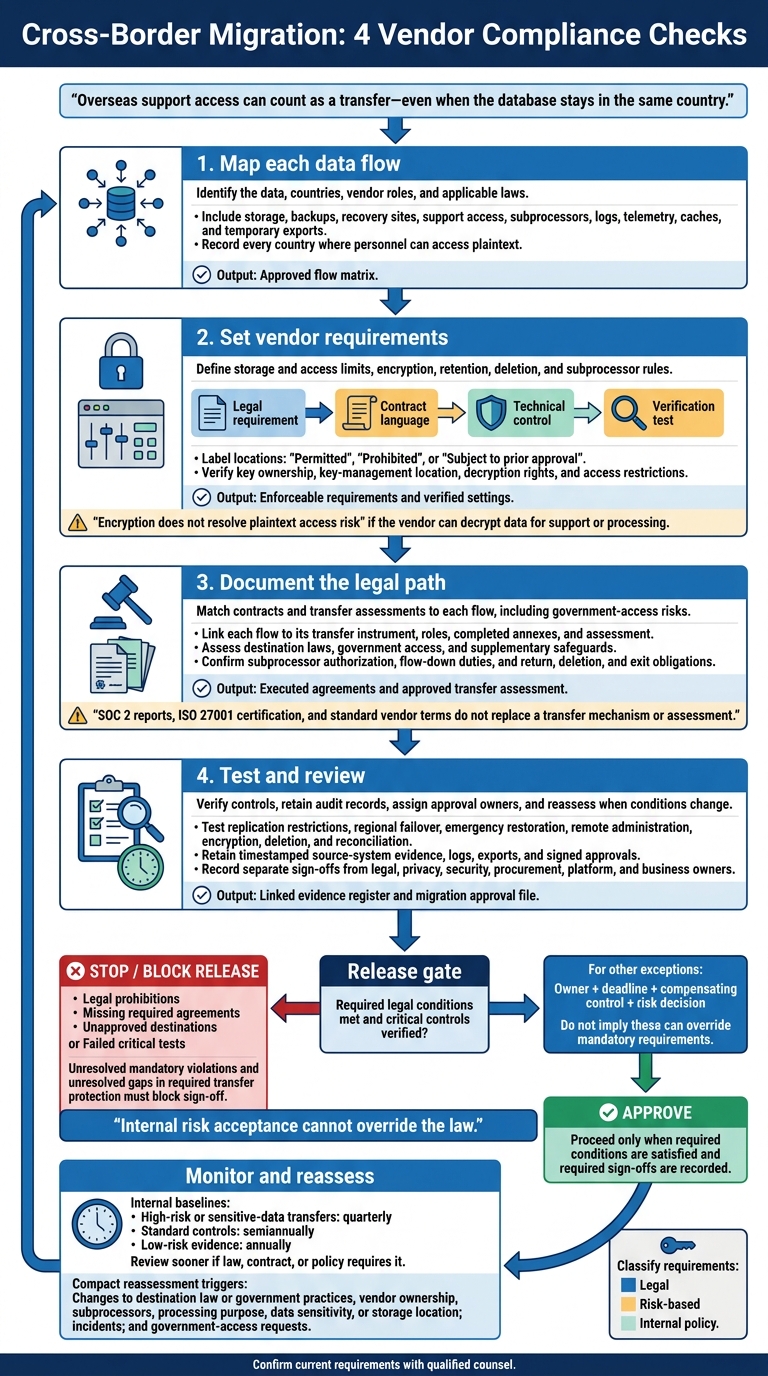
Cross-Border Migration: 4 Vendor Compliance Checks
Cross-Border Personal Data Transfers Explained | Privacy & GRC
sbb-itb-61a6e59
Set Vendor Transfer and Storage Requirements
Use the transfer matrix to turn each approved flow into enforceable vendor requirements. Tie every requirement to a specific transfer risk, jurisdiction rule, or audit obligation.
Translate each legal requirement into contract language, a technical control, and a verification test. Acceptance criteria should state what the vendor must prevent - not just what the service supports. Keep mandatory restrictions separate from optional safeguards and internal preferences.
Approve Storage, Backup, and Access Locations
Require a location register for primary storage, replicas, backups, recovery sites, support centers, subprocessors, logs, telemetry, caches, and temporary exports. Include each processing purpose and every country where personnel can access plaintext.
Mark each location permitted, prohibited, or subject to prior approval, and record those decisions in the contract and architecture specifications. Choosing a storage region does not control support locations, metadata processing, or subprocessor copies. Require advance notice and approval before any location change takes effect.
Set Security, Retention, and Deletion Controls
Specify encryption in transit and at rest for every approved cross-border flow. Define key ownership, key-management location, rotation intervals, and decryption rights. Require region-bound key management where required, separation of duties, least privilege, multifactor authentication, just-in-time privileged access, and monitoring.
Access logs should identify the user, source country, dataset, action, timestamp, and approval reference. Encryption does not resolve plaintext access risk if the vendor can decrypt data for support or processing.
Set retention periods by data category and purpose for indexes, logs, caches, migration files, and backups. Define the return format, deletion deadline, backup expiration, deletion proof, and narrow legal-hold exceptions.
Before cutover, test replication restrictions, regional failover, emergency restoration, and remote administration. Check that prohibited access is denied and logged, recovery stays within approved locations, and deleted records become unrecoverable after the approved backup-expiration period.
Check Vendor Controls Against Requirements
For each migration path, create one row per vendor service or processing function using verified settings. Treat the table as a verification checklist - not proof of compliance. Give each gap an owner, severity, deadline, and approval authority.
A certification alone does not prove location compliance. Block transfers with unresolved mandatory violations. Track supplementary safeguards and internal preferences separately, documenting decisions and remediation dates.
| Service or data flow | Approved regions | Actual storage and backups | Encryption and key controls | Support access | Deletion and return | Evidence | Gaps and owner |
|---|---|---|---|---|---|---|---|
| Production database | Contract-approved countries and regions | Verify primary, replicas, backups, and recovery sites | Verify encryption, key custody, region, and decryption rights | Verify countries, roles, and access expiration | Confirm export format and backup expiration | Configuration exports, key policies, recovery-test results | Record mismatches; vendor security owner |
| Support and monitoring | Approved storage and access countries | Verify logs, telemetry, and crash dumps | Verify key controls and data masking | Verify privileged-access approvals and logs | Confirm log, telemetry, and crash-dump deletion | Location register, access logs, retention settings | Record undisclosed processing; IT operations owner |
| Migration staging | Approved temporary-processing regions | Verify extracts, caches, and recovery copies | Verify encryption and credential restrictions | Verify migration-team and subprocessor access | Confirm purge deadlines and deletion proof | Job settings, access records, purge reports | Record residual copies; migration owner |
Carry every unresolved gap into the contract and transfer assessment record.
Document Contracts and Transfer Assessments
Once you’ve defined the transfer path and controls, record them in the contract and transfer assessment.
Match Contract Clauses to Data Flows
Link each mapped flow in the transfer matrix to its contract record, including the transfer instrument, role, and annexes. For EU SCCs, select Module 1 for controller-to-controller, Module 2 for controller-to-processor, Module 3 for processor-to-processor, or Module 4 for processor-to-controller. Include the applicable general clauses and complete the annexes. Assess UK restricted transfers separately. Use the UK IDTA or UK Addendum where appropriate, and complete the required transfer risk assessment (TRA).
Require documented instructions, limits on purposes and data categories, confidentiality and security measures, assistance with data-subject requests, regulator cooperation, audit and inspection rights, and records of processing. Also specify retention limits, return and deletion duties, and liability allocation. Set a breach-notification deadline that does not weaken any “without undue delay” obligation.
Subprocessor clauses must include an authorization process, advance notice, applicable objection rights, equivalent flow-down duties, and a current register. Check commercial terms for conflicts with mandatory transfer clauses. SOC 2 reports, ISO 27001 certification, and standard vendor terms do not replace a transfer mechanism or assessment.
Assess Destination Laws and Government Access
For SCC-based transfers, document destination law, government-access powers, oversight, remedies, and the recipient’s ability to meet the clauses. Assess the full processing chain and whether supplementary safeguards provide essentially equivalent protection. For UK transfers that rely on appropriate safeguards, document whether protection after transfer would be not materially lower. Record the evidence, safeguards, decision, and approver - not just a risk score. Any unresolved gap must block sign-off.
Require notice of government requests where lawful, challenges to unlawful or disproportionate demands, disclosure limited to the minimum necessary, and request logs. Address delayed notification or aggregate transparency reporting when immediate notice is prohibited.
Avoid or suspend transfers when the required protection cannot be maintained. Contractual promises cannot fix ineffective safeguards. Reassess after material changes to destination law, government practices, vendor ownership, subprocessors, processing purpose, data sensitivity, or storage location.
Assign Contract Owners and Exit Duties
Assign responsibility for migration failure, data corruption, cutover delay, and regulatory holds. Specify recovery-time and recovery-point objectives, transition access, usable machine-readable exports, exit assistance, and continued protection after termination.
Set a firm deadline for deleting backups. Require deletion evidence that identifies the systems, dates, exceptions, and responsible signatory. Obtain legal approval and resolve missing or conflicting mandatory terms before contract execution or migration approval.
| Clause checklist | Responsible party | Evidence | Review frequency | Escalation owner |
|---|---|---|---|---|
| Roles, transfer instrument, and completed annexes | Privacy counsel and procurement | Flow-to-contract mapping; executed instrument | Before signature and after scope changes | General counsel |
| Assessment of destination law and safeguards | Privacy and security | Approved assessment; safeguards plan | Annually and after material changes | Chief privacy officer |
| Authorization of subprocessors and flow-down duties | Vendor manager | Register; approvals; contractual confirmations | Quarterly and before changes | Procurement lead |
| Notice of breaches, government requests, audit, and cooperation | Legal and security | Contract schedules; request procedure; audit scope | Annually and after relevant incidents | CISO |
| Continuity, return, deletion, and exit assistance | Service owner | Exit plan; recovery tests; deletion certificate | Before migration and at termination | Program sponsor |
| Missing or conflicting mandatory terms | Legal and business owner | Closed redlines; legal approval | Before execution | General counsel |
Add any unresolved items to the evidence register and migration approval file.
Prepare Audit Evidence and Approve Migration
Maintain an Evidence Register
Build the evidence register from the approved flow matrix and contract record. For each approved flow, link the evidence that shows compliance with the approved legal, security, and storage design.
Include contracts, transfer instruments, transfer impact assessments, security schedules, configurations, access reviews, tests, incidents, deletion records, and corrective actions. Keep timestamped evidence from source systems - not standalone screenshots. Retain exports, logs, and signed approvals. Limit access by role, and preserve version history and protected approval logs. Use the longest retention period required by law, contract, audit, or internal policy, subject to legal holds.
| Control | Evidence owner | Source system | Approval date | Review or expiration date | Exception status | Remediation action |
|---|---|---|---|---|---|---|
| Approved flow map | Privacy and platform owners | Data catalog; architecture repository | Record timestamp | On flow change | Track open gaps | Confirm missing destinations |
| Contracts and transfer assessment | Legal and procurement | Contract and privacy repositories | Record timestamp | Renewal or reassessment date | Track missing approvals | Resolve before release |
| Regions, access, and encryption | Security and platform owners | Configuration and IAM systems | Record timestamp | Quarterly or configuration change | Track deviations | Correct settings; retest |
| Recovery, deletion, and validation | Platform owner | Test and ticketing systems | Record timestamp | Scheduled retest date | Track failed tests | Attach passing results |
Use the register to verify controls before release.
Test Controls and Obtain Migration Approval
Before cutover, check that the live configuration and test results match the approved design. The release checklist should cover:
- Approved vendor and subprocessors, plus executed agreements.
- Verified storage, backup, support, and remote-access locations.
- Tested encryption, recovery, deletion, and reconciliation.
- Active monitoring and linked evidence.
Check that audit reports cover the actual service, regions, and testing period. Record separate sign-offs from legal, privacy, security, procurement, platform, and business owners. Include the scope and timestamp for each approval.
Block release for legal prohibitions, missing required agreements, unapproved destinations, or failed critical tests. Give every other exception an owner, deadline, compensating control, and risk decision. Internal risk acceptance cannot override the law.
Name the owners authorized to halt transfers, freeze writes, restore systems, and notify affected parties if routing or access occurs without approval, data is lost, or recovery fails.
Set Review Dates and Reassess Changes
After approval, put the migration on a recurring review schedule. As an internal baseline, review high-risk or sensitive-data transfers quarterly, standard controls semiannually, and low-risk evidence annually. Review sooner if law, contract, or policy requires it.
Assign named owners and expiration dates. Reassess after incidents or government-access requests. Keep prior approvals, and record each new decision, corrective-action deadline, and condition for suspension and resumption.
Conclusion: Verify Transfers, Controls, and Evidence
Keep transfers approved only while the evidence, controls, and destination conditions match the approved design. Support that approval with continued monitoring and qualified counsel’s review of current requirements.
FAQs
Which transfer rules apply to my U.S.-based business?
U.S.-based businesses must comply with applicable regulations, such as CCPA and HIPAA, and industry standards like PCI DSS. Use attribute-based access control (ABAC) to manage rules for each jurisdiction, consent flags, and limits on how data can be used.
For audits and internal reviews, record job IDs, run timestamps in MM/DD/YYYY HH:MM format, and compliance approvals. Track personally identifiable information (PII) flags, legal holds, and retention statuses in metadata tables.
How can I verify a vendor’s actual data locations?
Don’t rely on contractual promises alone. Map every part of the data flow - including brokers, storage buckets, and replicas - by cloud provider, region, and tenant. Check those maps against audit logs, IAM exports, and deployment manifests to spot unknown destinations or regions that aren’t approved.
Use cloud-native logs alongside internal audit tables to track data movement. Test access across user personas and connection regions to verify that residency controls, masking, and row-level security work as intended.
What should I do if a vendor changes subprocessors mid-migration?
Treat the change as a major data architecture update that needs review. Update your flow map and internal documentation to record the new subprocessor’s role, region, tenant, and environment. Check that it meets your existing encryption, logging, and least-privilege access controls.
Run targeted security tests to confirm compliance and check for access paths that bypass permissions. Audit all identity and access logs to keep a reliable trail for future reviews.