
Top 5 Alumni Success Stories in Data Engineering
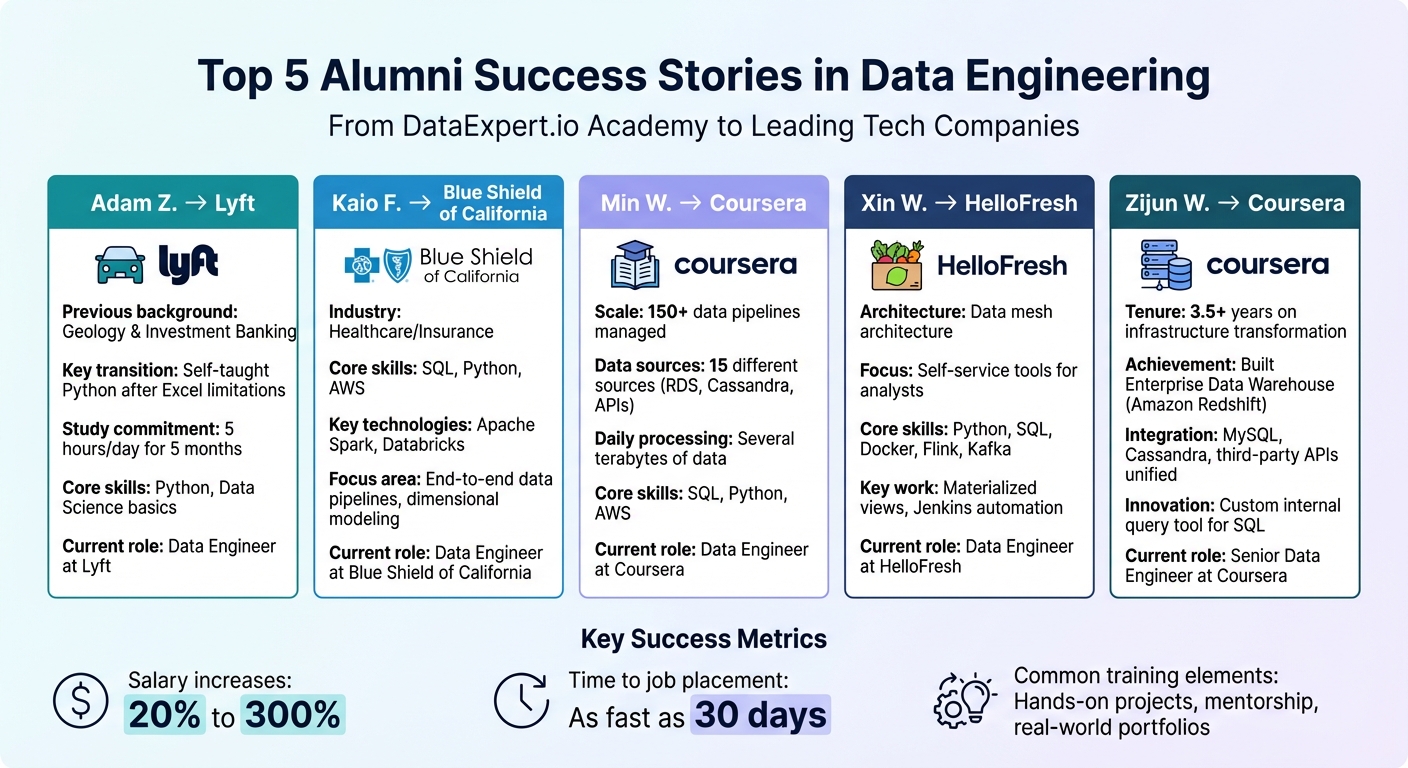
Data engineering is one of the fastest-growing fields in the U.S., with companies processing massive amounts of data daily. Alumni from DataExpert.io Academy, a program offering hands-on training in tools like Spark, Kafka, and AWS, have made impressive career changes. Five graduates - Adam Z. (Lyft), Kaio F. (Blue Shield of California), Min W. (Coursera), Xin W. (HelloFresh), and Zijun W. (Coursera) - transformed their careers by focusing on practical skills and structured learning. Here's a quick look at their journeys:
- Adam Z.: Transitioned from geology and investment banking to data engineering at Lyft by mastering Python and data science basics.
- Kaio F.: Moved into data engineering at Blue Shield of California, excelling in SQL, Python, and AWS to build data pipelines.
- Min W.: Manages 150+ data pipelines at Coursera, leveraging SQL, Python, and cloud platforms to process terabytes of data daily.
- Xin W.: Supports HelloFresh’s global data operations with expertise in Python, SQL, and data mesh architecture.
- Zijun W.: Led Coursera’s data infrastructure overhaul, creating a unified Enterprise Data Warehouse with Amazon Redshift.
These stories highlight the impact of focused training, hands-on projects, and mentorship on achieving career success in data engineering.
5 Data Engineering Career Transitions: Alumni Success Paths
How I Went From $60K to $450K as a Data Engineer
sbb-itb-61a6e59
1. Adam Z. at Lyft
Adam Zabrodski's career path is anything but conventional. Starting in geology, moving through investment banking and operations at Uber, and finally landing in data engineering at Lyft, his story highlights determination and a willingness to learn - despite not having a formal technical background.
While working at a web agency, Adam hit a roadblock with Excel. "It was obvious that my scope was being limited. There's only so much you can do in Excel", he shared. Watching his teammates work with Python piqued his curiosity, though his first experience with the language was far from smooth. "Python seemed tedious and horrible", he admitted.
A turning point came when the agency faced mass layoffs. With newfound time, Adam committed to studying for five hours a day. Platforms like Dataquest became his go-to for learning Python and building a solid data science foundation. "I think I was surprised at how difficult it was until it wasn't anymore", he reflected. After just five months of focused effort, he landed his first professional role in the data field.
Adam's shift to a data engineering role at Lyft, one of the country’s top ride-sharing companies, underscores how persistence and a dedication to learning can overcome the challenges of starting from scratch.
2. Kaio F. at Blue Shield of California
Kaio Fernandes made a career shift into data engineering by joining Blue Shield of California. Understanding the insurance sector's heavy reliance on advanced data systems to manage patient information and claims, Kaio focused on building his expertise in SQL, Python, and AWS, laying a strong foundation for his technical skills.
To gain hands-on experience quickly, Kaio dove into practical training that allowed him to work on real-world projects. This included designing end-to-end data pipelines, applying dimensional modeling techniques, and mastering tools like Databricks on AWS.
At Blue Shield, Kaio uses Apache Spark and Databricks to analyze healthcare data, providing insights that support decision-making. His journey highlights how structured, mentored programs - such as those offered by DataExpert.io Academy - can significantly speed up the transition into a data engineering role.
3. Min W. at Coursera
Min Wang stepped into a data engineering role at Coursera, where the data team oversees an ETL system that processes several terabytes of data every day. Tackling these challenges pushed him to sharpen his technical skills and expand his expertise.
At Coursera, Min is responsible for managing over 150 data pipelines that pull information from 15 different sources. These include Amazon RDS, Cassandra, log streams, and third-party APIs. This intricate system plays a critical role in supporting Coursera's ability to provide personalized learning experiences to millions of users around the globe.
Min's early proficiency in SQL, Python, and AWS provided the groundwork for his success. Through practical, hands-on exercises, he gained the confidence and skills necessary for real-world applications. Writing SQL queries and working with actual datasets helped him develop the logical and precise thinking required in production environments. This hands-on training proved to be a key factor in his growth.
Min's story highlights the value of structured, project-based learning - like the programs at DataExpert.io Academy - in helping individuals move from beginner to professional data engineer efficiently and effectively.
4. Xin W. at HelloFresh

Xin Wang works as a data engineer at HelloFresh, focusing on supporting domain teams and local markets through a data mesh architecture. Her primary responsibility involves creating self-service tools that help analysts across the company work more effectively.
One of her key contributions is maintaining materialized views that automatically refresh SQL-driven data views. She also uses Jenkins to automate tasks like running backfills and managing pipelines, streamlining HelloFresh's global data processes.
Xin's technical expertise spans Python, SQL, Docker, Flink, and Kafka. This foundation supports her skills in dimensional and fact data modeling, including designing cumulative tables and optimizing historical data.
Her capstone projects, which tackled practical challenges, bridged academic learning with real-world applications. This hands-on experience allowed her to seamlessly adapt to HelloFresh's distributed environment from the start.
Xin’s journey highlights how project-based training at DataExpert.io Academy equips engineers to excel in modern, large-scale data systems.
5. Zijun W. at Coursera
For over 3.5 years, Zijun Wang spearheaded Coursera's ambitious data infrastructure transformation, aiming to centralize, organize, and simplify access to data across the company. This massive project brought together data from various sources, including MySQL databases, Cassandra clusters, and even third-party tools like SurveyMonkey, into a single, unified system.
At the heart of this effort was the creation of an Enterprise Data Warehouse using Amazon Redshift. This platform became the backbone for Coursera's data operations, pulling in information from multiple sources and making it easily accessible to teams company-wide. To further enhance usability, Zijun developed an internal query tool that allowed employees to write and share SQL queries seamlessly. This system not only simplified data access but also empowered teams to leverage data effectively for their projects.
Zijun's work showcases how structured, hands-on training equips engineers to handle complex production challenges. His achievements highlight the practical value of targeted education, as seen in bootcamp programs that emphasize real-world applications. Capstone projects in such programs prepare students to design scalable and reliable data pipelines, helping them build portfolios that resonate with employers.
Coursera's technical landscape - relying on enterprise data warehouses like Amazon Redshift, SQL expertise, and custom ETL tools built with Docker - perfectly aligns with the skills taught in bootcamp training. This connection ensures that students can immediately apply what they've learned to make a tangible impact in the workplace.
Conclusion
The stories of Adam, Kaio, Min, Xin, and Zijun highlight how focused training can reshape careers. Their experiences show that structured learning, practical projects, and expert mentorship can open doors to data engineering roles. Whether transitioning from analytics, software development, or a completely unrelated field, those who chose comprehensive training programs reached their goals much faster than relying solely on self-study.
The results speak for themselves: graduates have reported salary increases ranging from 20% to 300% and have landed roles in as little as 30 days. What set them apart wasn’t just technical know-how - it was building real-world portfolios, receiving direct feedback from seasoned professionals, and mastering core concepts like data modeling and pipeline design.
Industry insiders echo this sentiment:
"The personalized learning path was a game-changer for me. The structured plan, hands-on projects, and direct industry guidance gave me exactly what I needed to upskill and transition into Data Engineering."
– Faiz Puad, Data Engineer
These success stories highlight the importance of practical experience over theory. Programs that emphasize end-to-end project development - from data extraction and processing with tools like Kafka and Spark to final visualization - equip learners for real-world challenges at companies like Lyft, Coursera, and Hello Fresh. This approach not only builds skills but also provides concrete proof of expertise that resonates with hiring managers.
If you're considering a career shift, look for programs that offer clear pathways, hands-on training with industry-standard tools, and direct mentorship. DataExpert.io Academy offers this winning combination through specialized boot camps, real-world projects, interview preparation resources, and a supportive community. With demand for data engineering projected to grow significantly through 2030, now is the perfect time to take the leap and invest in your future.
FAQs
How does DataExpert.io Academy help alumni succeed in data engineering careers?
DataExpert.io Academy focuses on giving students the tools and confidence to excel in data engineering. Through hands-on training, practical projects, and access to tools like Databricks, Snowflake, and AWS, students gain valuable, job-ready skills. The academy’s personalized learning paths and real-world experience help learners tackle the demands of modern data engineering roles.
Graduates often highlight how the program helped them master critical topics such as database design, building data pipelines, and working with cloud technologies. Many credit these skills for landing roles at top companies. Beyond technical training, the academy also provides career support, including interview prep and mentorship, making it a key stepping stone for aspiring data engineers.
What key skills and tools do you need to start a career in data engineering?
To pursue a career in data engineering, you'll need a blend of technical expertise and experience with widely-used tools in the field. Some of the core skills include designing and maintaining data pipelines, managing both OLTP and OLAP databases, and having a solid grasp of data governance and modeling principles. Being proficient in Python and SQL is a must since these languages are essential for tasks like scripting, automation, and querying datasets.
When it comes to tools, being comfortable with cloud platforms like AWS, Snowflake, and Databricks is highly beneficial, as these are commonly used for data storage, processing, and orchestration. It's also important to understand real-time data streaming, pipeline orchestration, and data quality management. Building hands-on experience through projects or enrolling in specialized training programs can help you sharpen these skills and make a strong impression in the industry.
How long does it take to switch to a career in data engineering with focused training?
The time it takes to move into a data engineering career can vary based on your starting point and the intensity of your training. However, with focused effort and a well-structured learning plan, many people can make the leap in 6 to 12 months.
Take, for example, individuals who have completed programs that combine hands-on projects, exposure to industry-standard tools, and career support. Some of them have successfully transitioned in as little as six months. Programs like the ones offered by DataExpert.io Academy are designed to fast-track this process, equipping learners with the skills needed to tackle real-world data projects soon after finishing their training.
With commitment and access to the right tools and guidance, shifting into a data engineering role is a realistic goal, often achievable in less than a year.