
10 Benefits of Domain-Oriented Data Architecture
Domain-oriented data architecture is transforming how organizations manage and use data. By decentralizing ownership, this approach allows teams closest to the data to manage it, leading to faster solutions, better quality, and improved scalability. Instead of relying on a central data team, each domain takes responsibility for its data, treating it as a product. This model addresses key challenges like bottlenecks, data silos, and governance issues.
Key Benefits:
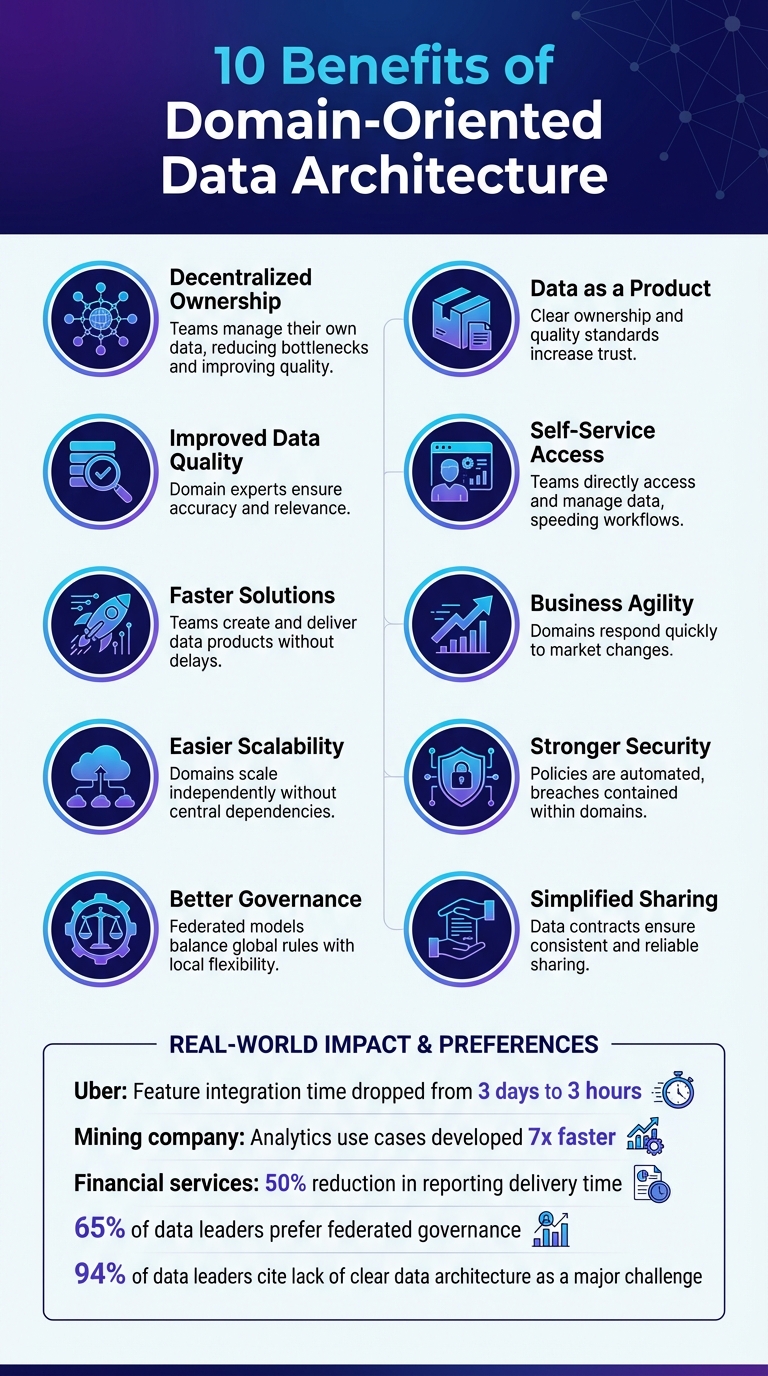
- Decentralized Ownership: Teams manage their own data, reducing bottlenecks and improving quality.
- Improved Data Quality: Domain experts ensure accuracy and relevance.
- Faster Solutions: Teams can create and deliver data products without delays.
- Easier Scalability: Domains scale independently without central dependencies.
- Better Governance: Federated models balance global rules with local flexibility.
- Data as a Product: Clear ownership and quality standards increase trust.
- Self-Service Access: Teams directly access and manage data, speeding workflows.
- Business Agility: Domains respond quickly to market changes.
- Stronger Security: Policies are automated, and breaches are contained within domains.
- Simplified Sharing: Data contracts ensure consistent and reliable sharing between domains.
This architecture empowers teams, reduces inefficiencies, and positions organizations for long-term success. Companies like Uber, PayPal, and Zalando have already seen massive improvements in speed, governance, and decision-making by adopting this model.
10 Key Benefits of Domain-Oriented Data Architecture
'Domain-driven Data Architecture'-Caleb Jones, Sr. Staff Software Architect, The Walt Disney Company
1. Decentralized Data Ownership
In traditional setups, a single centralized team is responsible for handling all data requests across an organization. While this might seem efficient on the surface, it often creates bottlenecks. IT and data engineers, who typically manage these requests, may lack the specific business context needed to define what qualifies as "good" data for different departments. This gap underscores the need for a more flexible approach that empowers those with domain expertise.
Decentralized data ownership flips this model by giving individual departments - like marketing or finance - control over their own data. These teams, being deeply familiar with their specific needs and goals, are better equipped to ensure the quality and relevance of their data. This autonomy not only streamlines processes but also leads to better overall data quality.
"The accountability of data quality shifts upstream as close to the source of the data as possible." – Zhamak Dehghani, Director of Emerging Technologies, Thoughtworks
This perspective highlights how moving responsibility to the source ensures data quality is managed where it matters most.
A great example of this approach in action comes from MuleSoft. In July 2025, the company implemented a decentralized model where each domain registered its data products in a central catalog. This clarified ownership and improved governance.
With this shift, the role of the central data team also evolved. Instead of acting as gatekeepers, they became platform providers, focusing on building self-service tools and infrastructure. These tools empower individual domains to manage their data quality independently. This transformation not only enhances efficiency but also sets the stage for the broader benefits discussed in the following sections.
2. Better Data Quality
Domain experts bring a level of deep, contextual understanding that centralized teams often lack. They know the ins and outs of their business processes, the true meaning behind data fields, and what qualifies as "good" data for their specific needs. This firsthand familiarity allows them to manage data with precision, reducing miscommunication and improving overall data quality more efficiently.
When centralized teams handle data, they face a significant challenge: interpreting business requirements and cleaning data without fully grasping its context. This can lead to misinterpretations, lost context, and errors that ripple throughout the organization. By adopting a domain-oriented architecture, this middle layer of interpretation is removed entirely, ensuring data stays accurate and aligned with business needs.
"Centralized data engineering teams don't always have all the information they need to make the best decisions about what constitutes 'good' data. Yielding these decisions back to the data domain owners results in better decision-making and better data quality." – Daniel Poppy, dbt Labs
A real-world example underscores the impact of this approach. In June 2023, a major mining company shifted from managing hundreds of siloed operational databases to implementing a decentralized data mesh. By empowering domain experts to take ownership of their data, the company was able to develop analytics use cases seven times faster than under their previous centralized model. They also saw noticeable improvements in data stability and reusability across the organization.
3. Faster Delivery of Data Solutions
When data teams are centralized, they often become bottlenecks, as departments have to wait in line for their data requests to be processed. This delay underscores the importance of a system where each team or domain can independently manage its data lifecycle without unnecessary back-and-forth.
A domain-oriented architecture changes the game by allowing teams to handle their data processes from start to finish. This approach removes the need for constant coordination between teams, significantly speeding up the delivery of data solutions.
Take Uber, for example. Between 2018 and 2020, their adoption of DOMA (Domain-Oriented Microservice Architecture) led to impressive results. Feature integration time dropped from three days to just three hours, and onboarding times were slashed by as much as 50%.
"Our goal with DOMA is to provide a way forward for organizations that want to reduce overall system complexity while maintaining the flexibility associated with microservice architectures." – Adam Gluck, Sr. Software Engineer II, Uber
This ability to deliver solutions faster directly contributes to greater agility across the organization. With self-service tools in place, domain teams can efficiently create and deploy data products on their own, cutting down dependencies and making the entire delivery process smoother and quicker.
4. Easier Scalability
As organizations grow, centralized data systems often struggle to keep up. A single data team managing everything can quickly become overwhelmed by the sheer volume of data sources and requests pouring in from various departments. These bottlenecks in workflow make it clear that a different approach is needed - one that allows teams to scale independently without being hindered by a central system.
This is where domain-oriented architecture steps in. By treating each domain as an independent deployment unit - the smallest unit capable of being deployed on its own - this approach allows teams to scale without dependency on others. For example, the marketing team can expand its data infrastructure without waiting on the central IT team or disrupting operations in the sales domain. On cloud infrastructure, this setup becomes even more flexible. Domain teams can add compute nodes as needed for specific tasks, scaling storage and processing power independently.
"Data mesh scales more effectively than a traditional framework because it does not require a centralized data engineering team to possess complete domain knowledge." – Snowflake
A real-world example of this approach is Uber. Between 2018 and 2020, Uber adopted Domain-Oriented Microservice Architecture (DOMA), organizing services into distinct domains. This shift allowed product teams to scale business lines like Rides, Eats, and Freight independently, all while significantly lowering platform support costs.
This distributed model empowers autonomous teams to work simultaneously, making scalability far more efficient. It eliminates the need for a complete platform overhaul, paving the way for better governance and greater autonomy in managing data products across domains.
5. Improved Data Governance
Improved governance goes hand-in-hand with autonomous data domains, creating standardized practices across teams. Traditional approaches to data governance often present a dilemma: centralized control can lead to delays, while decentralized management risks inconsistent data. Domain-oriented data architecture solves this with federated governance - a hybrid model. Here, a central authority sets non-negotiable rules for security, privacy, and compliance, while individual domain teams adapt these guidelines to their specific business needs. This approach lays the groundwork for automating policy enforcement.
With policy-as-code, governance rules are embedded directly into data pipelines, ensuring automatic enforcement during development. This means violations are flagged before data is even materialized. For instance, automated checks can identify sensitive data like PII and apply masking rules without requiring manual intervention. At the same time, domain teams retain the flexibility to set local governance parameters, such as specific data quality thresholds, as long as they align with enterprise-wide standards.
The benefits of federated governance are evident in real-world applications. Take TTCU Federal Credit Union, for example. By centralizing loan decision data while equipping branch teams with localized dashboards, they boosted loan processing from $400,000 per officer per month to $4 million per officer per month. Another success story is Autodesk, which adopted federated governance in 2021 to tackle a significant data backlog. This shift empowered 60 domain teams with complete visibility into their data products via a self-service interface.
"Federated data governance strikes a balance. It combines a central guiding structure with distributed, domain-level execution to achieve trust and compliance without compromising speed and scalability." – Daniel Poppy, dbt Labs
The trend toward hybrid governance models is gaining momentum. In fact, 65% of data leaders now prefer federated governance, and Gartner warns that without modern governance frameworks, 80% of digital organizations could face failure. By transitioning from a "gatekeeper" to an "enabler" role, central IT teams can offer self-service platforms and reusable templates. This empowers domain teams to develop compliant data products at their own pace, cutting time-to-insight from weeks to just hours.
sbb-itb-61a6e59
6. Data as a Product Approach
The shift to a domain-oriented architecture transforms data from being just a technical byproduct into a genuine product, complete with clear ownership and guaranteed quality. In this setup, each domain team takes responsibility for delivering high-quality, ready-to-use analytical data, treating internal consumers as valued customers.
Take this example: In 2023, a Fortune 500 oil and gas company adopted a self-service, distributed data architecture powered by dbt for data transformation. This move doubled the number of employees working on data modeling projects and slashed regulatory reporting time by three weeks. The result? A $10 million savings that was reinvested into the business. What drove this success was the establishment of clear Service Level Objectives (SLOs) focused on data quality, refresh frequency, and availability. These standards allowed downstream teams to trust the data and confidently build applications without constantly questioning its reliability. This approach naturally leads to defining what makes up a true data product.
For data to truly function as a product, it needs to meet specific criteria: it must be cataloged, uniquely identifiable, self-documented, meet defined SLOs, support native access through SQL or APIs, follow established standards, provide measurable value, and remain secure. Without these qualities, you’re likely just creating another data silo. As Daniel Poppy from dbt Labs aptly notes, "A data product that isn't discoverable and governed is just a data silo".
This product-focused mindset also shifts accountability upstream, closer to the data source. Zhamak Dehghani from Thoughtworks emphasizes, "The accountability of data quality shifts upstream as close to the source of the data as possible". By doing so, organizations can eliminate the bottleneck of centralized teams spending excessive time on data cleaning - a challenge that impacts 82% of enterprises and leaves 68% of enterprise data unanalyzed due to accessibility issues.
To implement a data-as-a-product strategy, start with specific business use cases, assign dedicated Data Product Owners, and establish measurable SLOs. For instance, a large mining company that adopted this strategy was able to develop analytics use cases seven times faster than before.
7. Self-Service Data Access
Expanding on decentralized ownership and improved data quality, self-service data access takes data management to the next level. It allows domain teams to access and manage their data directly, without having to wait for central IT to process every request. This speeds up workflows significantly. Self-service platforms simplify the technical side of things by hiding the complexities of the underlying infrastructure. Teams can create, manage, and share data products using familiar tools like SQL - no need to dive into the intricacies of storage systems or pipelines.
In this model, central IT's role shifts dramatically. Rather than processing every data request, IT becomes the backbone that provides the tools and infrastructure others rely on. Domain teams gain full control over their data lifecycle, from ingestion and transformation to analysis. This eliminates bottlenecks and builds on the foundation of decentralized ownership, giving teams the independence they need to operate efficiently.
For organizations to support this level of autonomy while staying compliant, three platform layers are essential: a data infrastructure provisioning layer to automate technical tasks, a data product developer experience layer to streamline creation and management, and a data mesh supervision layer to ensure governance standards are met automatically. With these layers in place, teams can provision their own data stacks instantly using Infrastructure as Code, all while maintaining security and compliance.
The challenge lies in finding the right balance between independence and accountability. Melissa Logan from Data Mesh Learning highlights this shift:
"By adopting a decentralized approach to data governance, [organizations shift] the role of governance from gatekeeper to facilitative force".
Domain teams register their data products in a central catalog and follow automated governance policies. However, they maintain control over their processes - no more waiting weeks for someone else to interpret their needs and deliver results.
8. Greater Business Agility
When domain teams manage their own data, they can pivot quickly without having to wait for IT to step in. In many cases, by the time centralized teams provide the requested data, market dynamics have already shifted, rendering those insights outdated. This setup allows companies to respond in real time to market changes, giving them a sharper competitive edge.
With a domain-oriented architecture, teams function more like nimble startups. They set their own priorities and swiftly release updated data products tailored to evolving business demands. Because each domain operates independently, one team’s progress isn’t hindered by another’s release schedules or lingering technical debt. This autonomy lets teams continuously refine their work and address shifting priorities on their own timeline.
Examples from the business world highlight this agility in action. PayPal handed over data ownership to domain-specific teams, transforming their platform and enabling faster decision-making across the board. Intuit allowed its domain teams to independently develop data products, leading to quicker iterations on machine learning features and sharper customer insights. Similarly, Zalando, a major European retailer, removed bottlenecks caused by a central data team. By fostering direct collaboration between data producers and consumers in areas like sales and logistics, they accelerated data-driven decisions across departments.
In one case, a financial services company achieved a 50% reduction in reporting delivery time after reorganizing around federated data domains.
"Data mesh flips the script from a centrally provisioned paradigm to a distributed, on-demand paradigm." - Major Phillips, Head of Data Engineering
9. Stronger Data Security
When domain teams manage their own data, they can implement security measures with a level of precision that centralized IT teams often can't match. Why? Because domain experts understand their data intimately. They know which datasets contain sensitive information, like personally identifiable information (PII), and who genuinely needs access to it. This deep understanding leads to more accurate security classifications and tighter access controls. And the best part? These security measures can be seamlessly integrated into automated, code-driven governance systems.
This architecture relies on federated computational governance, where security policies are embedded directly into code and automation, eliminating the need for manual approvals. At the organizational level, global security standards are established, but individual domains adapt and implement them according to their specific needs. This approach not only reduces human error but also ensures that compliance is automated and ongoing for all data products.
"Data mesh architectures enforce data security policies both within and between domains." - AWS
Another key advantage of this domain-oriented architecture is its ability to contain potential breaches. By organizing data into bounded contexts with clearly defined security boundaries, a breach in one domain doesn't automatically put the entire organization's data at risk. Each domain is responsible for tagging sensitive information at its source and establishing precise access rules through data contracts. These contracts spell out the security guarantees for data consumers, leaving no room for ambiguity.
Domain teams also have the agility to address compliance issues as they arise, underscoring the proactive nature of decentralized security. This approach highlights the critical role of a well-structured data architecture in maintaining security at scale. By aligning security practices with the specific needs of the business, domain-oriented architecture not only strengthens protection but also enhances the overall resilience of the organization.
10. Effective Data Sharing Between Domains
Domain-oriented architectures simplify data sharing by removing the bottlenecks typically found in centralized systems. Instead of relying on a single team to handle every data request, domains can exchange data directly using common interfaces and protocols. This setup allows each domain to maintain its independence while still making its data accessible to others.
At the heart of this approach are data contracts - formal agreements that define a domain's data guarantees. These contracts lay out details like schema, versioning, quality standards, and ownership. For instance, if the marketing team needs customer data from the sales team, the data contract ensures the information provided is consistent and reliable, without requiring marketing to understand the internal workings of the sales domain. These agreements streamline cross-domain data sharing and reduce friction.
The benefits of this model are evident in real-world examples. Zalando significantly sped up decision-making by enabling direct collaboration between data producers and consumers. Similarly, Delivery Hero eliminated regional silos by assigning responsibility for data products - such as those for restaurants, logistics, and marketing - to individual domains. Using a central platform for tools, they achieved real-time analytics across global operations. Another example comes from a financial services company that cut its reporting delivery time in half by restructuring around federated data domains with reusable data products.
To ensure smooth integration, a centralized data catalog plays a crucial role. While each domain operates independently, they register their data products in this shared catalog, making them easy to discover. This combination of autonomy and a centralized registry encourages collaboration and reuse, helping domains leverage each other's work instead of duplicating efforts. By blending independence with standardized sharing mechanisms, organizations can achieve both efficiency and cohesion in their data ecosystems.
Conclusion
Domain-oriented data architecture is changing the way organizations handle their data by addressing three key challenges: scalability, autonomy, and quality. Instead of relying on a central IT team - which often becomes a bottleneck - this approach shifts data ownership to the teams that know their data best. The result? Faster delivery, improved accuracy, and solutions that scale seamlessly. It’s a strategy that not only clears common roadblocks but also empowers domain-specific teams to take charge. As Zhamak Dehghani, the mind behind Data Mesh, puts it:
"My kind of value system puts responsibility on humans in saying, 'In fact, let's get the human in the loop to intentionally build data as a product to emit design and emit the right metadata to serve meaningful data'".
The results speak volumes. Companies adopting domain-oriented models have reported major improvements in reporting efficiency and delivery times. For example, 94% of data leaders say that lacking a clear data architecture is one of their biggest challenges. This highlights just how crucial a domain-oriented approach is for staying competitive. The evidence makes it clear - it’s time to move from theory to action.
The next step is practical application. Transitioning from concepts to real-world implementation requires hands-on experience with the tools and frameworks that make this architecture work. That’s where DataExpert.io Academy comes in. They offer specialized training programs designed to equip you with the skills you need. Whether you choose the $125/month All-Access Subscription or the 15-week Data and AI Engineering Challenge, you’ll gain experience with industry tools like Databricks, Snowflake, and AWS. The curriculum covers everything from defining domain boundaries and setting up data contracts to building self-service infrastructure and establishing federated governance. These are the building blocks for transforming your organization’s data strategy into a powerful, scalable system.
FAQs
How does a domain-oriented data architecture enhance data quality?
A domain-oriented data architecture improves data quality by giving specific domain teams ownership of the data. This means the people who work most closely with the data are responsible for managing it, creating a sense of accountability and ensuring quicker responses to issues. The result? Data that's more accurate, consistent, and trustworthy throughout the organization.
By decentralizing how data is managed, this approach allows teams to handle their unique data requirements more efficiently. This not only reduces errors but also strengthens the overall integrity of the data. In turn, organizations benefit from better decision-making and a smoother, more efficient data system.
How does decentralized ownership improve data security in domain-oriented data architecture?
Decentralized ownership enhances data security by putting domain teams in charge of their own data assets. These teams, being closest to the data, are better equipped to implement security measures like access controls and compliance protocols that align with their specific needs. This approach not only customizes security but also strengthens governance, reducing risks tied to centralized data storage.
Spreading data across multiple domains also lowers the chances of a single breach affecting all assets. Each domain can set detailed security policies and ensure proper auditing, while overarching guidelines maintain consistency throughout the organization. This blend of independence and centralized oversight encourages a security-first approach, tailored to the unique requirements of each domain.
What’s the best way for organizations to adopt a data-as-a-product approach?
To implement a data-as-a-product approach effectively, organizations need to focus on designing data products that align with specific use cases and cater to end-user needs. This begins with identifying concrete business challenges and working backward to define data products that directly address those issues. Each product should have clear boundaries and adhere to strict quality and accessibility standards.
A key step is assigning domain ownership. Teams responsible for particular domains should oversee the lifecycle, quality, and availability of their respective data products. This approach promotes accountability and ensures that domain experts manage the data. Using a decentralized framework, such as a data mesh, allows teams closest to the data sources to manage and deliver products more efficiently. This reduces bottlenecks and enhances flexibility.
Strong governance practices are also essential. Setting service level objectives (SLOs) helps maintain data quality and reliability. By starting with small, focused initiatives, iterating on use cases, and fostering collaboration across domains, organizations can create scalable, reliable data products that align with business objectives.