
Ultimate Guide to Data Engineer Salary Negotiations
Negotiating your salary as a data engineer is critical for long-term financial growth. Missing out on a single negotiation can cost you $500,000 to $1 million over your career. Yet, 60–70% of professionals accept the first offer without negotiating, leaving significant money on the table. On average, those who negotiate see a 15–20% increase in pay, with even a modest $5,000 raise at age 30 compounding to over $130,000 by retirement.
Here’s what you need to know:
- Market Research: Use tools like Levels.fyi to benchmark salaries. For example, a Google L4 Data Engineer earns a median total compensation of $307,000.
- Location Matters: Salaries vary widely by city. San Francisco leads with $278,000 median compensation, while Seattle follows at $250,000.
- Total Compensation: Look beyond base pay. Equity, bonuses, and benefits can significantly boost your earnings.
- Negotiation Tips: Start high, back your counteroffer with data, and focus on total compensation. If base salary isn’t flexible, negotiate for bonuses, equity, or PTO.
With demand for data engineers expected to grow 34% from 2024 to 2034, mastering negotiation and mastering data engineering are more important than ever. Even a small increase now can have a massive impact later.
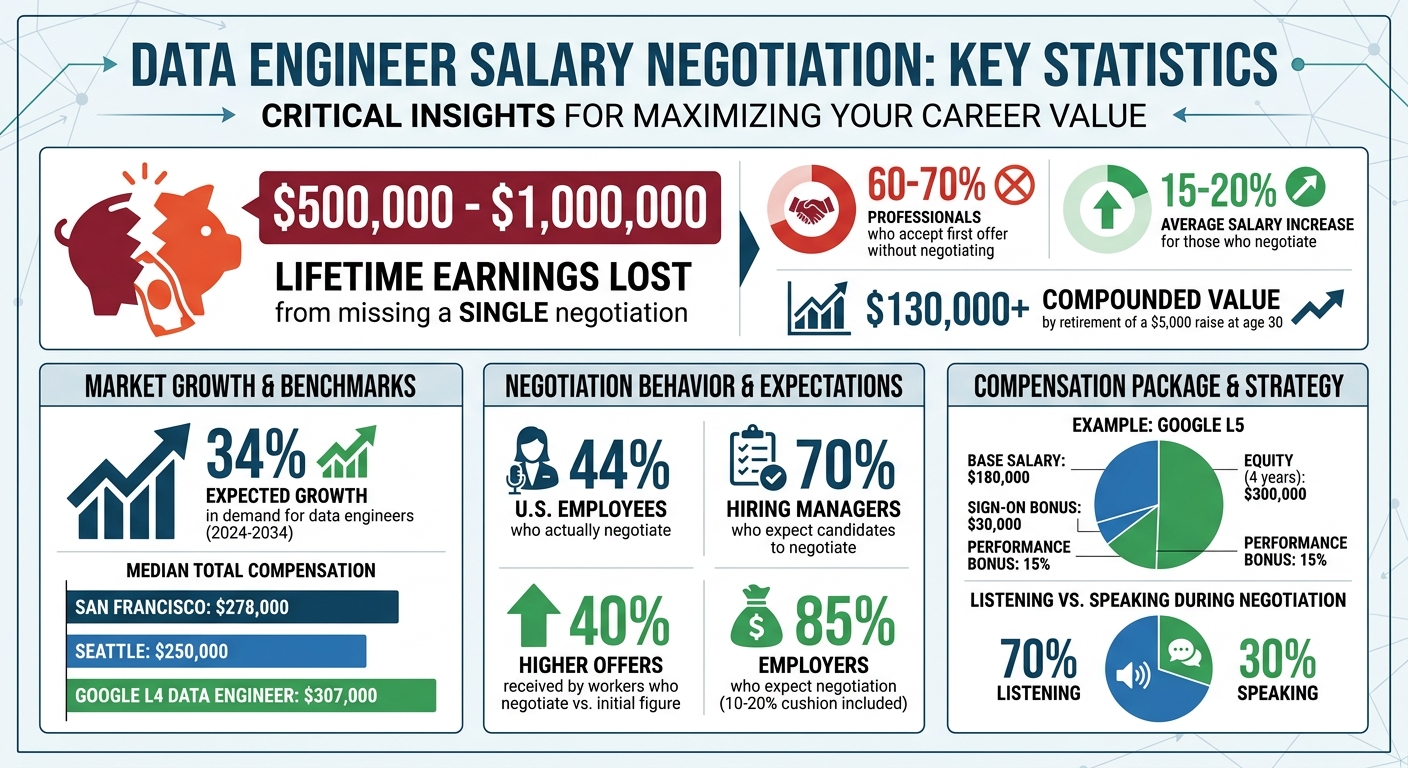
Data Engineer Salary Negotiation Statistics and Impact
The Negotiation Framework That Doubled My Data Engineer Income
sbb-itb-61a6e59
Research and Preparation Before Negotiating
Starting a salary negotiation without preparation is like walking into a test without studying. Solid research and understanding your worth are the foundation for success.
How to Research Market Salaries and Industry Benchmarks
If you're wondering how to figure out what data engineers actually earn, Levels.fyi is an excellent resource. It offers real-time, crowdsourced compensation data that's updated daily, breaking down total pay into base salary, stock grants, and bonuses. For example, a Level L4 Data Engineer at Google earns a median total compensation of $307,000, which includes base pay, stock, and bonuses.
Where you live also plays a huge role. Median pay can differ by over $80,000 depending on the metro area. The San Francisco Bay Area leads the pack with a median total compensation of $278,000, followed by Seattle at $250,000. Levels.fyi also has a standardized leveling framework to help you compare your experience to company-specific titles. Plus, if you contribute your salary data anonymously, you can unlock tools that show company rankings and percentile benchmarks for various roles.
"Compensation information was opaque and difficult to compare. Today, millions of professionals rely on shared salary data... to better understand pay across roles, companies, and levels." - Levels.fyi Team
And it’s not just about data; it’s about results. One data engineer used Levels.fyi's negotiation coaching service and walked away with a $78,000 increase in their total package.
With this kind of market insight, you’ll be better equipped to quantify your value and negotiate effectively.
Identifying Your Skills and Experience That Add Value
Your ability to negotiate hinges on how well you can demonstrate your value. Focus on measurable results. For example, highlight how your work improved uptime, sped up queries, or cut cloud costs. If you have expertise in high-demand areas like AWS, GCP, Azure, or tools like Kafka and Flink, you’re already in a great position to command higher offers.
The jump from mid-level to senior roles (usually after 5–7 years of experience) is where salaries see the biggest leap. Employers at this level look for proof that you’ve made architectural decisions and overseen entire systems. Certifications like AWS Data Engineer or Databricks can also help you stand out and secure higher-paying roles. If you’re moving from an internal role or consulting, emphasize how you can hit the ground running with minimal onboarding.
"Lead with numbers - it's what data engineers do." - Careery Team
Interestingly, workers who negotiate often receive offers nearly 40% higher than the initial figure. Yet, only 44% of U.S. employees negotiate, even though 70% of hiring managers expect it. During negotiations, aim to listen 70% of the time and speak 30%.
Once you’ve assessed your skills and market worth, it’s time to set your salary expectations.
Setting Your Target Salary and Minimum Acceptable Offer
Start by defining a three-tier salary range: your aspirational high, a target midpoint, and a non-negotiable minimum. For mid-career data engineers in 2026, base salaries range from $120,000 to $134,000. Meanwhile, senior engineers at FAANG-level companies can earn total compensation packages exceeding $200,000, with some reaching between $250,000 and $350,000.
Remember, it’s not just about the base salary. Base pay typically accounts for 60–80% of your total compensation, with the rest coming from bonuses and equity. Remote roles often pay more, averaging $148,600, which can surpass local rates in mid-tier cities. Be ready to adjust your expectations by balancing salary, equity, and bonuses to reach your desired total compensation.
"Lead with your aspirational number, not your target - anchoring high gives you room to compromise toward your true goal." - NexTool
If asked about your salary expectations early in the process, deflect by asking for the budgeted range for the role or explain that you need more details about the responsibilities before answering. Always take time to review offers and compare them against your research. Skipping the negotiation step can cost you over $1 million in lifetime earnings due to the compounding effect of raises and benefits.
For those wanting to sharpen their negotiation skills even further, resources like DataExpert.io Academy offer specialized training to help you prepare for these critical discussions.
Understanding the Full Compensation Package
When you’re evaluating a job offer, it’s important to look beyond the base salary. That top-line number is just one part of the equation. A full compensation package includes several components, and understanding each one is key to making informed decisions and negotiating effectively.
What's Included in a Data Engineer Compensation Package
At its core, your compensation package will include a base salary, but it’s the additional components like bonuses, equity, and benefits that can significantly boost your total earnings. For instance, at companies like Google, the numbers can be impressive. A Senior Data Engineer (L5) at Google might earn $180,000 as a base salary, supplemented by $300,000 in equity over four years, a $30,000 sign-on bonus, and a 15% performance bonus. Staff Engineers (L6) see even higher packages, with $215,000 in base pay, $500,000 in equity over four years, a $40,000 sign-on bonus, and a 20% performance bonus.
- Performance bonuses are typically paid annually or quarterly and range from 5% to 30% of your base salary, depending on your level. For example, Google offers 15% for L4/L5, 20% for L6, and 25% for L7.
- Equity grants come in two main forms: Restricted Stock Units (RSUs) and Stock Options. RSUs are common at public companies and function like shares, while Stock Options allow you to buy shares at a set price. At major tech firms, annual equity grants can range from $60,000 to over $100,000 on top of your base pay. Google’s equity vesting schedule is front-loaded: 33% in years one and two, 22% in year three, and 12% in year four. Keep in mind that equity grants often have a one-year "cliff", meaning you forfeit them if you leave the company within the first year.
- Sign-on bonuses are one-time payments designed to attract talent or compensate for lost equity from a previous employer. However, these often come with clawback clauses if you leave within a year.
Beyond cash and equity, companies may offer other perks like professional development budgets for data engineering certifications (e.g., AWS, Azure, or Databricks), enhanced retirement contributions (7–10% matching), private health insurance, and work-life perks such as remote work options or home office stipends.
"66% of American workers fail to negotiate pay, but 100% of employers lowball on the first offer." - CIO
Which Parts of Your Offer Are Easiest to Negotiate
Not every part of your offer is equally flexible. Base salary tends to have the least room for negotiation because companies operate within strict pay bands. However, other components like sign-on bonuses, equity grants, and additional paid time off (PTO) can be more negotiable.
- Sign-on bonuses are often the easiest to negotiate. Since they’re a one-time expense, they don’t affect a company’s long-term payroll budget. If a company can’t meet your base salary expectations, a higher sign-on bonus can help bridge the gap in first-year compensation.
- Equity grants are another area where companies might be flexible, especially startups that prefer offering stock over cash due to accounting advantages.
- Non-monetary benefits, such as flexible work schedules or professional development opportunities, are also worth negotiating. For data engineers, perks like on-call stipends or extra time off for system monitoring responsibilities can add significant value to your total package.
Interestingly, nearly two-thirds of people who negotiate benefits beyond base salary report getting at least part of what they asked for. Yet, only 44% of U.S. employees actually negotiate their salary.
"Companies will never rescind your offer for simply negotiating." - Exponent
How to Compare Multiple Job Offers Side by Side
Once you’ve received offers, it’s time to evaluate them thoroughly. Focus on total compensation (TC) rather than just the base salary. A simple spreadsheet can help you compare offers side by side, listing elements like base salary, bonuses, annual equity value (total equity divided by four), sign-on bonuses, and 401(k) matching.
Equity value can vary based on the company’s stage:
- At public companies, RSUs are often treated like cash but are subject to market fluctuations, typically valued at 80–90% of their quoted value.
- Equity at pre-IPO startups may be valued at 60–90%, depending on how close they are to liquidity.
- Early-stage startups carry more risk, and their equity should be viewed as a "lottery ticket" with no guaranteed value. In these cases, ensure your base salary is enough to cover your living expenses.
Leveling also plays a major role in compensation. A "Senior" title at one company might equate to a "Staff" level at another, which can significantly impact salary bands. In states like California and New York, you have the right to request salary ranges for positions, so don’t hesitate to ask.
Don’t forget to factor in "hidden" benefits like home office stipends, healthcare premium offsets, and PTO. Location also matters - if you’re earning a San Francisco-level salary while living in a lower-cost city like Austin, your purchasing power can increase by $20,000–$30,000 annually.
Negotiating your starting compensation is worth the effort. On average, tech professionals who negotiate see an 18.83% increase in pay compared to those who accept the first offer. Over five years, this can add up to more than $150,000 in additional earnings due to compounding raises and bonuses.
"The recruiter marks the req as filled... and the $15K that was budgeted for negotiation just quietly goes back into the department pool." - Gregg Flecke, Senior Talent Acquisition Partner, KORE1
How to Negotiate Your Salary Effectively
Preparation is key when entering a salary negotiation. Here's an encouraging fact: 85% of employers expect candidates to negotiate and often include a 10–20% cushion in their initial offers. Yet, a surprising 63% of workers accept the first offer without pushing back. This decision can have a long-term impact, potentially costing between $1 million and $1.5 million in lifetime earnings due to the compounding effects on raises and bonuses.
Starting with a Strong Number and Explaining Your Worth
Before entering negotiations, it’s essential to determine three key figures: your Target (75th percentile), Minimum (50th percentile), and Walk-away point. Tools like Levels.fyi, Glassdoor, and the Bureau of Labor Statistics can help you research salary benchmarks based on your role and location.
When you receive a verbal offer, avoid negotiating on the spot. Instead, ask for 24–72 hours to review the full package in writing. This pause not only gives you time to evaluate the offer but also demonstrates that you’re thoughtful and serious. When you respond, express enthusiasm for the role and team - this frames the negotiation as a partnership rather than a confrontation.
If the employer shares a starting number, use it as an anchor. But if you’re asked to propose a range, make sure your target is the lower end. For example, if you’re aiming for $150,000, suggest a range like "$150,000–$170,000". When countering, aim for 10–20% above the initial offer and back it up with data. For instance, you could say: "Based on Levels.fyi data for Data Engineers in San Francisco with four years of experience, the 75th percentile is $165,000".
Once you’ve made your counteroffer, stay silent and wait for a response. If the base salary isn’t negotiable, shift focus to other elements of the package - often called the "concession stack." These might include signing bonuses, equity, extra PTO, or an accelerated six-month performance review.
"Negotiation is not a one-time event - it's a permanent baseline adjustment that multiplies across every future compensation decision."
– Careery Blog
If you have competing offers, use them to strengthen your position.
Using Other Job Offers to Improve Your Negotiation
A competing offer can be one of your strongest tools. It serves as your Best Alternative to a Negotiated Agreement (BATNA), giving you leverage and the confidence to walk away if your expectations aren’t met. Competing offers create urgency, often prompting employers to work harder to secure your acceptance.
Be honest about other offers to maintain trust. When bringing it up, frame it as a validation of your market value rather than a threat. For example, you could say:
"I’ve received another offer, but I’m genuinely excited about your company’s mission. Is there a way we can bridge the gap?"
If the base salary is fixed, use the competing offer to negotiate for other benefits. Employers often have more flexibility with non-salary components like signing bonuses, equity, or additional PTO. Even without a formal competing offer, a strong personal brand that attracts recruiter interest can serve as an implied alternative.
Sample Scripts for Common Negotiation Situations
Having the right words ready can help you navigate tricky moments. Here are some adaptable scripts for common scenarios:
-
When asked about salary expectations early in the process:
"I’m focused on finding the right fit and understanding the role’s full scope. Once I know more about the responsibilities and compensation package, I’d be happy to discuss a range. What is the budgeted range for this position?" -
When you need time to review an offer:
"Thank you for the offer. Could I have a day to review it?" -
When making a data-backed counteroffer:
"I’m excited about joining. Based on my [X years of experience/specialized skills in pipeline optimization] and market rates for similar roles, I was hoping we could discuss a base salary of $X. Is there flexibility here?" -
When explaining your value with proof:
"I’m confident I can deliver [specific outcome] because I’ve already done [proof]. For example, I saved my previous company $200,000 by optimizing our data pipeline and reducing cloud compute costs by 15%." -
When referencing a competing offer:
"I have a competing offer. I’m especially drawn to your team because [reason], but the other offer is significantly higher. Is there any possibility of matching or coming closer to that number?" -
When the base salary is firm:
"I understand the base salary is fixed. Could we explore other aspects of the compensation package, such as a sign-on bonus, equity, or an accelerated performance review at the six-month mark?"
Practice these scripts out loud or use AI tools to roleplay scenarios. Rehearsing responses to common objections - like "That’s above our budget" or "Our pay bands are fixed" - can boost your confidence and help you stay composed during the actual conversation.
"A candidate who negotiates professionally and with evidence signals self-awareness, preparation, and the ability to hold a difficult but important conversation - qualities that are highly valued."
– inkeybit
For more resources to refine your negotiation and data engineering skills, check out DataExpert.io Academy.
Common Mistakes and Advanced Negotiation Techniques
Mistakes That Can Hurt Your Negotiation
One mistake many data engineers make during salary discussions is focusing solely on the base salary while neglecting other parts of the compensation package. Elements like equity, bonuses, sign-on incentives, and benefits can add significant value to an offer, yet they’re often overlooked. Another common misstep is revealing your current salary or suggesting a number too early in the process. Doing so can unintentionally cap your potential offer before you even understand the employer's range.
It’s also important to avoid making quick decisions on the spot. If you receive an offer over the phone, ask for 24–48 hours to review it in writing. While 70% of hiring managers expect candidates to negotiate, nearly 60% of workers still accept the initial offer without pushing back. Rushing to respond can lead to missed opportunities and poorly thought-out agreements.
Be mindful of how you communicate. Apologetic language can weaken your stance. Relying exclusively on email may limit your ability to interpret tone or respond dynamically, and fabricating competing offers can destroy trust, potentially leading to a withdrawn offer. Lastly, failing to negotiate your starting salary can lock you into a lower baseline, which can have long-term financial consequences throughout your career.
Advanced Methods to Increase Your Total Compensation
Once you’ve sidestepped these common pitfalls, you can focus on strategies to maximize your overall compensation. If the base salary is non-negotiable, shift your attention to other areas like sign-on bonuses, equity, or performance-based incentives. Equity options - such as stock options, Restricted Stock Units (RSUs), or equity refresh grants - can provide substantial long-term benefits. Sign-on bonuses can also help bridge gaps, such as unvested equity you’re leaving behind at a previous job.
You can also negotiate performance-based bonuses tied to specific technical achievements. For instance, bonuses could be linked to deploying a data lake, meeting uptime goals, or implementing streaming pipelines. These bonuses often range between 5% and 30% of your base salary. Additionally, consider discussing on-call stipends if your role involves managing 24/7 systems. If the salary budget is fixed, you might request a title bump (e.g., from "Data Engineer" to "Senior Data Engineer") or ask for an accelerated performance review after 90 days instead of waiting for the usual annual cycle.
Building Skills to Strengthen Your Negotiating Position
Improving your skills and showcasing measurable achievements can significantly boost your negotiating leverage. Highlight quantifiable results, such as reducing cloud costs by 15% through pipeline optimization, to demonstrate your value.
Ongoing skill development is equally crucial. Programs like those offered by DataExpert.io Academy provide practical training in data engineering, analytics, and AI. These boot camps include hands-on projects, exposure to tools like Databricks, Snowflake, and AWS, and career development resources. Guest speaker sessions and capstone projects further enhance both your technical skills and confidence.
In addition to formal training, building a portfolio of side projects, earning certifications, and staying active in professional communities can provide real-time salary insights and bolster your position during negotiations. By combining these efforts, you’ll not only strengthen your expertise but also position yourself as a highly valuable candidate.
Conclusion
Successfully negotiating a data engineering salary starts with solid preparation. Tap into resources like Levels.fyi, Glassdoor, and Payscale to research market benchmarks. Before entering discussions, define three key figures: your walk-away point, a realistic target, and an ambitious opening offer. This structured, data-backed approach not only helps you set realistic expectations but also gives you the confidence to advocate for your value effectively.
"Your preparation determines your confidence, and your confidence determines your outcome." - inkeybit
Beyond preparation, effective communication is crucial. Treat the negotiation as a professional dialogue rather than a confrontation. Whenever possible, opt for phone or video calls over email to establish rapport and better interpret tone. Once you receive a written offer, take 24 to 48 hours to review the details. Then, present your case with concrete examples - such as metrics showing revenue growth or successful project outcomes - to justify your salary request.
Skipping salary negotiations can cost you big - over $1 million in lifetime earnings when you account for compounded raises, 401(k) matches, and investment returns. Plus, 70% of employers expect candidates to negotiate. A reasonable counter-offer typically falls between 10% and 20% above the initial offer.
Finally, continuously breaking into data engineering and building your skills strengthens your position for future negotiations. Programs like DataExpert.io Academy offer hands-on training in data engineering, analytics, and AI while providing career development tools to boost both technical skills and confidence. Building a project portfolio, earning certifications, and engaging in professional communities not only keep you informed about salary trends but also demonstrate your commitment to growing in your field.
FAQs
When should I negotiate during the hiring process?
You should negotiate after receiving the initial job offer but before accepting it. This timing gives you the strongest position to discuss salary, benefits, and other forms of compensation. It's your opportunity to emphasize the value you bring and use market data to back up your requests. By doing this before formally agreeing, you can aim for the best package possible.
How do I decide my walk-away number?
To figure out your walk-away number, start by researching your market value. Use tools like salary comparison websites, industry reports, and geographic salary benchmarks to get a clear picture of what others in similar roles are earning. From there, set a target salary that feels realistic but reflects your worth. At the same time, define the absolute minimum offer you'd consider - one that aligns with your financial needs and professional value. This approach helps you avoid selling yourself short and ensures you're ready for negotiations, as employers typically anticipate some back-and-forth.
How do I value equity in a job offer?
Valuing equity requires a clear understanding of several important factors. The percentage of equity you’re offered often ties back to the company’s most recent funding valuation, but keep in mind that this figure might not fully represent the company’s current value.
You’ll also need to consider the type of stock options being offered - Non-Qualified Stock Options (NSOs) or Incentive Stock Options (ISOs) - as they come with different tax rules and benefits. Other key points include the exercise window (how long you have to purchase shares after leaving the company), potential tax liabilities, and the impact of future funding rounds, which can dilute your equity.
By carefully evaluating these elements, you’ll gain a more realistic understanding of how your equity fits into your overall compensation package.