
Modern Data Stack 2026: Tools, Trends, Roadmap
My advice for a modern data stack in 2026: start with batch pipelines, clear ownership, and a budget - not more tools. Set measurable targets, such as a daily report delivered by 6:00 a.m. Eastern Time, then choose the tools that meet them.
Here’s how I’d plan the stack:
- Choose the platform: Compare Snowflake and Databricks on SQL reporting, data science, concurrency, governance, team skills, and total cost. Use both only when the workload warrants it.
- Define data boundaries: Check Iceberg or Delta Lake support across storage, engines, catalogs, permissions, reads, and writes.
- Build reliable pipelines: Match batch, micro-batch, or streaming to the required delay. Use dbt for SQL models and tests; add Airflow for cross-system scheduling.
- Set controls before launch: Put contracts, code review, access rules, lineage, monitoring, and recovery tests in place.
- Track spending and test AI: Measure cost per completed task. Add retrieval, features, or agents only with permission checks, quality tests, and spending limits.
My rollout order is simple: batch first, governance next, streaming when needed, and AI after testing. <u>Expand only when results justify the added cost and work.</u>
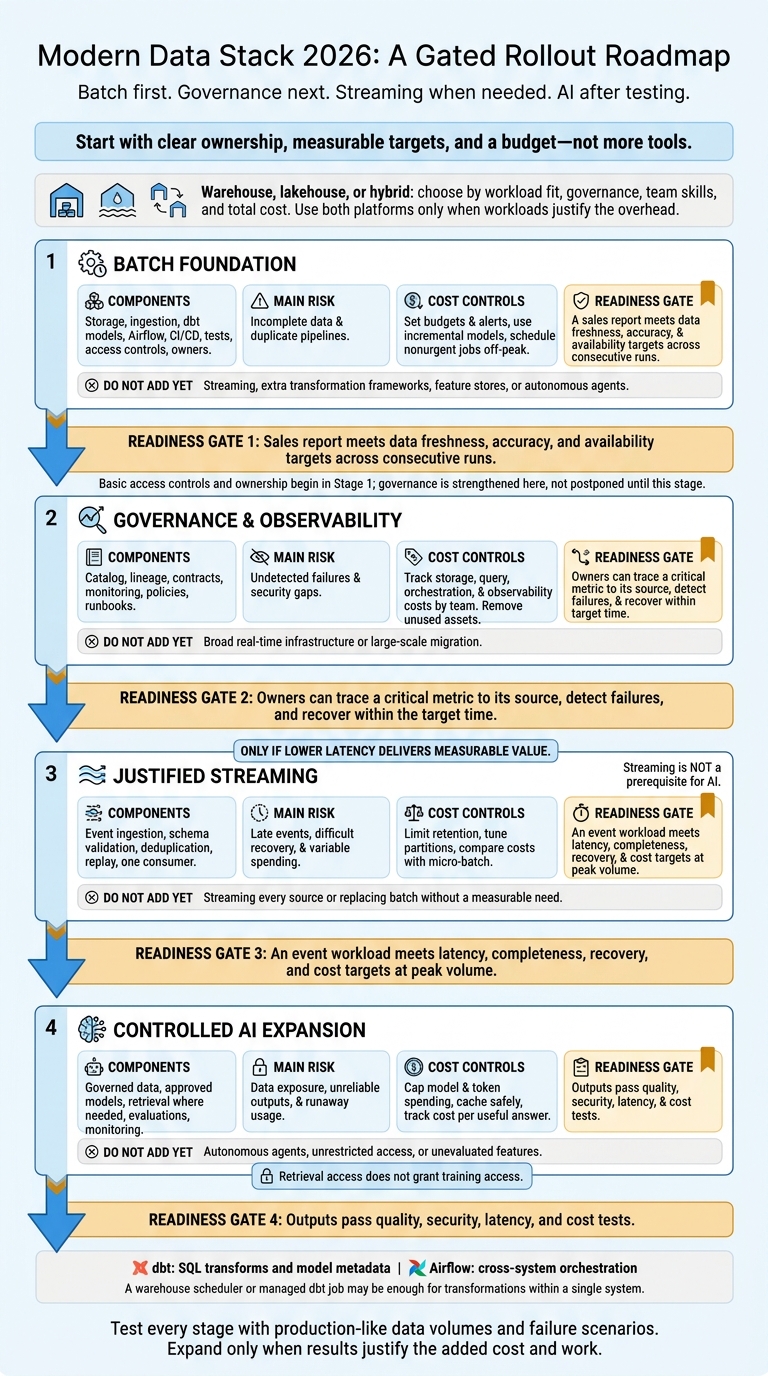
Modern Data Stack 2026: A Gated Rollout Roadmap
Choose a Warehouse, Lakehouse, or Hybrid
Choose hybrid only when separating workloads justifies running two platforms. Use this matrix to weigh your workload mix, governance needs, and team capacity.
| Decision area | Warehouse-first | Lakehouse-first | Hybrid |
|---|---|---|---|
| BI concurrency | Separate SQL compute can isolate reporting workloads; benchmark concurrent queries. | Test SQL serving concurrency alongside engineering workloads. | Assign a serving platform to each workload. |
| Data science | Fits SQL-centered analytics. | Fits Spark processing, feature engineering, and ML. | Keep training near authoritative data; publish only governed outputs. |
| Storage location | Managed storage with separate compute. | Object-storage-based storage, commonly using Delta Lake. | Define one authoritative storage location per dataset. |
| Interoperability | Check sharing, external access, and catalog support. | Check engine, format, and catalog compatibility. | Test writes and policy enforcement - not just reads. |
| Cloud strategy | Confirm availability for your required cloud, region, and features. | Confirm storage, compute, and catalog support. | Estimate cross-region and cross-cloud transfers. |
| Team capacity | Less infrastructure administration; SQL and governance skills still matter. | Requires pipeline, table-layout, and processing expertise. | Requires operations and monitoring across both platforms. |
If you narrow the choice to two platforms, compare workload fit, not branding.
Compare Snowflake and Databricks
Snowflake separates storage, compute, and cloud services for managed analytics. Databricks combines object-storage-based lakehouses with Spark, SQL, ML, and AI engineering. Your workload mix, governance needs, and operating model should guide the choice.
Check BI concurrency, data science, governance, and team capacity against your business requirements. Specialized training through a data engineering academy can help bridge these skills gaps.
| Dimension | Snowflake | Databricks | Combined use |
|---|---|---|---|
| Workloads | Managed analytics and governed sharing | Data engineering, analytics, ML, and AI | Separate workloads where testing shows value |
| BI concurrency | Elastic compute warehouses isolate workloads and scale with demand | Test SQL concurrency and isolation against your query profile | Route workloads by latency and concurrency targets |
| Data science and AI | Analytics on structured, semi-structured, and unstructured data | Spark, ML, and AI engineering on object storage | Use governed exchange with one authoritative data layer |
| Storage | Managed platform storage | Object-storage-based storage, commonly using Delta Lake | Keep raw and large-scale analytical data in one primary layer |
| SQL | Managed SQL experience | SQL analytics alongside Spark workloads | Match SQL and Spark to workloads and team skills |
| Streaming | Test the chosen ingestion and processing design | Batch and streaming lakehouse patterns | Define one authoritative platform for streaming tables |
| Governance | Account-level sharing and platform governance | Unity Catalog provides fine-grained governance and lineage for data and AI | Establish one policy authority or tightly mapped controls |
| Interoperability | Sharing and external access; assess transfer and request costs | Sharing of data and AI assets; open lakehouse technologies | Test formats, catalogs, permissions, and cross-cloud access |
| Maintenance | Managed service reduces infrastructure administration | Managed platform; Spark, file layout, and pipelines still need tuning | Adds integration, monitoring, and policy overhead |
For a useful cost comparison, use the same region, contract, and workload assumptions. Compare Snowflake compute, storage, and transfer costs with Databricks workload, infrastructure, storage, and transfer costs.
If you split workloads across platforms, table formats and boundary rules determine whether you can keep governance under control.
Choose Table Formats and Define Hybrid Boundaries
A table format defines data-file organization, transactions, snapshots, schema changes, and partition evolution. A compute engine reads and writes those tables. A catalog manages discovery, namespaces, permissions, and lineage. Apache Iceberg or Delta Lake alone does not define permissions or guarantee engine compatibility.
Compare formats against the cross-platform reads, writes, and catalog controls your hybrid design needs.
| Capability | Apache Iceberg | Delta Lake |
|---|---|---|
| Transactions | Snapshot-based operations and consistent table states | ACID transactions and transaction history |
| Schema evolution | Add, drop, rename, and supported type widening | Schema enforcement and evolution depend on engine and configuration |
| Time travel | Reproducible queries against historical snapshots | Time travel and versioning |
| Engine read/write support | Official docs list Spark, Trino, PrestoDB, Flink, Hive, and Impala integrations; verify the exact operations for your chosen release. | Strongest documented fit is Databricks and Spark-based lakehouse workloads; verify other readers and writers for your chosen version. |
| Governance | Supplied by the selected catalog and platform | Commonly paired with Unity Catalog in Databricks |
| Interoperability limit | An integration listing does not prove full write support | Migration does not prove bidirectional parity. |
For each hybrid dataset, record its owner, storage, format, catalog, readers, writers, retention, SLA, and replication rule. Prefer governed sharing or external-table access when it meets latency and security requirements. Justify replicated copies, and price storage duplication and egress separately.
Before launch, test inserts, updates, deletes, merges, schema changes, recovery, and policy enforcement across the boundary.
With storage boundaries set, define how data moves and transforms across them.
sbb-itb-61a6e59
Plan Ingestion, Transformation, and Orchestration
Compare Batch, Micro-Batch, and Streaming
| Pattern | Update frequency | Complexity and cost | Recovery | Best-fit workloads |
|---|---|---|---|---|
| Batch ELT | Hourly or daily | Usually the lowest operating overhead | Rerun date ranges from retained raw inputs; use safe merges or partition replacement | Financial reports, scheduled analytics |
| Micro-batch | Every 1–15 minutes for operational dashboards | Moderate; incremental processing and checkpoints need monitoring | Resume from checkpoints or replay offsets; handle late-arriving records | Operational dashboards, frequent warehouse updates |
| Continuous streaming | Seconds to sub-minute | Higher monitoring and state-management overhead | Replay retained events and rebuild state; deduplicate external effects | Inventory alerts and other time-sensitive actions |
Once storage boundaries are set, choose how often processing runs. Batch ELT loads data first, then transforms it. CDC captures database inserts, updates, and deletes, but doesn't set the downstream processing cadence. Kafka transports and retains events. Spark Structured Streaming processes them in micro-batches, with checkpointing and event-time handling.
- Financial report: Ingest hourly, close at 6:00 a.m. ET, upsert by transaction ID and source update timestamp, and restate late transactions.
- Inventory alerts: Use Kafka and Spark Structured Streaming with unique event IDs, SKU-warehouse keys, a lateness window, and idempotent alert delivery.
Checkpointing does not guarantee exactly-once webhook delivery. Delivery needs its own idempotency key.
With cadence set, use orchestration to make reruns, checkpoints, and alerts deterministic.
Define the Roles of dbt and Airflow
| Responsibility | dbt | Apache Airflow |
|---|---|---|
| Execution | Transformation models in the warehouse or lakehouse | Task scheduling across systems |
| Dependencies | Model-to-model dependencies | Ingestion, dbt, Spark, checks, and publishing |
| Testing | Model tests and data-quality checks | Check execution and downstream gates |
| Documentation and lineage | Model documentation and transformation lineage | Workflow dependencies; broader lineage through integrations |
| Backfills | Selected models or incremental ranges | Historical task runs and retries |
| Ownership | Analytics engineers | Data or platform engineers |
Keep model logic in dbt and cross-system orchestration in Airflow. Airflow can wait for an extract, load raw data, invoke dbt, launch Spark, enforce quality gates, and trigger publishing. This split keeps model logic stable while workflow control handles retries and dependencies.
Retries are safest when the underlying writes are idempotent. For transformations within a single system, a warehouse scheduler or managed dbt job may be enough.
Set Data Contracts and CI/CD Rules
After orchestration, define each interface before release. These rules connect pipeline execution to governed data that people and AI systems can trust.
Make each interface explicit: name its owner, schema, keys, timestamp meanings, delivery deadline, retention, and accepted null and duplicate rates. Specify whether inventory quantities are absolute values or deltas, how corrections arrive, and which records enter quarantine.
Version breaking changes, notify consumers, and agree on a migration window. Keep the previous contract available until dependent workloads migrate, and validate staged output before publishing it.
Keep contracts, dbt models, Airflow DAGs, Spark code, and configs in Git. Before deployment, require review, SQL compilation and linting, unit and data tests, schema checks, DAG import tests, and integration tests.
Separate development, staging, and production credentials and datasets. Require approval for breaking changes and high-risk backfills. Parameterize runs by date or event range, estimate backfill cost, and test in isolation.
Record the deployed commit and rehearse recovery through raw-data replay or a switch to the last known-good dataset. Code rollback alone does not repair written data.
Manage Governance, Costs, and AI Workloads
Connect Metadata, Access Controls, and Monitoring
Name owners before production. Assign dataset, pipeline, domain, and business owners. Link catalog schemas, classifications, timestamps, and lineage to business definitions and certified semantic metrics. Then connect the catalog to identity and access-management systems so permissions reflect data classifications and organizational roles.
dbt MetricFlow can store shared metric definitions, while orchestration logs document execution. Keep human, service-account, analyst, application, retrieval, training, and model-serving identities separate. Using a vector database or an agent framework should not give an AI system broader access.
Check data age, row counts, volume ranges, schema changes, null rates, uniqueness, referential integrity, and reconciliation totals across systems. dbt source definitions can support lineage, source tests, and freshness checks; a failed freshness check can stop downstream models from running.
Route alerts to the people who can act: source-freshness alerts go to ingestion owners, transformation-test alerts to analytics engineering, warehouse-capacity alerts to the platform team, and metric anomalies to the business owner.
| Check or control | Implementation and evidence | Owner and consumer impact |
|---|---|---|
| Data age | Catalog freshness targets, dbt source-freshness results, and orchestration run times | Ingestion owner investigates; downstream consumers are blocked when required |
| Volume and distributions | Expected ranges in catalog metadata, row counts in job logs, and null-rate, uniqueness, and distribution tests | Analytics engineering investigates; downstream models and retrieval indexes stay blocked until approval |
| Schema drift and referential integrity | Versioned schemas, dbt dependencies and relationship tests, deployment logs, and reconciliation checks | Dataset owner approves changes; features and embeddings are rebuilt only after validation |
| Least privilege and PII protection | Separate human and service identities; role permissions, masking, and row-level security; catalog PII tags and retention rules | Security and dataset owners approve access, including retrieval, training, and serving |
| Encryption and audits | Encryption in transit and at rest, access logs, configuration history, and policy checks | Platform and security owners review privileged activity and preserve audit records |
| Certified metrics | Semantic definitions linked to source lineage, dbt artifacts, and quality results | Business owner approves meaning; analysts and agents use the same approved definitions |
Track and Control Stack Costs
Separate production workloads from ad hoc queries and AI experiments. Right-size compute, cap autoscaling, and turn on auto-suspend where supported. Check query history for repeated scans. Select only the columns needed, partition or cluster suitable tables, and use incremental processing where safe.
Choose materializations with costs in mind: views save storage but may repeat compute, while tables add storage and refresh costs. Set retention periods for staging data, logs, features, and vector indexes without losing required recovery history.
For a hypothetical $5,000 monthly budget, allocate:
- $2,000 to compute
- $500 to storage
- $250 to egress and networking
- $750 to licenses and managed services
- $1,500 to platform engineering time
Attribute spending by team, workload, environment, and pipeline. Track actual costs and forecasts alongside unit metrics: cost per successful pipeline run, refreshed dashboard, and completed retrieval task. Set alerts at 70%, 85%, and 100% of budget, and investigate increases before cutting service levels.
Set Requirements for AI Workloads
Reuse governed data instead of creating an untracked AI copy. Each workload needs its own checks:
- Feature pipelines: Point-in-time joins, leakage checks, freshness, and training-serving consistency.
- Vector search: Clean chunks, source IDs, embedding versions, deletion handling, and relevance tests.
- RAG: Authoritative sources and citations or provenance.
- Agents: Bounded tools and approval gates for actions with material effects.
- Model serving: Versioned artifacts, input validation, drift monitoring, and rollback.
Carry source permissions into retrieval, authorize access before assembling context, and recheck cached results. Training access requires explicit approval; retrieval access does not grant it.
Treat AI-assisted SQL and pipeline code as untrusted drafts. Require automated tests, nonproduction execution, and qualified human review, including checks for full-table scans, PII exposure, and incorrect metric definitions. Record the specification, model version, reviewer, and results.
Evaluate adoption using retrieval precision and recall, grounded-answer rate, citation correctness, refusal accuracy, permission violations, SQL or pipeline acceptance rate, reproducibility, p95 latency, availability, and total cost per successful task. Include tokens, queries, infrastructure, and engineering time in that cost. Set acceptance thresholds before launch; usage alone is not evidence of value.
Implementation Roadmap and Final Review
Plan Stages From Batch to Governed AI
Turn your warehouse-lakehouse design into a rollout plan. Use dbt for SQL transforms and model metadata and Airflow for orchestration. Apply the four stages below to your warehouse, lakehouse, or hybrid. Put governance in place before expanding into AI.
Move forward based on test results - not because a feature is available. Test every stage with production-like data volumes and failure scenarios.
| Stage | Components | Main risk | Cost controls | Readiness criteria | Do not add yet |
|---|---|---|---|---|---|
| Batch foundation | Storage, ingestion, dbt models, Airflow, CI/CD, tests, access controls, and owners | Incomplete data and duplicate pipelines | Set budgets and alerts, use incremental models, and schedule nonurgent jobs off-peak. | A sales report meets data freshness, accuracy, and availability targets across consecutive runs. | Streaming, extra transformation frameworks, feature stores, or autonomous agents |
| Governance and observability | Catalog, lineage, contracts, monitoring, policies, and runbooks | Undetected failures and security gaps | Track storage, query, orchestration, and observability costs by team. Remove unused assets. | Owners can trace a critical metric to its source, detect failures, and recover within the target time. | Broad real-time infrastructure or large-scale migration |
| Justified streaming | Event ingestion, schema validation, deduplication, replay, and one consumer | Late events, difficult recovery, and variable spending | Limit retention, tune partitions, and compare costs with micro-batch. | An event workload meets latency, completeness, recovery, and cost targets at peak volume. | Streaming every source or replacing batch without a measurable need |
| Controlled AI expansion | Governed data, approved models, retrieval where needed, evaluations, and monitoring | Data exposure, unreliable outputs, and runaway usage | Cap model and token spending, cache safely, and track cost per useful answer. | Outputs pass quality, security, latency, and cost tests. | Autonomous agents, unrestricted access, or unevaluated features |
Build a Portfolio Project That Tests Your Design
Use one project to test your design against realistic data, failures, and costs.
Build around orders, payments, customers, products, stores, and inventory in your chosen warehouse, lakehouse, or hybrid. Load daily sales files or API extracts into a raw layer. Use dbt for tested staging models and dimensional marts, and Airflow to coordinate ingestion, validation, transformation, and publication.
Publish a daily report covering revenue, order count, average order value, and regional sales. Set a 6:00 a.m. Eastern Time publication target, with 99% successful scheduled runs over a rolling month. Reconcile store-level totals with the finance-approved daily total. Trace dashboard revenue through dbt models to source files. Measure storage growth, compute consumption, failed-run cost, and cost per successful refresh.
Explain your platform choice using the Snowflake and Databricks comparison: workload, formats, governance, concurrency, and team skills. Then test recovery. Delete or quarantine a source partition, introduce a schema change, replay duplicate events, fail a transformation task, and restore a prior model version. Record detection time, recovery time, data loss, operator actions, and downstream impact.
An optional second phase can add inventory events to test whether the business needs lower latency. Compare micro-batch and streaming using event volume, latency, replay, and operating-cost results.
Review Your Architecture Before Launch
Before go-live, require evidence for each check, not just completed infrastructure:
- [ ] Business targets and monitoring: Document and display update frequency, availability, latency, RPO/RTO, data freshness, volume, quality, success rate, resource utilization, and unit-cost metrics.
- [ ] Representative tests: Run realistic batch, BI, streaming, and AI tests wherever those workloads are planned.
- [ ] Platform choice: Justify the warehouse, lakehouse, or hybrid boundary using volume, formats, concurrency, governance, and team capability.
- [ ] Component roles: Define responsibilities for ingestion, storage, transformation, orchestration, serving, monitoring, and AI.
- [ ] dbt conventions: Standardize naming, folders, environments, incremental logic, tests, documentation, exposures, review, and deployment rules.
- [ ] Airflow needs: Define DAG ownership, schedules, retries, idempotency, sensors, backfills, alerts, and dependency boundaries.
- [ ] Contracts: Document schemas, keys, nullability, accepted values, data freshness, versioning, and breaking-change procedures.
- [ ] Ownership: Assign one owner to every source, model, dashboard, pipeline, and incident path.
- [ ] Lineage and metadata: Verify that teams can trace critical metrics to sources and assess how changes affect downstream assets.
- [ ] Security: Implement least-privilege roles, encryption, secrets management, sensitive-data classification, retention, and audit logging.
- [ ] Budgets: Tag and monitor storage, compute, orchestration, observability, streaming, and AI costs by team or workload.
- [ ] Reliability: Test failure, replay, backfill, schema-change, and disaster-recovery procedures.
- [ ] AI controls: Where applicable, require approved models, evaluation data, access restrictions, prompt-injection defenses, human review, and token budgets.
- [ ] Launch and expansion gates: Require evidence that critical checks pass before launch. Allow expansion only after batch workloads, governance, and cost controls are stable.
FAQs
How can I modernize my stack without disrupting reports?
Migrate in phases, with reliability first. Use dbt to keep transformation logic separate from storage, and version, test, and document each transformation. Apply Write-Audit-Publish to check data before publishing it to production tables.
Use Apache Airflow to isolate pipelines and manage dependencies. Monitor data quality and lineage to spot schema drift and anomalies early. Before committing to a full migration, test real workloads with proof-of-concepts and incremental materializations to check performance and costs.
When does streaming justify its added cost?
Streaming is worth the added cost when you need end-to-end data freshness under about 10 seconds. For that requirement, use a push-based approach, such as Kafka, Flink, or Spark Structured Streaming. When freshness intervals exceed 10 seconds, pull-based or batch designs are generally a better fit.
How can I assess my data’s readiness for AI?
Check data quality, observability, data contracts, stable metrics, and clear ownership. Use ACID-friendly table formats, and build in governance, row- and column-level security, and lineage from the start. Make pipelines idempotent so rerunning them won’t duplicate results, and ensure backfills are safe.
Test AI-compatible warehouse and lakehouse tools - including native AI functions or vector search - with real workloads to estimate per-query costs.
Databricks and Snowflake support these layers. Airflow and dbt help make pipelines and transformations production-ready.