
Real-Time Ad Campaign Optimization with AI
Real-time ad optimization is reshaping digital advertising. Here's why it matters and how AI is transforming the process:
- Traditional methods fail in speed and complexity. Delayed batch processing and manual optimizations can't keep up with fast-changing ad environments.
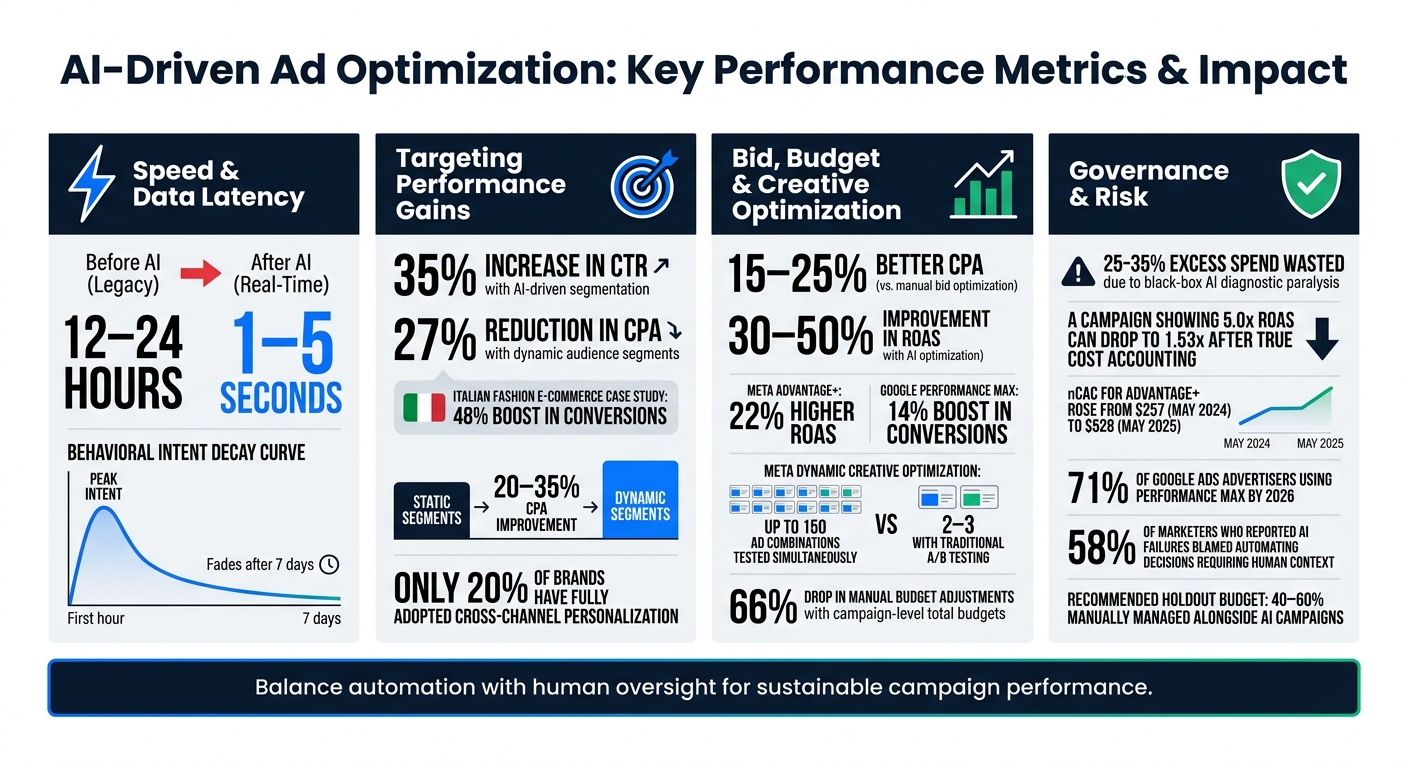
- AI enables instant adjustments. By analyzing live data, AI optimizes bids, budgets, and creatives in seconds, outperforming manual efforts by 15–25% in CPA and boosting ROAS by 30–50%.
- Fragmented data hurts performance. Scattered signals across platforms create delays and inaccuracies. Real-time streaming pipelines solve this by processing ad events immediately, reducing dashboard latency to 1–5 seconds.
- Static audience segments are outdated. AI-driven segmentation updates in real time, increasing CTR by 35% and reducing CPA by 27%.
- Manual optimization is unsustainable. AI handles thousands of campaign variables, avoiding human errors and decision fatigue.
- Transparency and governance are crucial. Adding explainability to AI decisions ensures better oversight and avoids costly mistakes.
AI isn't just faster - it’s smarter, tackling challenges like fragmented data, ineffective targeting, and manual inefficiencies. To succeed, marketers need clean data, real-time tracking, and clear rules for AI usage. Balancing automation with human oversight ensures campaigns remain effective and aligned with broader goals.
AI vs. Manual Ad Optimization: Key Performance Metrics
Problem: Fragmented Ad Data and Slow Feedback Loops
The Problem with Scattered Data Sources
Managing ad campaigns across platforms like Google, Meta, TikTok, and programmatic channels can feel like trying to piece together a puzzle with mismatched pieces. Each platform uses its own schemas, schedules, and identifiers. For example, a user who clicks on a search ad but later converts through a display retargeting campaign might appear as two entirely different individuals in your reports. This happens because the same person is represented by multiple identifiers - email addresses, cookie IDs, device IDs, and CRM IDs - across platforms. The result? A fragmented view of campaign performance that makes real-time analysis nearly impossible.
But mismatched IDs are only part of the challenge. Ad pipelines juggle three asynchronous signals:
| Signal Type | Description | Challenge |
|---|---|---|
| Ad Requests | Triggered when a user initiates an auction | High velocity; needs immediate correlation keys |
| Ad Impressions | Confirms an ad was displayed | Must link to a request from moments earlier |
| Callback Events | Includes clicks, conversions, and billing data | Often delayed by network or client-side issues |
When these signals arrive out of order - something that happens often in distributed systems - batch pipelines aggregate them during the next scheduled refresh. This delay creates a distorted view of which campaigns are actually performing.
How Delayed Reporting Hurts Campaign Performance
Timing is everything when it comes to performance signals. In industries like auto or finance, behavioral intent peaks within the first hour and quickly fades into irrelevance after seven days. A nightly batch job doesn’t differentiate between a fresh signal and a week-old one, which means your bidding system might overbid on audiences that have already gone cold while ignoring the ones that are ready to convert.
As Cometly explains:
"The gap between data collection and action is where wasted ad spend lives. Every hour that passes between a campaign underperforming and a marketer knowing about it is an hour of budget working against you."
This isn’t just an inconvenience - it’s a performance killer. Ad platform algorithms like Meta’s Advantage+ and Google’s Smart Bidding rely on up-to-date conversion signals to optimize campaigns in real time. Feeding them outdated data causes their models to underperform, amplifying the problem caused by delayed reporting.
Solution: Building Streaming Data Pipelines
The answer lies in replacing the traditional "store-then-process" approach with a process-in-motion model. Instead of waiting for a nightly ETL job, streaming pipelines capture ad events as they happen. These events are routed through a message broker - such as Apache Kafka, AWS Kinesis, or Redpanda - which separates data producers from consumers and ensures no events are lost.
Streaming SQL engines like Apache Flink or RisingWave handle live joins and aggregations using rolling windows (e.g., 1-minute for KPIs, 7-day for conversions). This approach connects clicks to outcomes without needing to reprocess historical data. The result? Metrics can flow directly into real-time dashboards or automated bidding systems, reducing dashboard latency from 12–24 hours to just 1–5 seconds.
To maintain data integrity, a Schema Registry can be used to enforce schema contracts. This ensures that malformed data is rejected before it reaches your AI models, preventing issues like training on corrupted features.
"Every hour of latency is budget burned on underperforming channels." - RisingWave Labs
Real-time streaming pipelines are more than just a technical upgrade - they’re the backbone of smarter decision-making in dynamic ad environments. By enabling continuous data processing, they ensure that AI models and bidding systems can respond to changes instantly, setting the stage for tackling even bigger challenges like audience targeting and creative optimization.
sbb-itb-61a6e59
Problem: Ineffective Targeting and Static Audience Segments
Why Static Audience Segments Fall Short
Relying on outdated audience segments can derail ad targeting efforts. Traditional segmentation methods often depend on nightly batch processing, which means the data powering your campaigns is already outdated by the time it’s used. For instance, a user searching for a car loan at 9 a.m. gets grouped into the same "high-intent" category as someone who performed the same search days earlier. This mismatch leads to inaccurate pricing of user intent. RisingWave Labs highlights the issue:
"The bid request lands in your DSP in 100 milliseconds... Meanwhile, the audience segment powering your decision was built from yesterday's batch job. That mismatch is not a minor inefficiency. It's a fundamental mis-pricing of intent."
Timing is critical. Behavioral signals - like a search query, a product page visit, or adding an item to a cart - are most valuable within the first hour. During this peak period, conversion likelihood is high enough to justify paying 3–5× higher CPMs. However, by day seven, these signals lose their relevance, particularly in high-consideration industries like finance or automotive. Worse, outdated segments often lead to wasted ad spend by targeting users who have already converted.
The problem is widespread. Over one-third of B2C marketers admit that incomplete or inaccurate audience data undermines dynamic creative campaigns. Yet, only 20% of brands have fully adopted cross-channel personalization, largely because they lack access to real-time data. To address these challenges, advertisers must embrace dynamic, AI-powered audience targeting.
Solution: Real-Time AI-Driven Audience Segmentation
AI-driven segmentation offers a smarter, more responsive approach. Instead of relying on manual audience definitions and periodic updates, AI continuously analyzes a wide range of behavioral signals - such as browsing habits, engagement levels, device preferences, and purchase history. These insights allow audience segments to update in real time.
The results speak for themselves. An Italian fashion e-commerce brand that adopted AI segmentation reported a 35% increase in CTR, a 27% reduction in CPA, and a 48% boost in conversions in 2026. On average, campaigns using dynamic audience segments outperform static ones by 20–35% on CPA.
Real-time capabilities also enable smarter ad suppression. By leveraging streaming database views, marketers can instantly remove converted users from retargeting lists, saving ad dollars. Similarly, lookalike audiences can be refreshed frequently - using the most recent 7 days of behavior - to maintain accuracy.
"Performance marketers focus on training data quality, which drives algorithm effectiveness." - Improvado
However, AI targeting models need enough data to perform well. Meta’s Advantage+ requires about 50 conversions per week per ad set to exit its learning phase, while Google’s Performance Max needs at least 30 conversions within 30 days to optimize effectively. To get the most out of these tools, consider consolidating ad sets and including a value parameter with every purchase event. This ensures the model optimizes for revenue, not just conversion volume.
Problem: Manual Bid, Budget, and Creative Optimization
Why Manual Optimization Does Not Scale
Managing ad campaigns manually just doesn’t cut it anymore, especially as teams strive to master data engineering and AI to keep pace with automation. A mid-sized account can demand thousands of optimization decisions weekly - far more than any team can handle. Ad auctions shift minute by minute, but most manual reviews happen daily or weekly. By the time someone identifies an underperforming ad, the damage is already done, with budgets wasted on poor placements.
The complexity of modern campaigns only makes things worse. Imagine a campaign with 5 creatives, 3 audiences, 2 placements, and 4 copy variations - that’s a matrix of combinations far too large to monitor effectively as conditions evolve in real time. Add in human factors like decision fatigue and confirmation bias, and it’s easy to see why marketers often stick to familiar strategies, even when the data suggests better options.
Manual adjustments also come with hidden costs. On platforms like Meta, changing a budget by more than 20% resets the learning phase, erasing 2–3 days of valuable conversion data. Even well-meaning tweaks can inadvertently set a campaign back instead of moving it forward.
"The gap between what humans can process and what modern Meta campaigns actually require has grown significantly... No team, regardless of how experienced, can monitor and optimize every variable in real time." - AdStellar
These limitations highlight why manual optimization simply can’t keep up with the lightning-fast pace of today’s ad auctions.
Solution: AI-Powered Optimization Loops
AI steps in where human capabilities fall short. It operates on a scale and speed that no team can match. Take Meta’s Andromeda system, for example - it evaluates every possible ad impression for its likelihood to convert in three stages (retrieval, ranking, and allocation) before the auction even starts. Google’s Smart Bidding works similarly, analyzing signals like device type, location, time of day, and user behavior in real-time auctions.
The results speak for themselves. AI-driven bid optimization consistently delivers 15–25% better CPA compared to manual efforts. When combined with creative and budget optimization, advertisers can see a 30–50% improvement in ROAS. Meta’s Advantage+ campaigns report a 22% higher ROAS, while Google’s Performance Max shows a 14% boost in conversions.
AI also revolutionizes creative testing. While traditional A/B testing might juggle 2–3 variations, Meta’s Dynamic Creative Optimization can handle up to 150 combinations at once. Multi-armed bandit algorithms take it further by shifting traffic to top-performing variations in real time, automatically introducing fresh assets as the performance of older ones declines.
Budget management gets smarter, too. AI reallocates spending to the most effective channels, avoiding the rigidity of static daily caps. Advertisers using campaign-level total budgets report a 66% drop in manual budget adjustments compared to those working with daily budgets.
However, AI isn’t a magic wand - it needs clear boundaries to stay aligned with campaign goals. Setting a ROAS floor or CPA ceiling helps keep it focused on the right objectives. Feeding AI systems actionable data, like actual purchases or CRM-qualified leads, instead of surface-level metrics like clicks, ensures it targets high-value customers and stays on track.
Problem: Limited Transparency and Governance in AI Decisions
The Risks of Black-Box AI Systems
AI systems are great at optimizing bids, budgets, and creatives at lightning speed. But their lack of transparency can cause serious problems. One major issue is diagnostic paralysis. If performance takes a nosedive, you’re left guessing - has the audience been saturated? Is there tougher auction competition? Have the creative options been exhausted? Without clear insights, teams often waste time and money running redundant tests, spending 25–35% more than necessary to figure out what’s wrong.
The financial risks can be just as alarming. For example, a campaign that appears to deliver a solid 5.0x ROAS can plummet to 1.53x once costs and fees are factored in. Why? These systems optimize for platform metrics, not your business’s actual profit margins, making campaigns look successful while quietly bleeding money. To make matters worse, attribution windows often introduce a 4–7 day reporting lag, forcing you to react to outdated conditions.
Then there’s the convergence problem. By 2026, around 71% of Google Ads advertisers are expected to use Performance Max. When everyone relies on the same AI tools, the algorithms start funneling advertisers toward identical audiences and creative formats. This drives up competition - and costs. For instance, new customer acquisition costs (nCAC) for some Advantage+ campaigns skyrocketed from $257 in May 2024 to $528 by May 2025, while manual campaign nCAC stayed steady.
"The competitive advantage has shifted from using AI to understanding your AI." - AdStellar
Adding to the pressure, regulatory changes are on the horizon. The EU AI Act, which takes full effect in August 2026, will impose stricter rules on high-risk AI systems, including those used in targeted advertising. Even if your campaigns are U.S.-based, global standards are reshaping platform disclosures - and raising the bar for advertisers to maintain proper oversight.
Solution: Adding Explainability and Governance Layers
The solution isn’t abandoning AI - it’s about creating a framework that makes its decisions understandable and manageable. Just as real-time data engineering pipelines solve performance delays, governance measures tackle the opacity of AI systems. The aim is to shift from being a passive observer to an informed partner who understands the reasoning behind AI-driven decisions.
A good first step is maintaining structural holdouts. Allocate 40–60% of your budget to manually managed campaigns alongside AI-driven ones. This approach provides a benchmark to verify whether AI-reported gains are genuine or simply a reallocation of existing demand. For example, an analysis of 640 geo-holdout experiments revealed that Meta’s Advantage+ campaigns underperformed manual ones by 12% by the end of the campaigns. Advantage+ delivered only a +17% post-treatment lift, compared to +32% for manual campaigns.
Beyond holdouts, look for tools that enhance explainability. Platforms offering feature attribution can break down which factors - like demographics, past behavior, or engagement signals - had the most influence on a recommendation. Tools that provide human-readable rationale, such as "This audience receives 40% of budget because it has a 3.2x higher conversion rate over 14 days," make it easier to understand and act on AI insights.
"You need the explanation before the recommendation is trustworthy." - Larry, AdLibrary
Governance also involves setting clear rules for when human intervention is necessary. A signal-to-action playbook can help guide these decisions:
| Signal Trigger | Pre-defined Action |
|---|---|
| Frequency > 3.5 or CPA > 150% of target | Flag for creative swap; do not pause campaign |
| CPA < 70% of target for 3 consecutive days | Increase daily budget by 30–50% in a single edit |
| CTR drops > 25% week-over-week | Introduce 2–3 new variants with the same hook archetype |
| Budget change > 30% or audience edit | Freeze all edits for 72 hours to allow stabilization |
Lastly, assign a Directly Responsible Individual (DRI) - someone from the brand team, not the agency - who has the authority to override AI decisions. Oversight needs to be clearly defined and enforced. As one framework puts it: "Responsibility cannot be delegated to software. Oversight is architectural - the system cannot operate without it."
Conclusion: What AI-Driven Ad Optimization Looks Like Going Forward
Key Steps for Implementing AI-Driven Ad Optimization
AI-driven ad optimization isn’t a one-size-fits-all solution - it’s a layered process that requires careful planning and execution. The first step is ensuring your data is clean and unified. Without this, siloed sources can send mixed signals, undermining the system’s effectiveness. Once the data foundation is solid, introduce real-time tracking to ensure timely adjustments. Then, set strategic guardrails to keep AI from chasing outcomes that might be mathematically sound but irrelevant to your broader goals.
With these building blocks in place, the focus shifts to execution. The aim is to move beyond AI that merely delivers insights to AI that takes meaningful actions - such as pausing poorly performing ads, reallocating budgets, or rotating creatives based on fatigue signals. A gradual rollout is key: test AI-driven campaigns alongside manual ones to validate results before scaling up. Austin Braham of EverWorker emphasizes this point:
"The winners won't be the teams that 'use AI' the most. They'll be the teams that operationalize AI into a repeatable execution system."
As more advertisers adopt AI tools, one challenge to watch out for is the convergence trap. Algorithms often steer budgets toward the same audiences and ad formats, creating a crowded space. For instance, 71% of Google Ads advertisers are already using Performance Max, highlighting this trend. Success will depend on blending automated execution with human oversight - ensuring strategy, messaging, and brand voice remain distinct. This balance is crucial, as a 2025 Gartner survey revealed that 58% of marketers who reported AI failures blamed it on automating decisions that required human context.
Building the Skills Needed for AI-Driven Marketing
Having the right tools is only part of the equation - your team also needs the technical expertise to leverage them effectively. AI-driven marketing demands a mix of marketing knowledge and technical skills, particularly in data engineering, analytics engineering, and AI engineering. Platforms like DataExpert.io Academy offer targeted boot camps to help professionals build these competencies. Their programs cover tools like Apache Spark, Kafka, Databricks, Snowflake, and AWS, with hands-on projects designed to mimic real-world scenarios. For example, their AI Engineering Boot Camp spans 4–5 weeks with a 7–8 hour weekly commitment, tackling topics like agentic AI, MLOps guardrails, and prompt engineering. Graduates have secured roles at companies like Meta, Airbnb, and Amazon, with some reporting 100% salary increases after completing the program.
"If you're a working engineer looking to upskill into AI, especially with limited time, I'd highly recommend this bootcamp." - Rakesh Rao, Data Platform Engineer
The gap between teams that deeply understand their AI systems and those that simply use them is growing. Building a strong technical foundation now is what separates campaigns that scale successfully from those that falter.
This AI Runs Google Ads 24/7… and Outperforms Humans (Full Demo)
FAQs
What data do I need before I can optimize ads in real time with AI?
To make real-time ad optimization with AI effective, you’ll need a solid data foundation that provides accurate, high-frequency signals. Start by setting up API integrations to track essential metrics like impressions, clicks, and costs. Combine this with server-side tracking and CRM integrations to capture complete conversion data.
Centralize and normalize this information in a single repository, allowing you to connect ad performance directly to revenue. For better insights, ensure you have at least 30 days of historical data. This will help you define your KPIs and spot meaningful trends.
How do I prevent AI bidding from chasing ROAS while hurting profit?
To make sure AI bidding doesn’t focus on ROAS at the cost of profit, begin by establishing a solid data foundation. This means fixing any issues with conversion tracking or correcting inaccurate value reporting. Simplify your campaigns so they generate at least 30–50 conversions per month - this ensures the data is reliable for decision-making.
Finally, adopt a human-in-the-loop approach. Use external tools to handle budget allocation and spot anomalies, but keep some manual controls in place to confirm that the strategy is delivering incremental profits.
What guardrails should I set so AI can optimize without breaking campaigns?
To make sure AI doesn't derail your campaigns or drain your budget, it's essential to set clear boundaries and rules. Here are some steps to take:
- Establish governance rules: Define specific limits, such as daily bid increase thresholds, budget caps, and non-overridable negative keywords. These guardrails help keep the AI's actions aligned with your goals.
- Leverage platforms with detailed API permissions: Choose tools that allow you to restrict sensitive actions. This ensures the AI can't make unapproved changes.
- Start in read-only mode: Before granting full control, test the AI in a read-only environment. This gives you a chance to evaluate its recommendations without risking live campaigns.
Additionally, keep a close eye on performance by maintaining audit logs and setting up alerts for critical thresholds. And don’t forget: AI thrives on data. Make sure it has enough to work with - like at least 50 weekly conversions - before allowing it to make significant adjustments.