
Presto vs Trino Interview Questions
Here’s the short answer: Trino is the old PrestoSQL, and PrestoDB is the branch that stayed under the Presto Foundation after the 2019 split. If I were answering this in an interview, I’d focus on 3 things first: the split, the rename in December 2020, and how the two engines differ in day-to-day use.
I’d keep it simple:
- Both started from the same Presto project at Facebook in 2012
- The project split in 2019 into PrestoDB and PrestoSQL
- PrestoSQL was renamed Trino in 2020
- Both use the same core model: coordinator, workers, stages, tasks, and splits
- Neither stores data itself; both query data where it already lives
- Trino comes up more in Iceberg and cloud/Kubernetes setups
- PrestoDB comes up more in large internal clusters and Hive/HDFS-heavy setups
- For workload fit, Trino is often tied to lakehouse SQL, while PrestoDB is often tied to array-heavy SQL patterns
That means if an interviewer says only “Presto”, I’d first clarify which branch they mean. That one move shows I know the history and I’m using the current names.
What I’d remember for a fast answer:
- Name it right: PrestoSQL = Trino
- Explain the split: 2019 created two branches
- Show the shared model: both are distributed SQL query engines
- Tie the answer to workload and deployment fit: not “which is best,” but “which fits the use case”
What is the difference between Presto and Trino?
sbb-itb-61a6e59
Quick Comparison
| Topic | PrestoDB | Trino |
|---|---|---|
| Current name | PrestoDB | Trino |
| Old name | Presto | PrestoSQL |
| Split timeline | Branch after 2019 split | Branch after 2019 split; renamed in Dec. 2020 |
| Governance | Presto Foundation | Trino Software Foundation |
| Backers often linked to it | Meta, Uber | Starburst, Netflix, LinkedIn |
| Core architecture | Coordinator + workers | Coordinator + workers |
| Data storage | Queries external data | Queries external data |
| Common setup | Large internal cloud / on-prem clusters | Cloud-native / Kubernetes |
| Metadata/catalogs often mentioned | Hive Metastore | AWS Glue, Hive Metastore |
| Workloads often linked to it | Array-heavy SQL, wide fact tables | Iceberg, lakehouse, complex analytics |
So if I had only 30 seconds, I’d say: “Trino is the renamed PrestoSQL branch, while PrestoDB is the Meta-backed branch under the Presto Foundation. They share the same distributed SQL roots, but Trino is more common in cloud and Iceberg setups, while PrestoDB is often linked to large internal clusters and array-heavy SQL workloads.”
Origin and Naming: PrestoDB, PrestoSQL, and Trino
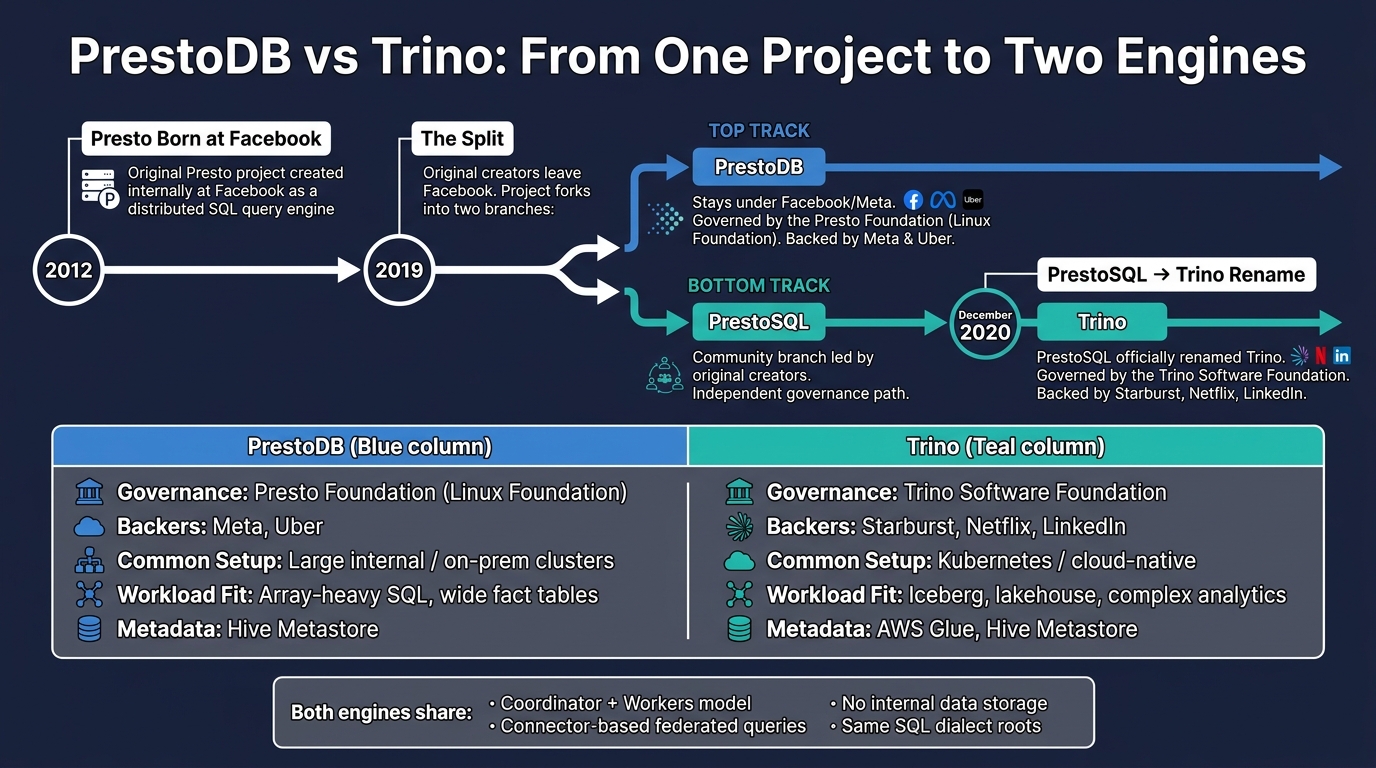
PrestoDB vs Trino: History, Split & Key Differences Timeline
PrestoDB and Trino started from the same codebase. Later, that original Presto project split into PrestoDB and PrestoSQL, and PrestoSQL was later renamed Trino. That split is the reason interviewers often move from naming into architecture and feature differences.
The Project Split and What Changed After It
After the original creators left Facebook, they launched a new branch called PrestoSQL. The branch that remained with Facebook became PrestoDB. From there, the two branches moved forward on separate paths with different governance models.
PrestoDB is hosted under the Presto Foundation, which operates under the Linux Foundation, with Meta and Uber as primary backers. PrestoSQL was later renamed Trino and is governed by the Trino Software Foundation.
For interviews, you usually only need to keep three things straight:
- Governance: each branch has its own foundation
- Naming: PrestoSQL is now called Trino
- Reference: when someone says Presto, you need to know which branch they mean
| Feature | PrestoDB | Trino |
|---|---|---|
| Original Name | Presto | PrestoSQL |
| Governance | Presto Foundation (Linux Foundation) | Trino Software Foundation |
| Primary Backers | Meta, Uber | Starburst, Netflix, LinkedIn |
How to Answer Naming Questions Without Using Outdated Terms
The rename gave the community branch its own identity. So if you say PrestoSQL today, it can sound dated. In most cases, use Trino for the community branch and PrestoDB for the Meta-backed branch.
If an interviewer or job description only says Presto, pause and clarify which branch they mean. It’s a small move, but it shows you know the history and can speak with precision. It also helps that both branches still share the same roots in SQL dialect and overall architecture.
Once you can name the branches the right way, the next interview question usually shifts to whether their execution model changed.
Shared Architecture and Core Execution Model
PrestoDB and Trino use the same basic distributed SQL model. Neither engine stores data itself. Instead, each one sits on top of existing storage and queries data in place at scale. For interviews, that point matters because it helps separate these engines from databases.
Coordinator, Workers, and Query Execution Flow
Each cluster has one Coordinator and multiple Workers. The Coordinator parses SQL, plans the query, and schedules the work. Workers run tasks in parallel and exchange data when needed.
The execution flow is pretty straightforward: a query breaks into Stages, stages break into Tasks, and tasks process chunks of data called Splits. That setup is what lets both engines handle large analytical workloads well.
Interviewers often ask about shuffle, which is the movement of data between workers when large datasets need to be joined. In practice, shuffle is usually the main performance cost. It can also break data locality and ordering. So when you're answering performance questions, shuffle is often the first tradeoff to explain.
That execution model sets up the feature differences interviewers usually ask about next.
Federated Queries and Connector-Based Data Access
Both engines use a connector-based architecture to query data where it already lives - whether that's Apache Iceberg, Snowflake, or Postgres - without moving the data first. That's what makes federated querying possible: you can join data from different systems in a single SQL query without copying either dataset.
Put simply, the connector model is the main reason both engines can query across systems without copying data up front.
Once you can explain that shared model, interviewers usually shift to feature and deployment tradeoffs.
Feature Differences Interviewers Usually Ask About
After architecture, interviewers often move to a simpler question: which engine fits which kind of work? That’s where Presto and Trino start to split in ways that matter in day-to-day data teams.
Feature Areas That Create Clear Interview Contrast
The clearest contrast usually shows up in three places: SQL capabilities, table format support, and workload fit.
On the SQL side, Trino comes up more often in conversations about recursive CTEs and other complex analytical queries. Presto, by contrast, is often tied to array-heavy SQL features like REDUCE, TRANSFORM, and CROSS JOIN UNNEST, especially for wide fact tables.
For table format support, Trino is often linked to Apache Iceberg and lakehouse-style setups. If an interviewer brings up slowly changing dimensions, idempotent queries, or partition evolution on a data lake, they often have Trino in mind. Presto is more often linked to Hive/HDFS environments or wide fact table models.
| Feature Area | Presto | Trino |
|---|---|---|
| SQL patterns interviewers ask about | Array-oriented SQL features like REDUCE, TRANSFORM, and CROSS JOIN UNNEST for wide fact tables |
Recursive CTEs and other complex analytical queries |
| Table Format Focus | Often used with traditional Hive/HDFS or wide fact table structures | Deep integration with Apache Iceberg and lakehouse architectures |
How to Discuss Tradeoffs Without Making Unsupported Claims
The safest way to talk about these differences is to explain fit, not to claim one engine is better across the board. Tie your answer to the workload. Presto is often a match for array-heavy, shuffle-sensitive SQL. Trino is more often used for lakehouse and Iceberg-heavy workloads.
When performance comes up, keep the framing grounded. Talk about the tradeoff - like shuffle versus sort order - instead of picking a blanket winner. Phrases like "generally associated with" or "more often used for" help show that you're pointing to common industry patterns, not hard rules.
Deployment Differences and How to Structure Your Interview Answer
Common Deployment and Operations Topics in Interviews
Once you’ve covered feature fit, interviewers often shift to where each engine runs and how teams manage it day to day. And this goes beyond a simple cloud vs. on-prem question.
PrestoDB is closely tied to large internal cloud clusters at companies like Meta and Uber. Trino, on the other hand, shows up a lot in cloud-native and Kubernetes-based setups, often alongside Starburst for enterprise support or Starburst Galaxy.
In many modern setups, teams use metadata catalogs like AWS Glue or Hive Metastore to track Iceberg or Delta Lake metadata, especially in Trino-based lakehouse environments. When interviewers dig into operations, they usually want to hear how you’d:
- scale workers separately from the coordinator
- isolate workloads across teams
- apply security controls around sensitive data
For large joins, shuffle is often the main bottleneck. That’s why teams try to cut it down with sorted data or denormalized tables.
Here’s the deployment split interviewers usually expect you to know:
| Deployment Topic | PrestoDB | Trino |
|---|---|---|
| Typical environment | On-premises / large internal cloud clusters | Kubernetes / cloud-native / Starburst Galaxy |
| Metadata integration | Hive Metastore | AWS Glue, Hive Metastore |
A Clear Answer Framework for Presto vs Trino Questions
A simple way to answer is to walk through four points: current names, shared origin, deployment pattern, and workload fit.
Start with the naming. PrestoSQL was renamed Trino, while PrestoDB kept going under the Presto Foundation.
Then move to what they still share: the same distributed SQL model and the same connector-based approach.
After that, talk about deployment context. Trino is common in cloud-native setups and Iceberg-heavy environments, while PrestoDB is more often linked to large-scale infrastructure aligned with Meta.
Then finish with workload fit. Trino is often the better match for lakehouse and analytical workloads, while PrestoDB is often tied to array-heavy, shuffle-sensitive SQL.
This structure works well whether you need a short 30-second answer or a deeper one. In a short version, hit the naming and shared purpose. In a longer version, add details like shuffle control, sorted fact tables, and Iceberg metadata tuning.
Conclusion: Key Points to Remember for Your Interview
The best answers tie naming accuracy to deployment fit. Know which branch is which. Know where each engine usually runs. And compare them based on workload patterns, not blanket claims.
That’s usually what makes an answer sound sharp instead of generic.
FAQs
Which should I say in an interview: Presto, PrestoDB, or Trino?
In an interview, prioritize Trino. After the original Presto project split, the community-led project was renamed Trino to set it apart from PrestoDB.
Use Presto or PrestoDB only when you're talking about legacy implementations. For modern data engineering and analytics engineering roles, Trino is the current term to use.
Can PrestoDB and Trino query the same data sources?
Yes. Both PrestoDB and Trino are built for federated analytics across many data sources, from modern platforms to older databases.
Since both came from the same codebase, their connector support and data integration features are, in most cases, quite similar. The two projects have gone in different directions since the split, but they still work in much the same way when it comes to querying data where it already lives.
That means you can query data in its native format without moving it first. For teams dealing with data spread across different systems, that's a big deal.
How do I choose between PrestoDB and Trino for my workload?
Choose based on your architecture and the kind of workload you run. Trino grew out of the original Presto project and leans hard into high-speed, federated analytics. It’s also known for active development, a strong community, and support for open table formats like Apache Iceberg.
The best way to judge it? Run a proof of concept with your own production queries. That gives you a straight look at performance, concurrency, and cost per workload instead of relying on marketing claims or lab benchmarks.