
Ultimate Guide to Behavioral Data Engineer Interviews
Behavioral interviews are now just as important as technical rounds for data engineers. While technical skills prove you can build systems, behavioral interviews assess how you handle challenges, collaborate, and align technical work with business goals. Companies increasingly focus on these skills, as they predict how well you'll perform in ambiguous, high-pressure situations.
Key Insights:
- Behavioral interviews now account for 60% of hiring decisions (up from 40% in 2019).
- They evaluate problem-solving, teamwork, and decision-making under uncertainty.
- Companies prioritize engineers who can connect technical systems to business outcomes.
- The STAR method (Situation, Task, Action, Result) is essential for structuring responses.
What to Expect:
- Questions about prioritization, handling pipeline failures, and cross-team collaboration.
- Emphasis on your ability to explain technical concepts to non-technical stakeholders.
- Interviewers look for measurable results in your past experiences (e.g., "reduced processing time by 30%").
Preparation Tips:
- Identify key projects where you solved problems, led initiatives, or worked across teams.
- Practice storytelling using the STAR method, focusing on your role and results.
- Quantify your impact with metrics (e.g., cost savings, performance improvements).
- Prepare 8–10 examples covering themes like leadership, conflict resolution, and time management.
Behavioral interviews are about showing how you think and act in real-world scenarios. By preparing structured, metrics-driven answers, you'll stand out as a candidate who can handle both technical and interpersonal demands.
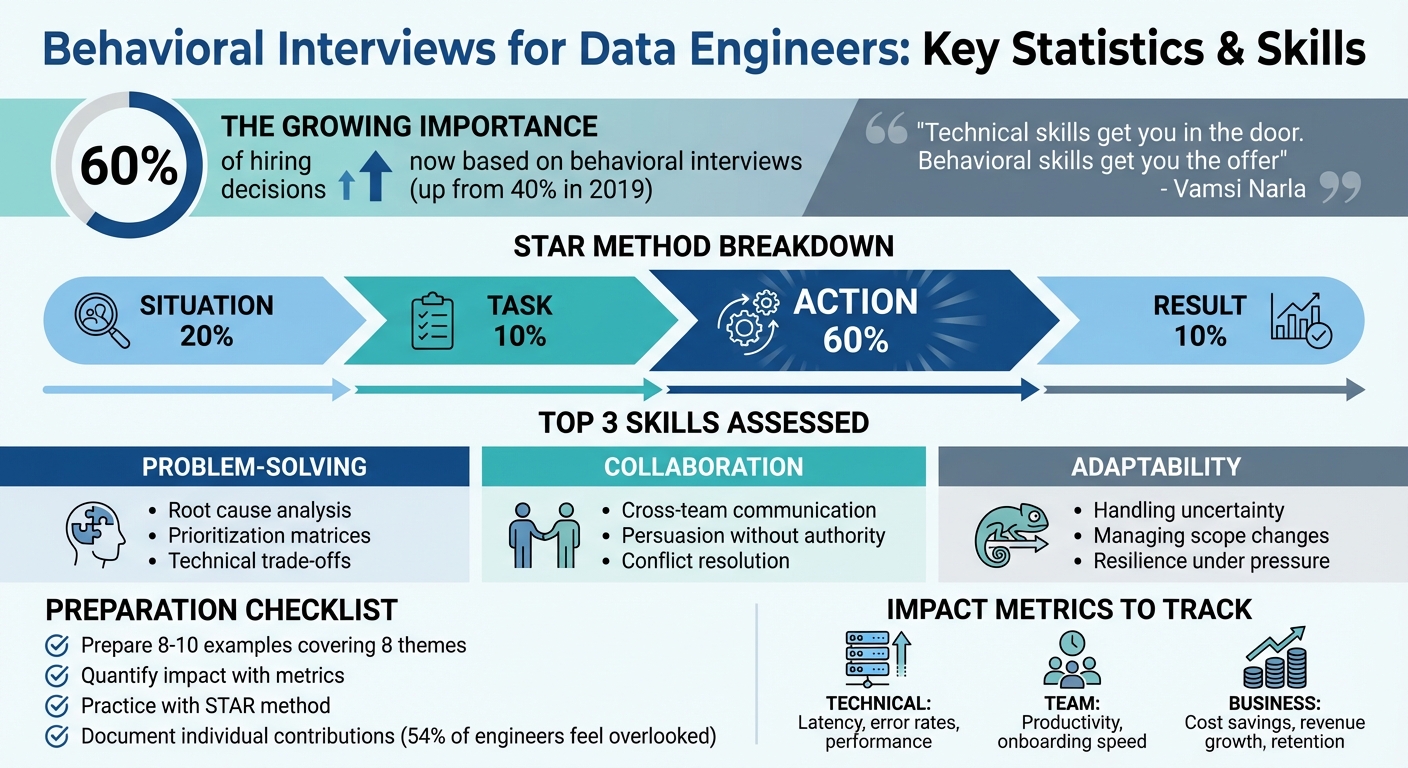
Key Behavioral Interview Statistics and Skills for Data Engineers
Master the Behavioral Interview: Why Data Engineers Fail & How to Succeed
Skills Assessed in Behavioral Data Engineer Interviews
Behavioral interviews for data engineers focus on more than just technical expertise. They dive into the human-centered skills that determine how well you can handle challenges when technical know-how isn't enough. With AI taking over routine tasks, companies are prioritizing engineers who can manage the complexities of team dynamics, problem-solving, and adapting to change. Here's a breakdown of the key skills interviewers are looking for:
Problem-Solving and Analytical Thinking
One of the first areas interviewers explore is your approach to diagnosing and solving problems, especially when faced with incomplete information. For instance, if a data pipeline fails, can you systematically identify whether the issue is a coding error, resource limitation, or miscommunication? This process, known as root cause analysis, is critical in determining the underlying problem.
Prioritization is another important skill. Interviewers may ask how you manage competing tasks, expecting you to explain a structured approach, such as using a prioritization matrix. This tool helps rank tasks based on urgency and importance, ensuring high-priority work gets immediate attention while less critical items are deferred or eliminated.
Your ability to make technical trade-offs also comes under scrutiny. For example, choosing between SQL and NoSQL databases often requires weighing project-specific needs against available resources. As Byte-Sized Wisdom puts it:
"What often decides the final offer is how you think, influence, and handle ambiguity."
Interviewers appreciate proactive problem-solvers who can identify inefficiencies or discrepancies before they escalate. When describing your problem-solving achievements, quantify the results. Instead of saying, "I optimized the pipeline", share specifics like, "I reduced processing time by 30%" or "increased client satisfaction by 15%".
Collaboration and Teamwork
Data engineers often act as a bridge between technical teams and departments like Finance, Marketing, or Product. This means you need to translate complex ideas - like ETL pipelines or predictive models - into terms that non-technical stakeholders can grasp.
Another critical skill is persuasion without authority. Can you convince colleagues to adopt a tool or method when you don't have formal power over them? Interviewers might also ask how you handle disagreements, probing for examples of resolving technical conflicts and finding compromises to keep projects on track.
Chris Garzon, Founder of Data Engineer Academy, emphasizes this point:
"Behavioral questions are like a window into how you approach challenges at work. Don't underestimate them - they're not just fluff."
When discussing teamwork, highlight measurable outcomes. For example, explain how your collaboration saved time, reduced costs, or improved team efficiency. Using the STAR method (Situation, Task, Action, Result) can help structure your responses, with a focus on how your interpersonal skills directly contributed to the project's success. Additionally, you should be ready to discuss how you managed shifting project parameters and unexpected changes.
Handling Change and Uncertainty
Adaptability is a must-have for data engineers, as the field is rarely static. Projects often deviate from their original scope, and architectures can remain unclear until late in the process. Interviewers want to see how you handle uncertainty and whether you can stay resilient when faced with shifting requirements. This is especially important for senior roles, where you might need to deliver results despite unclear direction, evolving architectures, or team challenges.
Byte-Sized Wisdom explains:
"Interviewers... want to probe how you operate when the architecture, people, and direction are fuzzy."
To prepare, think of 2-3 stories that demonstrate how you adapted to unexpected challenges or evolving requirements. For example, you might describe how you used a prioritization matrix to reorganize tasks when project priorities changed midstream. Always tie your actions to measurable outcomes, such as meeting a tight deadline despite a 50% scope increase or maintaining system reliability during a significant architectural shift.
Interviewers also want to know if you can pinpoint why projects fall behind. Whether the issue stems from technical bottlenecks, team misalignment, or inefficient processes, your ability to diagnose and address these root causes sets you apart from other candidates.
How to Structure Your Behavioral Responses
Crafting a clear story is essential for behavioral interviews. A well-structured response helps interviewers quickly understand your role and contributions. The way you organize your answer can be the difference between being overlooked and landing the job.
Using the STAR Method
The STAR framework - Situation, Task, Action, and Result - is a proven way to structure your answers. Here's how to allocate your time within this framework: dedicate 20% to the Situation, 10% to the Task, 60% to the Action, and 10% to the Result.
The Action section deserves the most attention. This is where you demonstrate your problem-solving skills. For instance, if you're explaining how you handled a data pipeline failure, avoid vague phrases like "we fixed it." Instead, break it down: Did you analyze logs, identify bottlenecks, or adjust resource allocation? Did you implement query optimization, parallel processing, or set up automated alerts to prevent future issues? Be specific about your approach.
One common pitfall is overusing "we" in your answers. Even in team settings, interviewers need to know exactly what you contributed. Use "I" statements to highlight your individual role, whether that's writing the code, designing the architecture, or coordinating with stakeholders. This is especially important, as 54% of engineers report feeling their individual contributions are often overlooked.
Tailoring Responses to Data Engineering Scenarios
Once you've structured your response using STAR, personalize it for the data engineering context. Avoid generalities. For example, if asked about handling pipeline failures, focus on how you diagnosed the issue, allocated resources, and implemented monitoring systems to prevent recurrence.
For collaboration-related questions, emphasize how you connected technical and business teams. You could discuss creating custom dashboards for marketing teams or holding regular alignment meetings to refine project requirements.
When addressing conflicts, steer clear of personal disagreements. Instead, focus on how you used data to resolve differences. For example, explain how you compared tools or methodologies based on project goals rather than opinions. In high-pressure scenarios, highlight your ability to manage scope - share how you identified bottlenecks, prioritized critical tasks, and delivered on time without compromising data quality.
Showing Impact with Numbers and Metrics
The Result section is your opportunity to leave a lasting impression. Replace vague outcomes with measurable results. For example, instead of saying, "improved system performance", say, "reduced response time from 1.2 seconds to 250 milliseconds". If exact numbers aren’t available, use relative comparisons like "achieved the best performance in a decade" or "completed the project two weeks ahead of schedule".
Think of impact in three areas: Technical (e.g., improved latency or reduced error rates), Team (e.g., increased productivity or faster onboarding), and Business (e.g., cost savings, revenue growth, or higher customer retention). Tailor your metrics to align with the company’s priorities. For infrastructure roles, emphasize reliability improvements; for customer-facing teams, highlight metrics like user satisfaction or retention.
As Exceeds.ai notes:
"The 'Result' part of STAR is what makes your answer memorable".
Prepare 8-10 examples ahead of time that showcase various types of impact. Practice quantifying your contributions, especially since only 14% of engineers feel past performance reviews have provided meaningful insights. Self-documentation is key to standing out.
Common Behavioral Interview Questions for Data Engineers
When preparing for data engineering interviews, expect behavioral questions to play a significant role. An analysis of 1,000 interview rounds revealed that "How do you prioritize when you have multiple different items to do?" is the most frequently asked question for data engineers. This makes sense, given the nature of the role, which often involves balancing pipeline maintenance, feature development, and urgent fixes.
Interviewers also use these questions to evaluate soft skills like communication, leadership, and problem-solving under pressure. They want to see how you handle real-world challenges, such as pipeline failures or conflicting stakeholder demands. Sean Coyne, Director of Software Engineering at GoodRx, highlights the importance of these questions:
"The underlying assumption (although often flawed) is that past behavior is a good indicator of future behavior, making these questions valuable for assessing a candidate's skills, competencies, and suitability for a job".
These questions often build on structured response techniques and focus on scenario-based problem-solving.
Working on a Data Pipeline Project with a Team
Collaboration is a key skill for data engineers, especially when working on projects that connect technical teams with business departments like Finance or Marketing. When answering questions about teamwork, emphasize how you aligned technical work with business goals rather than just focusing on implementation details.
For instance, if you built a recommendation system for a dating app, explain how you worked with product managers to define success metrics. A real-world example could be implementing an elastic search model for job recommendations, which resulted in a 10% increase in applications compared to the baseline. This not only highlights technical expertise but also demonstrates measurable business impact.
Be specific about your contributions. Use "I" statements to clarify whether you designed the schema, wrote ETL logic, or created dashboards for stakeholders. This helps interviewers see how your work directly influenced outcomes and underscores your role in collaborative success.
Managing Data Pipeline Failures Under Pressure
Pipeline failures are inevitable, and how you handle them can reveal your problem-solving and composure under stress. When discussing such scenarios, focus on how you identified the issue, addressed it, and implemented long-term solutions. The goal is to show that you approach problems methodically rather than reactively.
Structure your response to highlight three steps: diagnosis, immediate resolution, and prevention. For example, describe how you analyzed logs to identify a memory leak, used a temporary workaround to restore functionality, and later refactored the code while adding monitoring alerts to prevent future issues. This approach demonstrates technical depth and a proactive mindset.
For senior roles like Principal or Staff Engineer, expect more complex questions about making trade-offs with limited data or managing priorities without formal authority. Be prepared to share examples where you balanced short-term fixes with sustainable solutions, all while keeping stakeholders informed and aligned.
Explaining Technical Concepts to Non-Technical Stakeholders
Strong communication skills are essential for bridging the gap between technical teams and business stakeholders. When asked to explain technical concepts, focus on summarizing them clearly in one or two sentences, avoiding jargon while emphasizing business outcomes.
For example, you might explain ETL versus ELT like this: "ETL transforms data before loading it into storage, which is ideal for structured reports. ELT, on the other hand, loads raw data first and transforms it later, giving analysts more flexibility for ad-hoc queries." This explanation makes the trade-offs easy to understand, even for non-technical audiences.
To further enhance clarity, use visuals like slides or dashboards to make abstract ideas more tangible. Practicing with non-technical audiences can also help refine your ability to communicate complex concepts effectively. Since recruiters often spend less than one minute reviewing resumes, your ability to convey ideas concisely during interviews becomes even more critical. Clear communication not only strengthens your technical credibility but also positions you as a strategic partner who can align technical work with business goals.
sbb-itb-61a6e59
How to Prepare for Behavioral Data Engineer Interviews
Building on the STAR framework, preparation involves reflecting on your past work and transforming those experiences into strong, structured responses. This approach helps you showcase both your technical expertise and your ability to work well with others.
Identifying Your Key Experiences and Projects
Start by aligning your previous projects with common behavioral interview topics. For example, prioritization questions frequently come up in data engineering interviews. Identify 3–5 key success stories that demonstrate your ability to tackle challenges like solving data integration issues, optimizing pipelines, or migrating data warehouses to the cloud.
When crafting these stories, focus on your specific role. Did you design scalable systems, automate repetitive tasks, or introduce a new tool to your team? Highlight your individual contributions and include measurable results - like reducing processing time by 30% or improving data accuracy by 15%. Be ready to discuss situations where you resolved technical disagreements or helped a teammate overcome obstacles. If you're aiming for a senior role, emphasize experiences where you influenced decisions without formal authority or guided junior engineers through uncertain situations.
Once you’ve identified these experiences, practice explaining them clearly using the STAR method.
Practicing with Real Data Engineering Scenarios
Rehearsing responses to real-world scenarios helps you prepare for unexpected questions. Practice addressing challenges like pipeline failures, data discrepancies, delayed migrations, or meeting tight deadlines. Use the STAR method to organize your responses, focusing on your specific contributions to each situation.
Record yourself to assess your clarity and body language. Work on explaining technical concepts - like stream vs. batch processing - in simple terms that non-technical stakeholders can understand. Tailor your examples to the company's values. For instance, if the company values ownership, share a story about taking charge of a struggling project.
Sean Coyne, author of Ace the Data Engineering Interview, highlights the importance of these questions:
"The underlying assumption (although often flawed) is that past behavior is a good indicator of future behavior, making these questions valuable for assessing a candidate's skills, competencies, and suitability for a job."
Using DataExpert.io Academy Resources
DataExpert.io Academy offers a range of tools to help you prepare for behavioral interviews. Their training programs, created by experienced data engineers, include personalized guidance like resume reviews and career coaching. The hands-on curriculum features real-world AWS projects and introduces frameworks like the Prioritization Matrix to help you manage competing tasks effectively.
The academy also provides access to an extensive interview database covering SQL, Python, data modeling, and system design, ensuring you're ready for both technical and behavioral rounds. Some students have even reported tripling their salaries after completing the program. By using these resources, you can build a compelling narrative that highlights your technical abilities and interpersonal skills, boosting your confidence throughout the interview process.
Common Mistakes to Avoid in Behavioral Interviews
Behavioral interviews can be tricky, even if you're well-prepared. Small missteps can weaken your responses and leave the wrong impression. To help you shine, here are some common mistakes to steer clear of.
Giving Vague or Generic Answers
When you're under pressure, it's easy to fall into the trap of giving answers that lack detail or measurable outcomes. For example, saying something like, "I improved the data pipeline", doesn't tell the interviewer much about your actual contribution or its impact. In fact, only 14% of engineers say their past performance reviews provided valuable insights, which makes specific examples even more critical.
To avoid this, use the STAR method to structure your answers. Be specific. Instead of "we optimized our system", say, "I redesigned the ETL process, reducing data processing time by 40% and cutting monthly costs by $12,000." Also, focus on your role. Overusing "we" can blur your individual contributions. While teamwork is important, the interviewer is assessing your skills and impact.
Ignoring Soft Skills in Your Responses
Another common mistake is overlooking the importance of soft skills. While technical expertise is crucial, it’s often your interpersonal abilities that set you apart. Research shows that soft skills can be a deciding factor in hiring decisions. With 54% of engineers reporting that their efforts are rarely acknowledged by leadership, showcasing your ability to collaborate, communicate effectively, and adapt to challenges becomes even more important.
Don’t get too bogged down in technical jargon during behavioral interviews. Instead, connect your work to broader business outcomes. For example, instead of diving into the specifics of a coding project, explain how you translated technical trade-offs for non-technical stakeholders. Share examples of mentoring teammates, resolving conflicts, or navigating unexpected changes in project scope. These stories highlight your ability to work well with others and adapt, which are just as valuable as your technical skills.
Not Asking Questions During the Interview
Failing to ask questions can make you appear disinterested. Behavioral interviews are not just about answering questions - they’re a chance to engage in a meaningful conversation. If your interviewer mentions pipeline failures, for instance, you could ask, "How does your team currently handle incident response and post-mortems?"
Take time to research the company’s products, values, and business model beforehand. If the company prioritizes data reliability, ask about their monitoring tools or SLA goals. Thoughtful questions like these show that you've done your homework and are genuinely interested in how you can contribute to their success.
Conclusion
Key Takeaways
Behavioral interviews have become a key factor in data engineering hiring. In fact, they now account for about 60% of the interview assessment, while technical skills make up just 40%. As hiring manager Vamsi Narla aptly states:
"Technical skills get you in the door. Behavioral skills get you the offer".
This shift highlights the importance of strategies like using the STAR method to frame responses and clearly demonstrating the impact of your work. When answering questions, focus on the Result, quantifying your contributions in terms of technical achievements, teamwork, and business outcomes. Use "I" statements to emphasize your individual role in these successes.
To prepare effectively, develop 2–3 compelling success stories for each of the eight core behavioral themes: Leadership, Conflict, Failure, Adaptability, Problem-Solving, Communication, Ownership, and Time Management. Practice delivering these stories out loud until they flow naturally and fit within a 60–90 second timeframe. Avoid overwhelming your responses with technical jargon during behavioral rounds; instead, focus on the broader impact and how your work added value to the organization.
By following these strategies, you’ll be well-equipped to excel in behavioral interviews.
Next Steps for Candidates
Start by identifying your most impactful projects and documenting them with clear metrics. Use a prioritization matrix to organize your experiences and practice presenting them using the STAR framework. Record yourself delivering these responses to ensure clarity and confidence.
For additional support, platforms like DataExpert.io Academy provide valuable resources to enhance your preparation. Their offerings include interview prep videos on topics like Data Structures, SQL, Data Modeling, and Data Architecture. With boot camps starting at $3,000 and an All-Access Subscription for $125/month, you can access over 250 hours of content, hands-on projects, and a supportive community to sharpen both your technical and behavioral skills.
The hiring landscape has evolved. Companies now prioritize engineers who can handle uncertainty, work well with others, and deliver measurable results. With a focused approach and thorough preparation, you’ll be ready to make a lasting impression in your next behavioral interview.
FAQs
How do I choose the best STAR stories?
When preparing for interviews, selecting the right STAR stories can make all the difference. These stories should highlight your top skills and demonstrate positive results. Focus on 2-3 key strengths that align closely with the job description, such as problem-solving, leadership, or flexibility.
Aim to create 10-20 concise examples that follow the STAR format:
- Situation: Set the scene with relevant context.
- Task: Describe your responsibility or goal.
- Action: Explain the steps you took to address the situation.
- Result: Highlight the outcome, emphasizing measurable success when possible.
For example, if leadership is a focus, you might share a story about stepping up during a team crisis, outlining how you motivated others and delivered results under pressure.
Keep your stories genuine and adaptable. Instead of memorizing them word-for-word, focus on the core details so you can adjust based on the interview question. This approach keeps your responses natural and flexible, ensuring they resonate with the interviewer.
What metrics should I use if I don’t have numbers?
If you don’t have hard numbers to back up your claims, lean on qualitative insights instead. Emphasize why certain tasks are crucial and time-sensitive, walk through how you make decisions, and outline the tools or methods you rely on to set priorities. By sharing these details, you can showcase your ability to solve problems and stay organized effectively.
How do I explain data engineering to non-technical people?
To help non-technical folks understand data engineering, think of it like setting up the backbone of a house. Imagine the plumbing and wiring - the pipes carry water, and the wiring delivers electricity. Similarly, data engineers build systems and pipelines that ensure data flows smoothly from one place to another. This setup allows data to be gathered, processed, and ready for analysis, helping businesses make smart decisions without diving into complex technical details.