
AI Engineering Career Path: Complete Guide for 2026
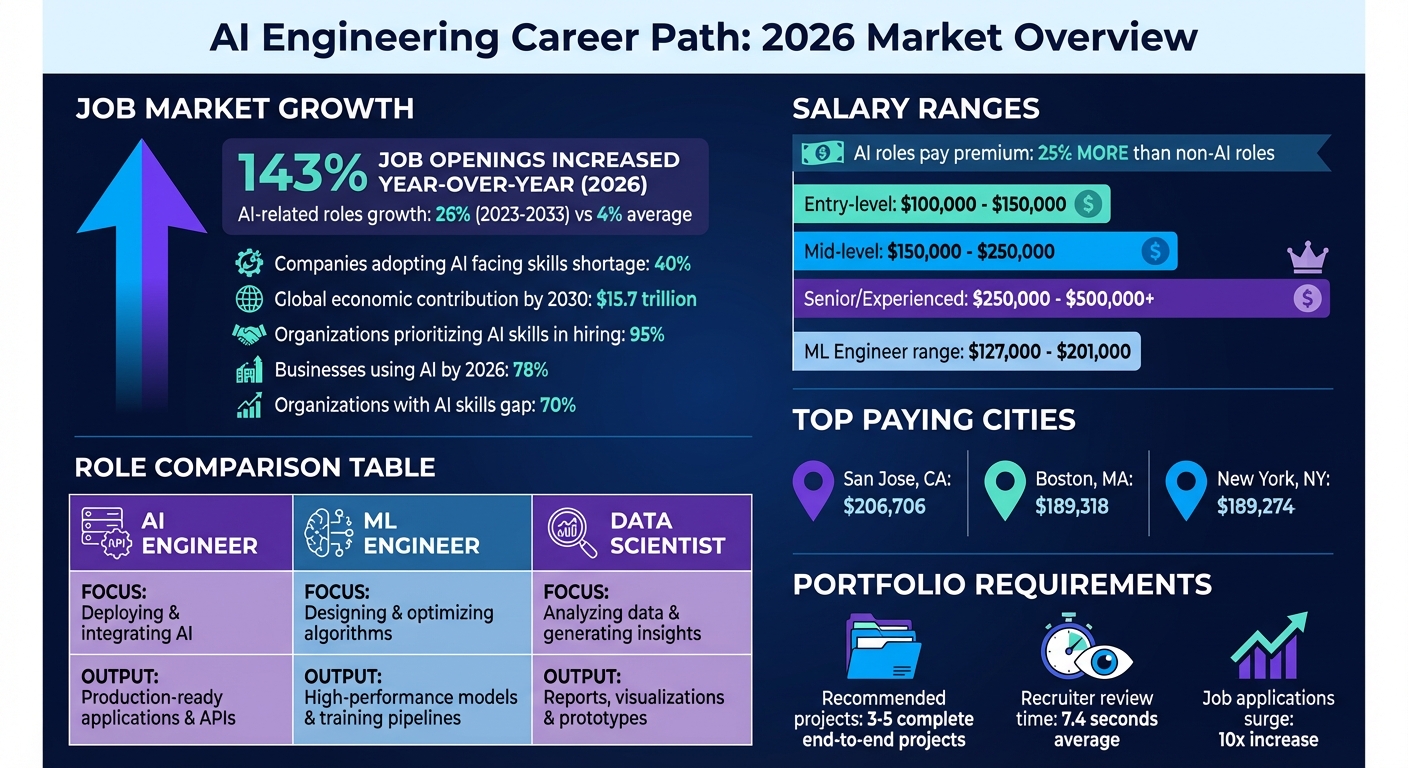
AI engineering is one of the fastest-growing roles in tech, with job openings increasing by 143% year-over-year in early 2026. Companies demand professionals who can manage end-to-end AI systems, from AI-enabled data pipelines to deployment, emphasizing practical skills over theoretical research. Here's what you need to know:
- Salary Insights: Entry-level roles offer $100,000–$150,000 annually, while experienced professionals earn $250,000–$500,000+.
- Core Skills: Python (3.10+), MLOps tools (Docker, Kubernetes), frameworks (PyTorch, TensorFlow), and vector databases (Pinecone, Weaviate).
- Specializations: AI software engineering, machine learning engineering, and reinforcement learning engineering.
- Job Market: AI-related roles are growing at 26% between 2023–2033, driven by industries like tech, healthcare, and finance.
- Portfolio Tips: Focus on 3–5 complete projects showcasing deployment, monitoring, and handling real-world challenges.
This guide covers the skills, tools, and strategies you need to succeed in AI engineering in 2026, whether you're starting out or advancing your career.
AI Engineering Career Statistics 2026: Salaries, Growth & Market Demand
How to Become an AI Engineer FAST (2026) | AI Engineering Roadmap Built by Expert
To accelerate your journey, you can master technical AI engineering concepts like RAG and prompt engineering through hands-on training.
What Does an AI Engineer Do?
AI engineers are the builders and problem-solvers who take machine learning models and turn them into real-world applications that people can use. While researchers focus on theoretical advancements, AI engineers use existing tools and pre-trained models - like large language models (LLMs) - to tackle real business challenges. Their work spans the entire lifecycle, from designing data pipelines and integrating APIs to deploying systems in the cloud and monitoring how they perform.
Day-to-day tasks might include investigating why a model’s recall rate suddenly dropped, debugging issues like hallucinations in an LLM-powered assistant, or testing whether advanced retrieval techniques outperform fine-tuning for a specific feature. AI engineers collaborate closely with product managers and backend engineers to define metrics and seamlessly integrate AI capabilities into products. Their role demands technical know-how combined with practical problem-solving - whether that’s fixing bottlenecks in data pipelines, reducing inference times, or ensuring systems scale effectively.
By 2026, the role has evolved to require a systems-first mindset. Companies are looking for professionals who can manage every aspect of AI systems, from deployment and monitoring to cost management and AI safety. Sakshi Gupta from Interview Query highlights this shift perfectly:
"AI engineers turn machine learning and large language models into real products people can actually use".
This evolution emphasizes skills in MLOps, containerization tools like Docker and Kubernetes, and designing scalable architectures - not just training models.
The scope of the job also depends on the company. In startups, AI engineers often handle everything - from data cleaning to deployment. At larger tech companies, roles are more specialized, focusing on tasks like reducing inference latency or managing distributed training across GPUs. Regardless of the setting, the primary mission remains the same: bridging the gap between AI research and practical applications. This distinction in responsibilities lays the groundwork for understanding the core skills needed for success.
AI Engineer vs. ML Engineer vs. Data Scientist
Although these roles overlap in some areas, they each serve distinct functions within the AI ecosystem. Data scientists focus on exploring data, applying statistical methods to uncover insights, and building experimental models. Their work often results in reports, visualizations, and prototypes. Machine learning engineers, on the other hand, specialize in creating and optimizing algorithms, building high-performance models, and designing training pipelines. Meanwhile, AI engineers take these models and make them functional in real-world products, handling the integration, deployment, and all the technical infrastructure that brings AI solutions to life.
| Role | Primary Focus | Key Output |
|---|---|---|
| AI Engineer | Deploying and integrating AI into products | Production-ready applications and APIs |
| ML Engineer | Designing and optimizing algorithms | High-performance models and training pipelines |
| Data Scientist | Analyzing data and generating insights | Reports, visualizations, and prototypes |
Understanding these differences is crucial when planning your career in AI. AI engineers need a solid foundation in software engineering, along with hands-on experience with APIs, cloud platforms, and orchestration tools. ML engineers dive deep into areas like gradient optimization and algorithm design, while data scientists rely on statistical expertise, SQL, and tools like R or Pandas. Knowing these distinctions helps you focus on the right skills for your chosen path.
These clearly defined roles reflect the growing demand for specialized expertise in AI engineering.
AI Engineering Job Market in 2026
The job market for AI engineers is booming. Over the past year, job openings in this field have grown by 143%, making it one of the fastest-growing roles in tech. According to an IBM survey, 40% of companies adopting AI cite a lack of AI engineering skills as their biggest roadblock. By 2030, AI is expected to contribute an astounding $15.7 trillion to the global economy, and job growth for AI-related roles is projected to hit 26% between 2023 and 2033, far outpacing the 4% average for all occupations.
Compensation reflects this high demand. Entry-level AI engineers can expect salaries around $100,000, while senior roles often exceed $250,000. On average, AI-related positions pay 25% more than similar non-AI roles. Salaries also vary by location, with San Jose, CA averaging $206,706, Boston, MA $189,318, and New York, NY $189,274.
The strongest demand comes from industries like technology, finance, healthcare, manufacturing, and government. For example, the U.S. Army is actively building a team of AI experts to integrate AI and machine learning into military operations. Lt. Col. Orlandon Howard describes it as:
"a dedicated cadre of in-house experts who will be at the forefront of integrating AI and machine learning across our warfighting functions".
In 2026, hiring managers often prioritize portfolios showcasing 3–5 complete, end-to-end projects over traditional degrees. Certifications like the Microsoft Azure AI Engineer Associate can also be valuable, helping to validate skills and strengthen your position during salary negotiations. This growing demand underscores the importance of building a strong portfolio that demonstrates practical, hands-on experience.
Core Skills for AI Engineers
To thrive as an AI engineer, you need to develop expertise in three key areas: programming fundamentals, data engineering, and specialized AI domains. These skills form the backbone of building, deploying, and maintaining AI systems ready for real-world applications.
Programming Skills and Tools
Proficiency in Python 3.10+ is a must. To go beyond basic scripting, you’ll need to understand advanced features like type hints, modular code design, and asynchronous programming using asyncio. Tools like asyncio and aiohttp are particularly useful for handling non-blocking API calls. While Python dominates the AI landscape, familiarity with Go, Java, or C++ can be invaluable for creating high-performance infrastructure.
For machine learning, PyTorch is highly regarded for its flexibility and ease of transitioning from research to production. TensorFlow remains essential for scaling large production pipelines [5,12]. Scikit-learn is your go-to tool for implementing classic machine learning algorithms [5,13]. In the growing field of generative AI, mastering frameworks like Hugging Face Transformers, LangChain, and LlamaIndex is becoming increasingly important for building applications powered by large language models (LLMs) [1,12].
When it comes to deploying models, FastAPI is a popular choice for creating REST APIs, often used alongside Docker for containerization [1,6,12]. Kubernetes is critical for ensuring scalability and reproducibility in production environments [1,12]. Modern LLM applications also demand experience with vector databases like Pinecone, Weaviate, or Chroma, which play a key role in supporting Retrieval-Augmented Generation (RAG) workflows [1,12].
| Category | Essential Tools & Frameworks |
|---|---|
| Programming Languages | Python (3.10+), SQL, Go, Java, C++ |
| Machine Learning | Scikit-learn, XGBoost, LightGBM |
| Deep Learning | PyTorch, TensorFlow, Keras |
| LLM Orchestration | LangChain, LlamaIndex, Hugging Face Transformers |
| Data Handling | Pandas, NumPy, Apache Spark, Apache Airflow |
| Deployment/Ops | FastAPI, Docker, Kubernetes, MLflow, ONNX |
| Vector Databases | Pinecone, Weaviate, Chroma, Milvus |
These programming tools and frameworks lay the groundwork for building the robust data pipelines discussed in the following section.
Data Engineering Foundations
A critical part of an AI engineer's job involves creating reliable data pipelines. These pipelines act as the "plumbing" that delivers clean, organized data to AI models. SQL is indispensable here, as it’s the foundation for querying, joining, and optimizing data. Tools like Pandas and NumPy are essential for handling and transforming raw data into model-ready formats, while Apache Spark and Apache Airflow are key for managing large-scale pipelines [12,13,15,6].
Data wrangling tasks - such as fixing missing values, identifying outliers, and resolving inconsistencies - are routine but crucial. Feature engineering, which includes scaling, normalization, and encoding, directly impacts model performance [16,6].
By 2026, building retrieval and embedding pipelines with vector search tools will become a standard practice for RAG systems. This involves working with vector databases and constructing chunking pipelines or retrieval indexes tailored to specific domains. With RAG gaining traction as a default architecture for enterprise AI, these skills are becoming increasingly valuable.
These data engineering techniques provide the foundation for the advanced AI models discussed in the next section.
Deep Learning, NLP, and Computer Vision
Once you’ve mastered programming and data engineering, the next step is to dive into deep learning and domain-specific techniques. Deep learning serves as the backbone of modern AI, powering tools like generative models, language understanding systems, and image recognition applications [5,18]. While a PhD isn’t necessary, a solid grasp of linear algebra, calculus, and probability is essential [5,1]. Knowledge of architectures like Convolutional Neural Networks (CNNs), Recurrent Neural Networks (RNNs), and Transformers is critical for optimizing performance, managing costs, and reducing latency in production systems [17,1].
In natural language processing (NLP), it’s often more efficient to fine-tune pre-trained models from Hugging Face rather than building models from scratch. For instance, creating a RAG-based Q&A assistant is a portfolio-worthy project that demonstrates your expertise. Skills like sentiment analysis, text classification, and working with large language models are increasingly in demand for 2026 and beyond [5,1].
Expanding into computer vision opens doors to applications like object detection, facial recognition, and medical imaging. These skills are especially valuable in sectors like healthcare and autonomous vehicles [5,17]. Additionally, the ability to work with multimodal AI systems - those that integrate both vision and language - is becoming a key differentiator for AI engineers [17,1]. Ultimately, transitioning from experimenting with models to designing complete, end-to-end systems is what sets successful AI engineers apart.
AI Engineering Specializations and Career Paths
As you develop your technical foundation, it’s important to choose a specialization that matches your interests and career aspirations. The AI engineering field has grown into several distinct paths, each with its own focus, tools, and opportunities. Employers today are looking for professionals who can manage entire systems, not just experiment with models in isolated environments. These specialized tracks allow you to tackle specific challenges in the industry with targeted solutions.
Machine Learning Engineering
Machine learning engineers act as the bridge between research and production. Using skills in Python, TensorFlow, and data pipelines, they design algorithms, create features, and build scalable systems to ensure that models perform effectively in real-world settings. This role requires a strong command of tools like PyTorch, TensorFlow, and scikit-learn for model development, along with MLOps platforms such as MLflow and Apache Airflow for workflow orchestration.
Industries like healthcare (e.g., medical imaging), finance (e.g., fraud detection), and manufacturing are actively hiring ML engineers to solve complex prediction problems. Salaries for these roles typically range from $127,000 to $201,000, with senior roles at major tech companies exceeding $500,000. What sets this track apart is the ability to deliver production-ready models that meet demands for scalability, low latency, and cost efficiency.
AI Software Engineering
AI software engineers focus on turning pre-trained models into smooth, user-friendly applications. This specialization has seen rapid growth as businesses integrate AI features into their products. Key tools for this role include LangChain, LlamaIndex, and vector databases like Pinecone or Weaviate, which are used to develop Retrieval-Augmented Generation pipelines. Additionally, you’ll work on prompt engineering, API orchestration, and microservices to bring AI functionalities to life for end users.
"In numbers, there's probably going to be significantly more AI Engineers than there are ML engineers / LLM engineers. One can be quite successful in this role without ever training anything." - Andrej Karpathy, Sr. Director of AI, Tesla
This path is ideal for those interested in UX and product development. Companies in entertainment (e.g., recommendation systems), e-commerce (e.g., personalized shopping), and tech startups launching AI-driven features are all seeking talent in this area. Entry-level compensation typically starts between $100,000 and $150,000, with mid-level roles offering $150,000 to $250,000.
Reinforcement Learning Engineering
Reinforcement learning engineers focus on creating autonomous systems that learn through trial and error. This specialization builds on expertise in data engineering and deep learning, using methods like policy gradients and Q-learning for tasks in robotics, simulations, and optimization problems. It’s a math-heavy field that requires familiarity with deep learning architectures (such as CNNs and RNNs) and simulation tools.
Key industries hiring RL engineers include transportation (e.g., autonomous vehicles), robotics, logistics (e.g., route optimization), and healthcare (e.g., surgical robots). The U.S. Army is also investing in RL to advance its AI capabilities. This track is particularly suited for those who enjoy mathematical modeling and research, as RL often involves extensive experimentation before achieving practical results. If you’re drawn to intellectually demanding problems over product-focused work, this specialization offers some of the most challenging puzzles in AI.
sbb-itb-61a6e59
Building Your AI Engineering Portfolio
When you're aiming for AI engineering roles, your portfolio can make or break your chances. The competition is fierce - job postings have tripled, and applications have surged tenfold. With recruiters spending an average of just 7.4 seconds reviewing materials, you need more than a polished resume. A strong GitHub profile paired with a live demo often carries more weight than traditional credentials.
What sets you apart is showcasing your ability to handle the entire lifecycle of AI systems. This means going beyond training models to include data collection, preprocessing, deployment, and monitoring. By 2026, hiring managers are increasingly favoring candidates who understand production challenges like inference latency, token costs, and model drift. Your portfolio should prove you can build systems that work in real-world conditions - not just within the confines of a Jupyter Notebook. Here's how you can stand out.
Showcasing Practical Projects
Your projects need to demonstrate more than theoretical knowledge - they should be production-ready. Focus on creating solutions that resonate with employers, such as Retrieval-Augmented Generation (RAG) pipelines, agentic workflows involving multiple tools, or systems addressing real business needs like churn prediction or support ticket routing.
Each repository should include a detailed README. Use architecture diagrams, provide cost and latency metrics, and explain why you chose specific models over others. To show you're ready for production, include a deployment checklist covering data contracts, monitoring setups, rollback strategies, and KPI tracking. Deploy at least one project on platforms like Streamlit, FastAPI, or Hugging Face Spaces so hiring managers can interact with your work directly.
Quantify your results - whether it's reducing latency or improving accuracy. Work with messy, real-world datasets to highlight your data engineering skills. For example, you could build a RAG-based Q&A assistant that processes domain-specific PDFs, a computer vision tool for defect detection, or a multi-agent system where one agent plans tasks while another executes API calls. Avoid overly curated datasets; real-world data challenges are what hiring managers want to see.
Using GitHub and Kaggle
Your GitHub profile is your technical resume in the AI world. Pin 2–3 standout projects that feature clean, modular code, environment setups, and unit tests. Kaggle can supplement this by showcasing your ability to experiment, but prioritize unique, competition-winning projects over generic ones. Contributing to open-source tools or frameworks is another excellent way to demonstrate your expertise and gain recognition.
Presentation matters. Ensure your GitHub repositories are well-organized and easy to navigate. This makes it easier for potential employers to understand your work and its impact.
Optimizing LinkedIn and Building Your Professional Network
LinkedIn isn't just a social platform - it’s your professional billboard. Use it to highlight your specialization, whether that's NLP, LLMs, Computer Vision, or MLOps. Start with a concise summary that outlines your focus area, technical expertise, and one measurable achievement.
For your experience section, adopt the Context-Action-Result format. For example, "Reduced inference latency by 120ms through optimized model architecture". Link live project deployments directly to your profile and share posts detailing the technical decisions behind your work. Incorporate high-demand keywords like "RAG pipelines", "distributed training", "Vector DBs", and "MLOps" to improve your profile's visibility.
Engagement is key. Regularly share project updates, technical blogs, and live demos that show your ability to solve practical problems. Follow major AI conferences like NeurIPS and ICML, and interact with industry leaders to stay informed and grow your network. Participating in hackathons and contributing to open-source projects can further enhance your credibility. With 95% of organizations now prioritizing AI skills in hiring, a strong online presence combined with tangible projects will give you a competitive edge in the 2026 job market.
Staying Current with AI Trends and Tools
AI engineering is advancing at lightning speed. By 2026, 78% of businesses worldwide are expected to use AI in at least one business function, while 70% of organizations are grappling with a growing skills gap in AI and advanced analytics. The tools you rely on today might look entirely different tomorrow, making it essential to stay updated to remain competitive in this fast-changing field.
The focus is shifting from training models to building functional products. This means staying informed about both established frameworks and emerging tools is critical. For instance, PyTorch continues to dominate research and deep learning thanks to its flexibility, while TensorFlow is favored for production pipelines due to its robust visualization tools. By 2026, new frameworks like LangGraph (for stateful agents), AutoGen (for multi-agent collaboration), and CrewAI (for role-based workflows) are becoming key players in the AI landscape . Additionally, the Model Context Protocol (MCP) has emerged as a standard for linking AI agents to data sources, acting like a "USB-C port" for AI. According to Gartner, 40% of enterprise applications will integrate task-specific agents by 2026, a significant leap from less than 5% in 2024.
"2026 will be the year of frontier versus efficient model classes... we can't keep scaling compute, so the industry must scale efficiency instead." - Kaoutar El Maghraoui, Principal Research Scientist, IBM
This rapid pace of change underscores the importance of continually updating your skills. Learning these new frameworks and tools requires a focused approach, which is covered in the next section.
Learning Resources and Certifications
Certifications can boost your credibility, but combining them with hands-on experience is key. For beginners, the Microsoft Azure AI Fundamentals (AI-900) exam costs $99 and covers the basics of AI. For more technical roles, consider the Google Professional Machine Learning Engineer certification ($200) or the AWS Certified Machine Learning – Specialty ($300), both highly respected in the industry . If you're working in the Microsoft ecosystem, the Microsoft Certified: Azure AI Engineer Associate (AI-102) ($165) is a valuable credential.
For structured learning, platforms like Coursera offer courses in collaboration with DeepLearning.AI, including Andrew Ng's Machine Learning Specialization, which boasts a 4.9/5 rating from over 38,000 reviews. If you prefer a hands-on, code-first approach, check out Fast.ai for practical model-building tutorials or Hugging Face for mastering transformer models and Retrieval-Augmented Generation (RAG) systems. For comprehensive training, DataExpert.io Academy's Spring 2026 AI Engineering Boot Camp ($3,000) focuses on RAG systems, agents, and real-world AI applications.
Set aside 2–3 hours per week for focused learning to keep up with the pace of change. Free resources like YouTube channels (StatQuest, Yannic Kilcher, Two Minute Papers) can help you quickly grasp complex concepts. Supplement these with Google's Machine Learning Crash Course and documentation for tools like LangChain and LlamaIndex . Keep in mind that many certifications, including Microsoft's AI-900 and AI-102, require annual renewal to reflect ongoing advancements .
Joining AI Communities
Engaging with AI communities can accelerate your learning and connect you with opportunities. Platforms like the Microsoft Tech Community, roadmap.sh Discord servers, and GitHub provide spaces to collaborate on open-source projects . Stay informed about cutting-edge research by following major conferences like NeurIPS and ICML. On LinkedIn, sharing updates on your projects, technical blogs, or live demos can help you network with industry leaders. With 95% of organizations prioritizing AI skills in hiring, active participation in these communities demonstrates your commitment to growth.
Continuous Education and Upskilling
The AI field rewards those who adapt quickly. Move beyond simple RAG systems to mastering Large Action Models (LAMs), which handle more complex tasks. Tools like Docker and Kubernetes are essential for making your AI experiments scalable and ready for production . Dive into frameworks like PydanticAI, which uses Python type hints to ensure reliability.
Adopt strategies like "LLM as Judge" to evaluate model performance and conduct error analysis. This helps you identify whether new models or prompts are genuinely improving your systems. Experiment with microservices that expose LLM functions, log usage, and support versioning to test new tools in production-like settings. Keep an eye on reports like the Gartner Emerging Tech Impact Radar, O'Reilly Tech Trends Report, and the Stack Overflow Developer Survey to stay ahead of shifts in hiring trends and tool adoption.
If you're looking for comprehensive training, DataExpert.io Academy's All-Access Subscription ($125/month or $1,500/year) offers over 250 hours of content on data engineering, analytics, and AI, with hands-on access to platforms like Databricks, Snowflake, and AWS. Their 15-week 2026 Data and AI Engineering Challenge ($7,497) includes guest speaker sessions, capstone projects, and mentorship. Whether you choose boot camps, self-paced courses, or workshops, consistency is key - dedicate time each week to learning, building, and sharing your work.
Conclusion: Planning Your AI Engineering Career
AI engineering has shifted from just developing models to creating scalable, reliable products that address tangible needs. With the field growing by an impressive 143% year-over-year, it’s clear that AI is redefining how systems are built and deployed. This surge in demand also brings competitive compensation for those who excel in the field. To thrive, adopting a systems-first mindset is essential.
To map out your career, start with a clear 12–18 month plan. In the first three months, focus on mastering foundational programming and data skills. Between months 3–6, dive into machine learning fundamentals, and from months 6–12+, advance to deep learning techniques and working with large language models. Along the way, learn to deploy your models as microservices using tools like Docker and FastAPI. Document your system architecture thoroughly and monitor key metrics like costs and latency. Aim to complete 3–5 polished, end-to-end projects that address real-world challenges, and showcase them on platforms like GitHub and LinkedIn to establish your credibility.
Prioritize learning how to design efficient data pipelines, implement robust deployment strategies, monitor for model drift, and manage costs effectively. These are skills best developed by building actual systems - not just by following tutorials.
To stay ahead in this rapidly evolving field, set aside 2–3 hours each week to explore new tools, keep up with research from major conferences like NeurIPS and ICML, and engage with technical communities. With 95% of organizations now emphasizing AI skills in their hiring priorities, the need for engineers who think beyond isolated models to complete systems has never been greater. Focus on building, deploying, and sharing your work to stand out in this competitive landscape.
FAQs
What skills do I need to succeed as an AI engineer by 2026?
To excel as an AI engineer in 2026, you'll need a blend of technical know-how and interpersonal skills. On the technical side, mastering Python is non-negotiable, along with expertise in machine learning frameworks like TensorFlow and PyTorch. Familiarity with data tools such as SQL/NoSQL and techniques like feature engineering will also be key.
Understanding MLOps is another must. This includes working with CI/CD pipelines, Docker, Kubernetes, and cloud platforms like AWS, Azure, or GCP to streamline the deployment and upkeep of AI systems. A strong grasp of statistics, linear algebra, and algorithms forms the backbone of AI work, complemented by knowledge in specialized areas such as computer vision, natural language processing (NLP), and reinforcement learning.
Employers will also look for a software engineering mindset - think clean, maintainable code, efficient API design, and performance tuning. And as AI continues to grow, being well-versed in AI ethics, bias reduction, and responsible AI practices will make you stand out in this fast-changing industry.
What’s the difference between an AI engineer, a machine learning engineer, and a data scientist?
AI engineers are responsible for creating and implementing AI-powered applications. Their job revolves around taking models or pre-trained AI services and embedding them into functional products. They ensure these applications are scalable, reliable, and high-performing. This often involves writing production-ready code, managing APIs, and overseeing systems for monitoring and continuous integration.
Machine learning (ML) engineers, on the other hand, focus on developing and refining models. They handle tasks like designing, training, and fine-tuning algorithms while also building the infrastructure needed to move research models into production-ready environments.
Data scientists are primarily concerned with analyzing and interpreting data to address business challenges. Their work includes cleaning and exploring datasets, employing statistical techniques, and creating prototype models. However, they are less involved in the engineering side of scaling and implementing these models.
To put it simply: AI engineers excel at bringing AI into practical applications, ML engineers concentrate on building and perfecting models, and data scientists are the go-to experts for data analysis and generating insights.
What industries are driving demand for AI engineers, and what roles are available in the field?
AI engineers are in high demand across various industries in the U.S., as businesses increasingly embrace intelligent automation. For example, healthcare utilizes AI in diagnostic imaging, surgical assistance, and predicting patient outcomes. In finance, AI plays a critical role in fraud detection, risk assessment, and algorithmic trading. The transportation and automotive sectors are pushing forward with self-driving technologies and fleet management, while entertainment uses AI to deliver personalized content recommendations. Other industries, such as retail, manufacturing, and cloud services, are also driving the need for skilled AI professionals.
The field offers a wide range of roles. Entry-level positions like AI Engineers typically involve working with pre-trained models and APIs. More specialized roles, such as Machine Learning Engineers and MLOps Engineers, focus on building scalable pipelines and deploying models. Mid-career professionals might take on roles like AI Solutions Architects or AI Data Scientists, blending deep technical skills with industry-specific insights to solve unique challenges. At the senior level, positions such as Senior AI Engineers and AI Research Engineers involve overseeing complex AI systems and incorporating advanced research into practical applications. Whether at established tech giants or innovative startups, these opportunities provide numerous paths for career advancement.