
dbt Core vs dbt Cloud: Key Differences
Choosing between dbt Core and dbt Cloud depends on your team's needs for control, resources, and ease of use. Both tools run the same transformation engine but differ in infrastructure management, collaboration features, and cost structure. Here's a quick breakdown:
- dbt Core: Open-source, free, and requires self-managed infrastructure. Ideal for technical teams with strong DevOps capabilities who prefer flexibility and control.
- dbt Cloud: A managed SaaS platform with a web-based IDE, built-in scheduling, and enterprise-grade security. Best for teams prioritizing simplicity, faster onboarding, and collaboration.
Quick Comparison
| Feature | dbt Core | dbt Cloud |
|---|---|---|
| Cost | Free | $100 per developer/month (Team) |
| Setup | Manual (CLI, Python) | Browser-based, minimal setup |
| Scheduling | Requires external tools | Built-in job scheduler |
| Collaboration | Manual Git workflows | Integrated Git and Slim CI |
| Security | Self-managed | SOC2, HIPAA, ISO 27001 compliance |
| Onboarding time | ~30 hours per developer | Minutes |
For small, technical teams, dbt Core offers control and cost savings. Larger teams or those without DevOps resources will likely benefit more from dbt Cloud's managed environment and collaboration tools. If you're looking to build these skills, consider comparing data engineering bootcamps to find the right training for your career. Some organizations even use both: dbt Core for development and dbt Cloud for production workflows.
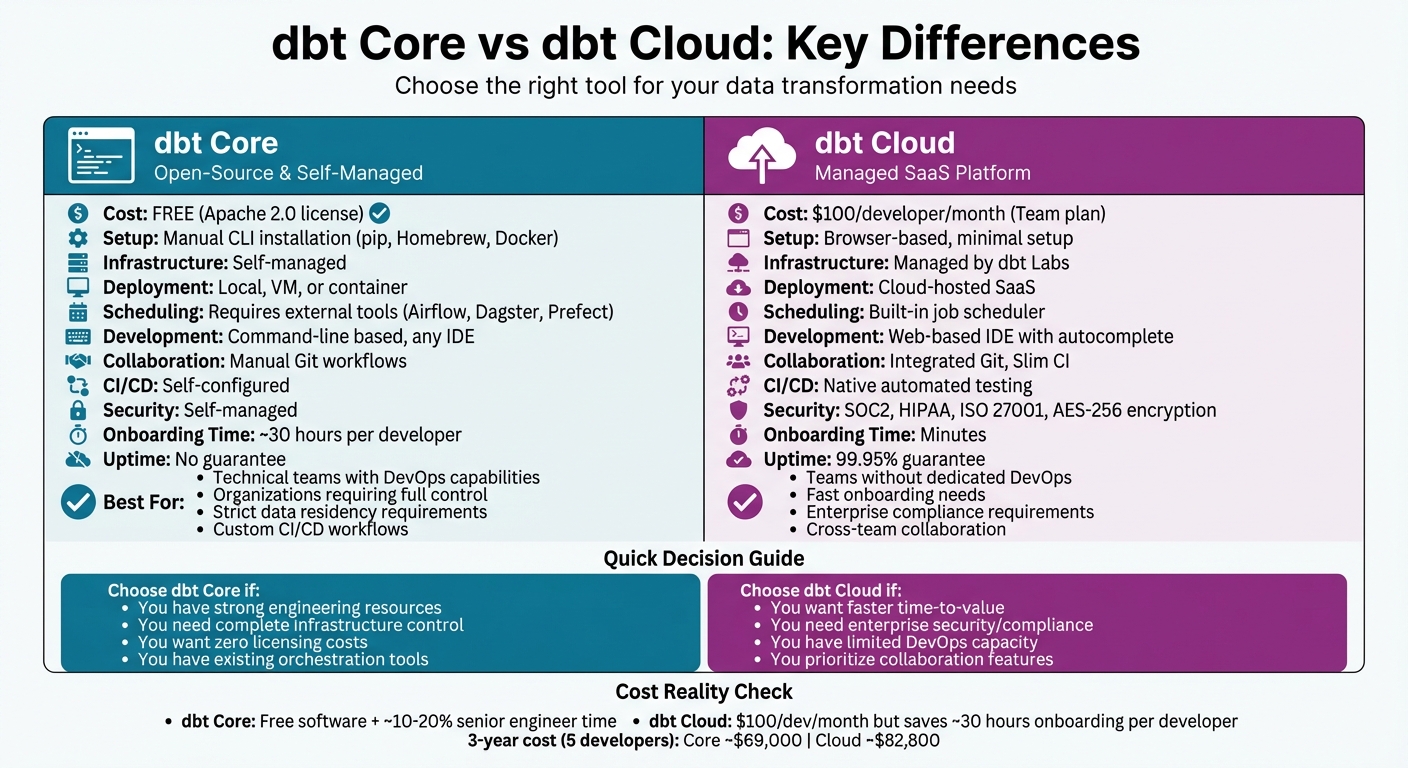
dbt Core vs dbt Cloud: Feature Comparison Chart
DE Zoomcamp 4.2.1 - dbt Core vs dbt Cloud
sbb-itb-61a6e59
What is dbt Core?
dbt Core is an open-source, Python-based command-line tool designed to transform raw data into SQL models ready for analytics engineering interviews and professional roles. It operates under the Apache 2.0 license and plays a vital role in helping data teams build and share organizational knowledge. As Jason Ganz, Director of Product Marketing, and Jeremy Cohen, Product Manager at dbt Labs, put it:
"dbt Core is the open source framework that is essential to the work we do, and to our mission of enabling data practitioners to create and disseminate organizational knowledge."
With dbt Core, you can process modular SQL code, map out dependencies between models, create transformation graphs, and even generate comprehensive documentation - all directly from your terminal. Installation is straightforward and can be done using pip, Homebrew, or Docker. Once installed, you configure your profiles.yml file with your data warehouse credentials and execute commands like dbt run, dbt test, or dbt docs generate from your favorite text editor. For added convenience, extensions like the VS Code Power User can improve visualization and workflow.
However, this flexibility does come with some trade-offs. You’ll need to manage your own infrastructure, including maintaining a Python environment and resolving version conflicts between developers. Additionally, since dbt Core doesn’t include a built-in scheduler, external orchestration tools like Apache Airflow or Dagster are often required. While the software itself is free, teams should be prepared to invest time and resources into setup and ongoing maintenance.
What is dbt Cloud?
dbt Cloud is a managed SaaS platform built around the dbt Core engine, offering enterprise-level tools, collaboration features, and a browser-based IDE. Lauren Benezra and Rabi Abbasi from dbt Labs describe it as:
"dbt Cloud is a managed service which provides Git-integrated code editing, job orchestration, and data quality controls on top of dbt Core's transformation engine".
With dbt Cloud, you can skip setting up Python locally and jump straight into writing SQL in your browser. Its web-based IDE includes features like syntax highlighting, autocomplete, and real-time DAG (Directed Acyclic Graph) visualization, eliminating common local environment issues. This makes onboarding new team members a breeze, often taking just minutes.
The platform goes beyond development by offering native job scheduling to manage task queuing, retries, and alerting - no need for external orchestration tools. It also features Slim CI, which focuses on testing only the models and dependencies affected by pull requests. This approach speeds up reviews and reduces costs. For governance, dbt Cloud provides Single Sign-On (SSO), Role-Based Access Control (RBAC), and meets compliance standards like SOC-2, HIPAA, and ISO 27001.
Pricing options include a Developer plan (free), a Team plan ($100 per developer per month for up to 8 seats), and a customizable Enterprise plan.
Other standout features include the Semantic Layer, which centralizes business metric definitions, and Discovery and Administrative APIs for programmatic access to metadata and job management. Additionally, the platform includes dbt Copilot, an AI-powered assistant that helps generate documentation, tests, and SQL code directly within the IDE. These features pave the way for a deeper comparison with dbt Core in the upcoming sections.
Key Differences: dbt Core vs dbt Cloud
Now that we've covered what dbt Core and dbt Cloud bring to the table, let’s dive into the practical differences between the two. The choice often boils down to infrastructure management, team workflows, and how you allocate resources - whether that’s subscription fees or engineering hours.
Both platforms run the same SQL transformations on your data warehouse. However, they diverge significantly in areas like deployment, collaboration, scheduling, and cost. Here’s a closer look at each aspect to help you decide which option suits your team best.
Deployment and Infrastructure
The most noticeable difference lies in infrastructure management. With dbt Core, you handle everything yourself. You install the CLI locally using pip, Homebrew, or Docker, and you’re responsible for setting up orchestration tools (like Apache Airflow or GitHub Actions), managing CI/CD pipelines, and securing warehouse credentials. While this gives you full control, it also demands ongoing engineering effort.
On the other hand, dbt Cloud is a fully managed SaaS platform. dbt Labs takes care of the infrastructure, including a PostgreSQL backend, S3-compatible storage for logs, and Kubernetes for task management. Everything is browser-based, eliminating the need for local setup, Python installations, or version management. Many organizations report saving around 30 hours per developer during onboarding thanks to this streamlined setup.
Security is another key distinction. dbt Cloud comes with built-in SOC2 Type II, HIPAA, and ISO 27001 compliance, along with AES-256 encryption and a 99.95% uptime guarantee. With dbt Core, your team must handle all security and compliance needs independently. If strict data residency rules are a priority - ensuring no data leaves your network - dbt Core might be the better choice.
| Feature | dbt Core | dbt Cloud |
|---|---|---|
| Deployment Model | Self-hosted (local, VM, container) | Managed SaaS (cloud-hosted) |
| Installation | CLI via pip, Homebrew, Docker | Browser-based, no installation |
| Infrastructure Management | User-managed | Managed by dbt Labs |
| Security & Compliance | Self-managed | SOC2, HIPAA, ISO 27001, AES-256 encryption |
| Uptime Guarantee | None | 99.95% |
User Interface and Development Experience
The development experience also sets these platforms apart. dbt Core operates entirely through the command line. You write SQL in your preferred IDE - like VS Code or PyCharm - and run commands like dbt run or dbt test in the terminal. While this setup offers flexibility, it can lead to inconsistencies across teams if developers use different dbt versions or configurations.
In contrast, dbt Cloud provides a centralized, web-based IDE. Features like syntax highlighting, autocomplete, and real-time DAG visualization make it easy for new team members to jump in without a lengthy setup process. The platform also includes Slim CI, a feature that automatically tests only modified models and their dependencies, speeding up reviews and reducing compute costs.
The trade-off? dbt Cloud’s managed environment is less flexible than a local IDE. Some teams opt for a hybrid approach, using local tools for development while relying on dbt Cloud for production orchestration and documentation hosting.
Collaboration and Version Control
Collaboration methods differ significantly between the two tools. With dbt Core, teams rely on manual Git workflows. Developers manage branches, commits, and pull requests through the command line or IDE integrations. Each person is responsible for maintaining their own environment, which can sometimes result in inconsistencies.
dbt Cloud simplifies collaboration by integrating Git directly into its web IDE. Teams can commit code, create pull requests, and review changes without leaving the platform. Built-in Role-Based Access Control (RBAC) and Single Sign-On (SSO) further streamline permissions. Slim CI automates pull request testing, while dbt Core users must configure their own CI/CD pipelines.
Real-world examples highlight these benefits. Jared Sout, Head of Data Management at Sunrun, noted:
"The number one reason why we switched from the open source offering to dbt was the ability to more meaningfully collaborate across data teams and with business stakeholders."
Josh Carlson, Director of Analytics at Code42, shared that moving to dbt Cloud improved visibility into code changes and dependencies, boosting dashboard uptime to 95%.
For large organizations, dbt Cloud offers dbt Mesh, enabling separate teams to manage distinct dbt projects while resolving cross-project references - something dbt Core doesn’t provide.
| Feature | dbt Core | dbt Cloud |
|---|---|---|
| Git Workflow | Manual, CLI-based | Built-in, automated version control |
| Development Environment | Local file system with IDEs | Browser-based IDE or managed CLI |
| CI/CD | Self-configured with external tools | Native Slim CI with automated pull request checks |
| Access Control | Managed externally | Native RBAC and SSO |
| Cross-Team Collaboration | Requires external tools | dbt Mesh, dbt Explorer, dbt Canvas |
Scheduling, Monitoring, and Scalability
Operational differences become clear when it comes to scheduling and monitoring. dbt Core doesn’t include a built-in scheduler. To automate transformations, you’ll need external tools like Apache Airflow, Prefect, Dagster, or even cron jobs. While this gives you control over scheduling logic, it requires additional engineering resources to maintain.
dbt Cloud, however, includes a native job scheduler accessible through its web UI. You can set run frequencies, configure retries, and create alerts without external tools. The platform handles queuing, failure management, and provides monitoring dashboards, making it ideal for teams without dedicated DevOps resources.
Scalability is another area where dbt Cloud shines. For instance, WHOOP’s Senior Director of Analytics, Matt Luzzi, collaborated with dbt Labs to optimize a model processing 15–20 billion messages daily, cutting runtime from 45–60 minutes to just 10 minutes.
Cost, APIs, and Extensibility
dbt Core is free and open-source under the Apache 2.0 license, but as Datacoves puts it:
"Open source looks free the way a free puppy looks free."
The real cost lies in the engineering effort needed to set up and maintain orchestration, CI/CD, and other infrastructure. For a team of five developers, these expenses could total around $69,000 over three years.
dbt Cloud operates on a subscription model. The Developer plan is free for one seat and 3,000 models per month. The Starter plan costs $100 per developer per month (up to five seats) and includes 15,000 models, API access, and basic Semantic Layer features. Enterprise plans start at $50,000 annually, offering unlimited projects, advanced RBAC, and priority support. For a five-developer team, dbt Cloud would cost about $82,800 over three years.
When to Choose dbt Core
dbt Core is ideal for teams that require complete control over their infrastructure and have strong engineering resources to support it. If your team already uses orchestration tools like Apache Airflow, Prefect, or Dagster, integrating dbt Core into your existing pipelines can be much smoother than relying on dbt Cloud's built-in scheduler. This setup works particularly well for workflows that involve more than just data transformations, such as triggering internal tools behind a firewall or managing intricate ingestion processes. Beyond that, considerations like security, cost, and customization play a big role in deciding whether dbt Core is the right fit.
For organizations in regulated industries like finance, healthcare, or government, security and compliance are often top priorities. Deploying dbt Core in private cloud or on-premise environments ensures that code and metadata remain tightly controlled, which is crucial when dealing with strict data residency requirements.
As Noel Gomez from Datacoves highlights:
"dbt Core is the open-source CLI tool maintained by dbt Labs. It's free, runs in any environment, and gives teams full control over their setup."
Cost is another significant factor. While dbt Cloud costs $100 per developer per month - which might work well for smaller teams - larger teams can face escalating expenses. dbt Core, on the other hand, is free under the Apache 2.0 license. For organizations with robust DevOps capabilities, this means avoiding per-seat fees. As Joris Van Den Borre, Founder of Tropos.io, explains:
"For a small or early-stage company, dbt Core offers cost savings and flexibility, enabling agile development without heavy infrastructure costs."
Customization is another strong point for dbt Core. If your team requires a tailored CI/CD setup with non-standard Git providers like Bitbucket Server or AWS CodeCommit, or if you rely on internal tools like Jenkins, dbt Core gives you the flexibility to make it work. Additionally, teams that prefer local IDEs and tools like SQLFluff or dbt Power User can create an environment that aligns perfectly with their workflow.
When to Choose dbt Cloud
dbt Cloud speeds up model building by removing the need to manage infrastructure. If your team doesn’t have DevOps engineers to handle tasks like maintaining Airflow clusters, configuring CI/CD pipelines, or resolving version conflicts across developer machines, this managed platform takes care of those responsibilities for you. New team members can dive into building models within minutes, saving what could otherwise be up to 30 hours of setup time.
The platform also helps keep teams aligned. By standardizing dbt versions, dbt Cloud avoids the headaches of code inconsistencies between local development and CI environments. This is especially useful for larger teams, where version mismatches could lead to transformations that work locally but fail in production. Additionally, its built-in collaboration tools make it easier for data teams to work together and communicate with business stakeholders effectively.
For regulated industries, dbt Cloud offers enterprise-grade security. Features like SSO, RBAC, and audit logging ensure compliance with strict standards, while the platform also provides 99.95% uptime and AES-256 encryption.
The browser-based IDE stands out for teams with mixed technical skills. Analysts who aren’t comfortable using command-line tools can still branch, commit, and merge code through a simple interface, bypassing the need for Git CLI. Cristian Ivanoff, a Data Engineer at McDonald’s Nordics, summed it up perfectly:
"With dbt we don't need to think about the underlying technical stuff and can instead focus on modeling our business concepts". For those looking to master these workflows, a data engineering content pass provides deep-dive training on modern stack implementation.
These benefits, along with easier onboarding and collaboration, contribute to overall cost efficiency.
When considering costs, it’s important to look beyond the $100 per developer per month for the Team plan. Unlike self-managed dbt Core, dbt Cloud includes savings on maintenance and orchestration. Think about the engineering hours your team would spend managing orchestration tools, hosting documentation, and solving environment issues with dbt Core. For teams growing quickly or working under tight deadlines, dbt Cloud often ends up being more cost-effective than building and maintaining a custom setup.
Conclusion
Deciding between dbt Core and dbt Cloud comes down to your team's technical skills, engineering resources, and budget. Choosing the right tools often requires the expertise found in the top data engineering boot camps. dbt Core is free and gives you full control, but it requires considerable effort to handle orchestration, CI/CD, and infrastructure. On the other hand, dbt Cloud, priced at $100 per developer seat per month, simplifies these tasks by managing them for you.
For smaller, highly technical teams that prioritize control and flexibility, dbt Core is a solid choice. However, running a self-hosted dbt Core setup can take up 10–20% of a senior engineer's time.
Larger or growing teams with mixed technical abilities often find dbt Cloud to be the better fit. Its browser-based IDE, built-in scheduling, and native CI/CD features can save around 30 hours of onboarding time per developer, a gap often bridged by an analytics engineering boot camp. When factoring in engineering salaries, the subscription cost of dbt Cloud often ends up being more cost-effective than creating an in-house solution. As Joris Van Den Borre, Founder of Tropos.io, put it:
"dbt Cloud's licensing costs are rarely higher than the total cost of an in-house solution."
Some organizations even take a hybrid approach - using dbt Core locally for development flexibility while relying on dbt Cloud for production orchestration and monitoring. This blend offers the best of both worlds.
FAQs
Can I use dbt Core for development and dbt Cloud for production?
Yes, you can. dbt Core is a free, open-source tool that's perfect for local development and testing of data transformations. However, it doesn’t include features like scheduling, orchestration, or a web-based interface - key components needed for production environments. That’s where dbt Cloud comes in. It provides a managed platform with built-in scheduling, job orchestration, and collaboration tools, making it well-suited for production workflows.
What additional tools are needed to run dbt Core in production?
Running dbt Core in a production environment means you'll need to set up and maintain your own infrastructure. This involves taking care of several critical components, including orchestration, CI/CD pipelines, developer environments, and secrets management. Since dbt Core is open-source, your team will need to handle these responsibilities independently.
How do I estimate the real cost of dbt Core vs dbt Cloud for my team?
When figuring out costs, you need to account for both direct and indirect expenses. While dbt Core is free, it comes with additional costs for infrastructure, setup, monitoring, and ongoing maintenance. These can vary depending on your team's size and skill level. On the other hand, dbt Cloud operates on a subscription model but offers built-in features like scheduling and monitoring, which can help cut down on operational tasks.
To find the right option, weigh dbt Cloud's subscription fees against the labor and infrastructure expenses tied to self-hosting dbt Core. This comparison will help you decide which approach aligns better with your needs and resources.