
Fraud Detection with Streaming Data: Use Cases
Streaming data helps you check fraud risk before money moves or an account changes - often in under 10 seconds. I use the same approach across these cases: check live activity against past behavior, then approve, request verification, or hold for review.
- Banking and fintech: Account takeover, card testing, and linked transfers through mule accounts.
- E-commerce: Checkout fraud, promotion and referral abuse, and refund abuse.
- Insurance: Suspicious claims that need verification before payout.
- Telecom: Subscription fraud, SIM swaps, and unusual calling or messaging.
The key: a risk signal isn’t proof of fraud. I match rules, activity counts, models, and linked-account checks to the time available for a decision - not just the need for speed.
To test the system, I use synthetic events and replay, check late or duplicate records, and track fraud losses, false flags, and customer friction. <u>Fast decisions still need checks for accuracy</u>, especially when fraud reports arrive days or weeks later.
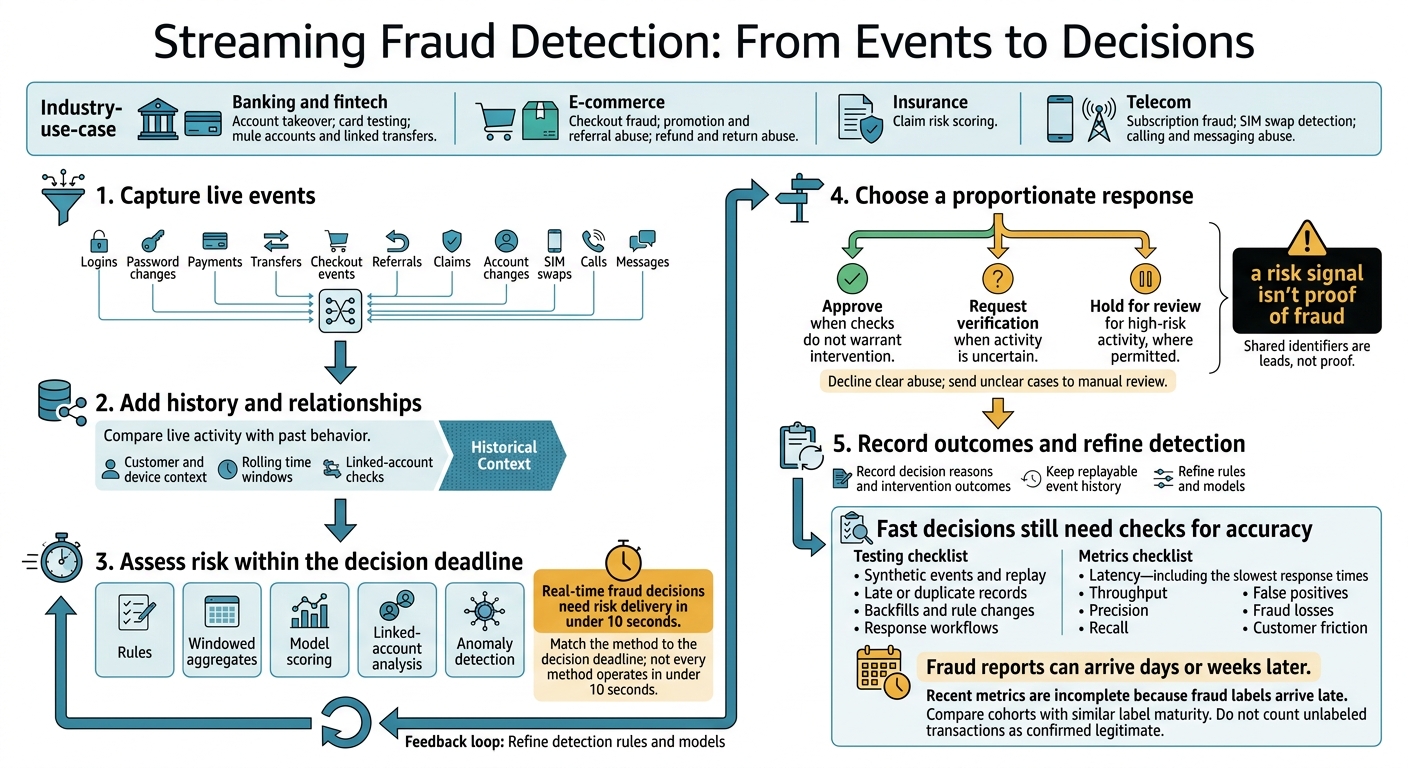
Streaming Fraud Detection: From Events to Decisions
Data Streaming in Real Life: Banking - Fraud Detection
sbb-itb-61a6e59
Banking and Fintech: Account and Payment Fraud
In banking and fintech, the most valuable streaming checks target account access, card abuse, and transfer fraud.
Account Takeover Detection
Connect new-device logins, failed login attempts, and password changes within short time windows. Check these signals alongside payment events to flag account takeover before funds move.
If the signals don't give a clear answer, request extra verification. End suspicious sessions or hold transfers only when multiple signals point to fraud.
Card Testing and Payment Abuse
Track small authorization attempts and payment failures in quick succession as they arrive. Use velocity counters across related signals instead of checking each payment in isolation. Separate repeated attempts using different cards from legitimate retries for the same purchase.
Compare live velocity with historical patterns to reduce false declines. Decline clear abuse, but request verification when activity is uncertain. Real-time fraud decisions need risk delivery in under 10 seconds.
The same streaming logic can also flag fraud that moves money through linked accounts.
Mule Accounts and Linked Transfers
Connect incoming and outgoing transfers over rolling time windows to spot coordinated money movement - not just high transaction volume. Shared identifiers are leads, not proof that account holders are working together.
Where permitted, hold high-risk transfers before they execute and refer linked activity for investigation.
E-commerce: Checkout, Promotion, and Refund Abuse
E-commerce follows the same streaming pattern as banking: live events, historical context, and fast risk decisions.
Checkout Fraud Checks
Event-driven checks help protect orders, discounts, and refunds. Before approving an order, combine storefront data, payment details, and customer history. Check for bursts of checkout activity alongside repeated payment failures.
Streaming pipelines can trigger extra verification or a temporary hold before checkout completes. Customer and device context also helps detect reward abuse.
Promotion and Referral Abuse
Connect loyalty, device, and referral events to spot promotion abuse across linked accounts. Verify eligibility before issuing rewards, and send repeated referral loops or other high-velocity patterns for manual review.
A legitimate household or repeat customer may generate a burst of activity, so don’t reject rewards based on one signal alone. Keep event history so replay can correct false flags after rules change.
That history also helps distinguish legitimate returns from refund abuse.
Refund and Return Abuse
Join purchase, return, delivery, and refund events before issuing a refund. Calculate rolling refund rates against completed orders, then use the combined history to score risk or flag cases for review. Start with rules and refine them as abuse patterns emerge.
Insurance and Telecom: Claim and Subscriber Fraud
Insurance Claim Risk Scoring
Use streaming claim and policy events to score suspicious claims in real time without delaying legitimate payouts. Send unclear cases to manual review.
The same event-first approach applies to subscriber account changes. Aspiring engineers can learn these patterns in a data engineering boot camp.
Subscription Fraud and SIM Swap Detection
Combine identity, account-change, and SIM-swap events to detect subscription fraud and prevent account takeover without flagging normal activity. When several signals point to risk, require identity verification before sensitive changes rather than blocking every request.
After a SIM swap or account takeover, abuse often appears in call and message volume.
Calling and Messaging Abuse
Compare call and message rates with each subscriber’s normal pattern to detect abuse from compromised accounts. Send borderline cases to near-real-time review rather than taking automatic action.
Conclusion: Reliable Streaming Fraud Decisions
Streaming fraud systems combine event history with live risk signals to trigger verification, review, or holds before a loss occurs.
Choose Detection Methods by Fraud Pattern
Match the method to the decision deadline. Use real-time streaming when you need to act within seconds, and slower verification when accuracy matters more than speed. Your choice depends on the fraud pattern and how much time you have to respond.
| Method | Fraud pattern | Speed tradeoff | Main strength | Main limitation |
|---|---|---|---|---|
| Rules | Promo abuse, SIM swap | Seconds | Easy to audit | Rules need updates |
| Windowed aggregates | Card testing | Near real time | Flags bursts | Requires state management |
| Model scoring | Account takeover, claim risk | Near real time to minutes | Combines risk signals | Model drift |
| Linked-account analysis | Mule accounts | Minutes or batch | Reveals linked activity | Costly at scale |
| Anomaly detection | New fraud patterns | Seconds to minutes | Flags unfamiliar behavior | False positives |
Protect Data and Measure Results
Once you choose a method, check whether it reduces fraud without adding unnecessary friction. Maintain behavioral state and replayable logs for restatements, and define how to handle late events. If master data feeds decisions, audit it before publishing. Record decision reasons and intervention outcomes to fine-tune when to verify, review, hold, or reject.
Track latency - including the slowest response times - along with throughput, precision, recall, false positives, fraud losses, and customer friction. Recent metrics are incomplete because fraud labels arrive late. Compare cohorts with similar label maturity, and don't count unlabeled transactions as confirmed legitimate.
Before production, test the entire fraud flow using synthetic events and replay.
Build a Synthetic Fraud Pipeline
Build a synthetic streaming fraud pipeline to test detection rules, duplicate events, and response workflows before adding more use cases. Use replay to test backfills, late events, and rule changes before production.
FAQs
Which fraud use case should I tackle first?
Focus on scenarios that need data updated in less than a second, such as real-time credit card transaction monitoring. As fraud patterns shift, use stateful processing and event-time handling to keep results precise. Start with existing credit card fraud solution accelerators to set a baseline.
To learn these streaming architectures, DataExpert.io Academy offers specialized data engineering and AI engineering boot camps and subscriptions.
How do I set risk thresholds without frustrating customers?
Leave room for uncertainty. Use grace periods or allowed lateness so legitimate events that arrive slightly late aren’t rejected by mistake. Set thresholds by severity: mark customer-impacting issues as “fail” and everything else as “warn.” This lets you send alerts and monitor issues without blocking legitimate traffic. Review high-scoring cases and adjust scoring criteria over time to reduce false positives [3].
How should I handle missing or delayed fraud signals?
Balance processing speed with data completeness. Use watermarks to mark the timestamp before which events are likely complete. To set a watermark, subtract a slack interval - such as 30 seconds - from the latest observed timestamp.
For late events that arrive after the watermark has passed their timestamp, set an allowed lateness period to keep windows open. Or route late data to a side output or dead-letter topic for auditing.